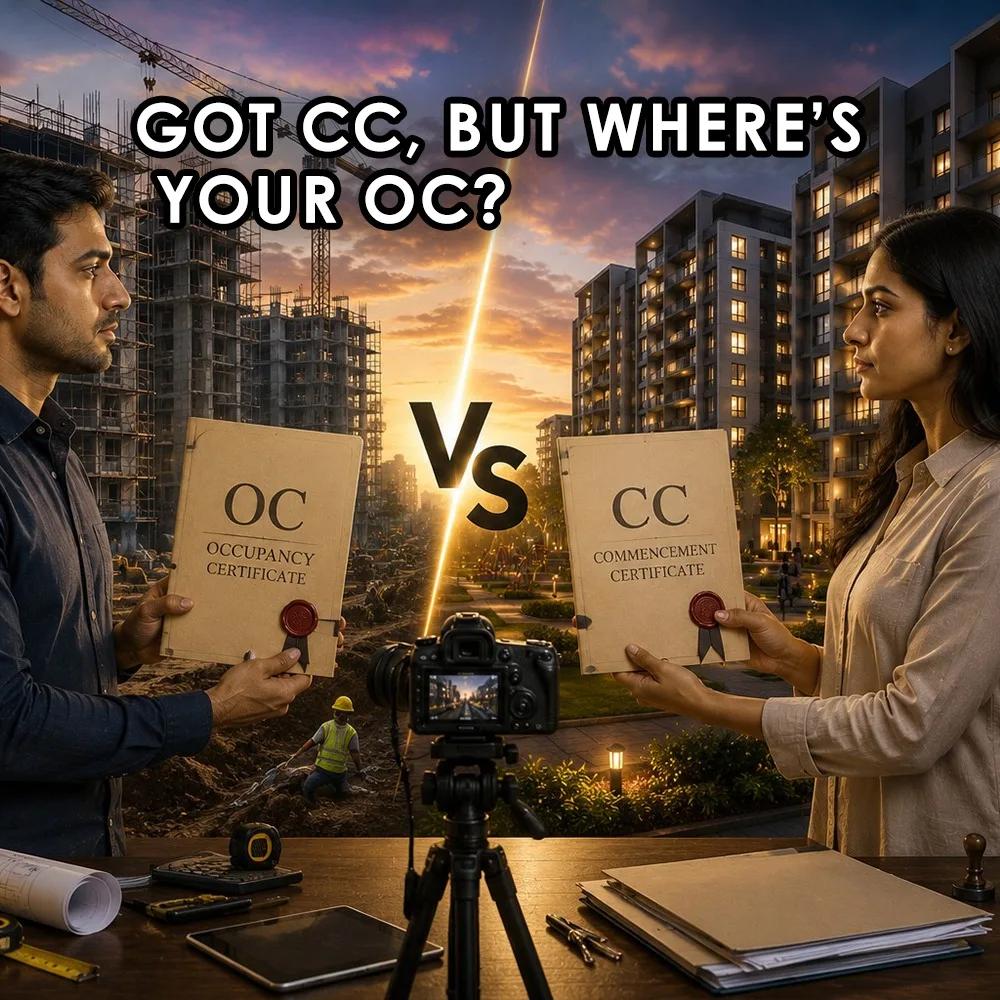

Two letters can mean the difference between legally moving into your new home and technically occupying it illegally. Yet most buyers spend far more time picking tile finishes than checking whether their builder actually has these two documents in place.
Understanding the difference between OC and CC protects buyers from a legal and financial headache that's entirely avoidable with a little diligence.
A Completion Certificate, issued by the local municipal or development authority, verifies that a building has been constructed exactly according to its approved plans. It checks structural details like the building's height, its distance from the road, and whether provisions like rainwater harvesting have actually been implemented as promised on paper. The builder applies for this once construction wraps up, and it's the local civic body that grants it after inspection.
An Occupancy Certificate comes next, and it confirms something the CC doesn't, that the building is actually safe and ready for people to live in. This means verifying that water supply, electricity, drainage, elevators and fire safety systems are fully functional, not just planned or partially installed. A building can technically have a completion certificate and still not qualify for an occupancy certificate if these operational systems aren't genuinely in place.
The sequence here isn't arbitrary. A builder must first secure the CC, proving the physical structure matches what was approved, before even applying for the OC, which then verifies the building's actual livability. Skipping straight to occupancy without the completion certificate in hand simply isn't how the process is meant to work.

Occupying a flat before the OC has been issued is considered illegal in a fair number of Indian cities, regardless of how finished the building genuinely looks. Beyond the legal risk, permanent electricity, water and sewage connections are typically only granted once the OC is in hand, meaning residents moving in early often end up stuck with temporary construction connections that were never meant to last.
Lenders routinely ask for both the CC and OC before approving or disbursing a home loan, since financing a property that technically isn't legally habitable creates obvious risk on their end too. Buyers who skip verifying these documents sometimes discover the problem only when their loan application stalls, well after they've already paid a booking amount.
A notable case in Bangalore saw the Karnataka High Court explicitly rule that builders must obtain both certificates before handing over possession to buyers, after a dispute arose involving a developer who'd skipped this step entirely. Cases like this have pushed the issue further into mainstream buyer awareness across other cities too.

Before signing anything, ask the builder directly for copies of both certificates, or check the relevant municipal authority's records if the project falls under their jurisdiction. It's a five minute conversation that can save months of legal complication down the line if something's actually missing.
For projects registered under RERA, the completion and occupancy certificate status is meant to be visible directly on the state RERA portal, giving buyers a way to independently confirm this without relying solely on what a sales representative tells them.
Understanding the difference between OC and CC protects buyers from a legal and financial headache that's entirely avoidable with a little diligence. A Completion Certificate confirms construction matches approved plans, while an Occupancy Certificate confirms the building is genuinely safe and functional to live in. Since banks, utility providers and local authorities all treat these as essential, verifying both before finalising any property purchase remains one of the simplest ways to avoid serious trouble later.


Find Detailed Answers to Frequently Asked Questions to Help You Make Smart and Confident Real Estate Decisions
A Completion Certificate (CC) verifies that construction matches approved plans, while an Occupancy Certificate (OC) confirms the building is safe and livable with functional utilities like water, electricity, and fire safety systems.
No, occupying a flat without an OC is illegal in many Indian cities. You may also face issues getting permanent electricity, water, and sewage connections, leaving you dependent on temporary construction connections.
Banks need both certificates to confirm the property is legally habitable and structurally compliant before disbursing loans, as financing an illegal property creates significant risk for lenders.
Ask the builder directly for copies, check municipal authority records, or verify on your state's RERA portal for registered projects where certificate status should be publicly visible.
The builder cannot legally apply for an OC without first obtaining the CC. The sequence is mandatory: CC first proves structural compliance, then OC verifies livability.