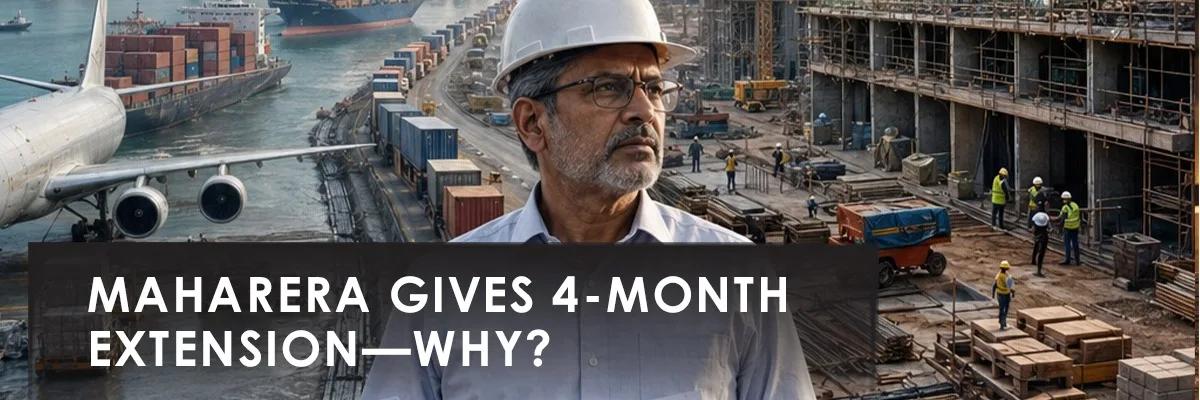
Property buyers waiting on possession dates just got a piece of news that cuts both ways. MahaRERA has pushed back completion timelines for a large chunk of registered projects across the state by four months, and the reason has nothing to do with construction quality or builder efficiency, it has to do with a war thousands of kilometres away.
This wasn't a decision MahaRERA cooked up on its own. The Union Ministry of Housing and Urban Affairs sent out an advisory on July 31, 2026, asking every state regulator to consider the ongoing West Asia conflict as grounds for relief. Maharashtra simply became one of the first states to act on it, and given how much of India's real estate activity runs through this state, that made the announcement impossible to ignore.
Section 6 of the RERA Act allows regulators to extend a project's timeline when war, natural disaster, or similarly extraordinary events disrupt normal execution. That's technically what's being invoked here, force majeure, a term most homebuyers only encounter in fine print until suddenly it applies to their own flat. Section 7(3) adds another layer, letting authorities keep a project's registration active rather than cancelling it outright when delays pile up.
Not every project gets this benefit automatically. Only those whose original, revised, or previously extended completion dates fall on or after February 28, 2026, are eligible, and anything registered fresh on or after August 1, 2026, misses out entirely. MahaRERA has also made clear that developers don't need to file a separate application, the extension applies on its own once the authority updates its records and portal.
It sounds strange at first, a conflict between Iran, Israel, and allied forces affecting a housing project in Thane or Kalyan, but construction runs on imported steel, certain finishing materials, and machinery that depends on stable shipping routes. When tensions disrupt those routes, procurement slows, and procurement delays ripple straight into pouring concrete on schedule. Builders across the country have apparently been flagging exactly this bottleneck for months.
Industry bodies like Credai had actually pushed for a broader window, somewhere between three and six months, arguing that four months barely covers the disruption already absorbed. What they got was the lower end of that ask. Still, for developers juggling half finished towers and rising material costs, even a four month cushion without regulatory penalty counts as real breathing room.
Here's the part that understandably hasn't gone down well with everyone. Normally, RERA requires developers to compensate buyers for unjustified delays, but classifying this as force majeure removes that penalty obligation entirely. For someone who has already waited past their promised possession date, watching that clock reset without any compensation attached feels less like relief and more like an inconvenience shifted onto them.
A blanket extension, however well justified on paper, risks becoming a convenient shield for delays that had little to do with any war at all. Some projects may genuinely be stuck waiting on imported materials, others may simply be behind schedule for entirely unrelated reasons and now have a fresh alibi. Distinguishing between the two isn't easy from outside, and that ambiguity is exactly what worries buyer advocacy groups the most.
Since land and housing regulation sits with individual states, this advisory doesn't apply uniformly across India just because Maharashtra adopted it. Other states will decide separately whether to extend similar relief, and that could create an uneven picture where a delayed project in Gujarat gets no such cushion while a comparable one in Maharashtra sails through penalty free. Buyers evaluating projects in different states should factor that inconsistency into their expectations.
MahaRERA's four month extension, triggered by an advisory tied to the West Asia conflict, gives registered real estate projects breathing room from penalties linked to construction delays. While developers facing genuine material shortages get meaningful relief, homebuyers lose the compensation they'd normally be entitled to during such delays. As other states weigh similar decisions, this move highlights how global conflicts, however distant, can quietly reshape possession timelines and expectations within India's real estate sector.


Find Detailed Answers to Frequently Asked Questions to Help You Make Smart and Confident Real Estate Decisions
MahaRERA extended deadlines by four months due to the ongoing West Asia conflict, classifying it as a force majeure event that disrupts construction supply chains and material procurement.
Only projects with original, revised, or previously extended completion dates falling on or after February 28, 2026, are eligible. New projects registered after August 1, 2026, do not qualify.
While developers gain a penalty-free extension, homebuyers lose the right to compensation for delays that would typically be provided under RERA, leading to frustration and extended waiting periods without recourse.
No, developers do not need to file a separate application. The extension is automatically applied once MahaRERA updates its records and portal for eligible projects.
Since real estate regulation is state-specific, other states will decide independently whether to adopt similar relief measures based on the advisory from the Union Ministry of Housing and Urban Affairs.