
The Classroom Effect: Why Property Near Educational Institutions Quietly Outperforms
Summary
Commercial property near Indian educational institutions consistently delivers dependable returns, anchored by stable demand from students, faculty, and the service economy. These resilient hotspots offer strong rental yields and high occupancy through economic cycles.

Introduction
Every major Indian city has a neighbourhood that feels perpetually alive. Shops stay open late. Cafes run at full capacity on weekday mornings. Landlords rarely struggle to find tenants. And when you look closely at what is anchoring all that activity, it is almost always a cluster of colleges, universities, or prominent schools sitting nearby.
Commercial property near educational institutions in India has delivered some of the most consistent returns of any asset sub-category in the sector. Not the most glamorous returns. Not the ones that make headlines. But the quiet, dependable kind that investors who play long games tend to prefer.
Why Footfall Near Education Hubs Never Disappears
A technology company can relocate. A corporate office can shut down or downsize. But a university campus or a cluster of established colleges does not pick up and move. The demand it generates, from students, faculty, administrative staff, visiting parents, and the service economy that grows around all of them, is structurally embedded in that geography for decades.
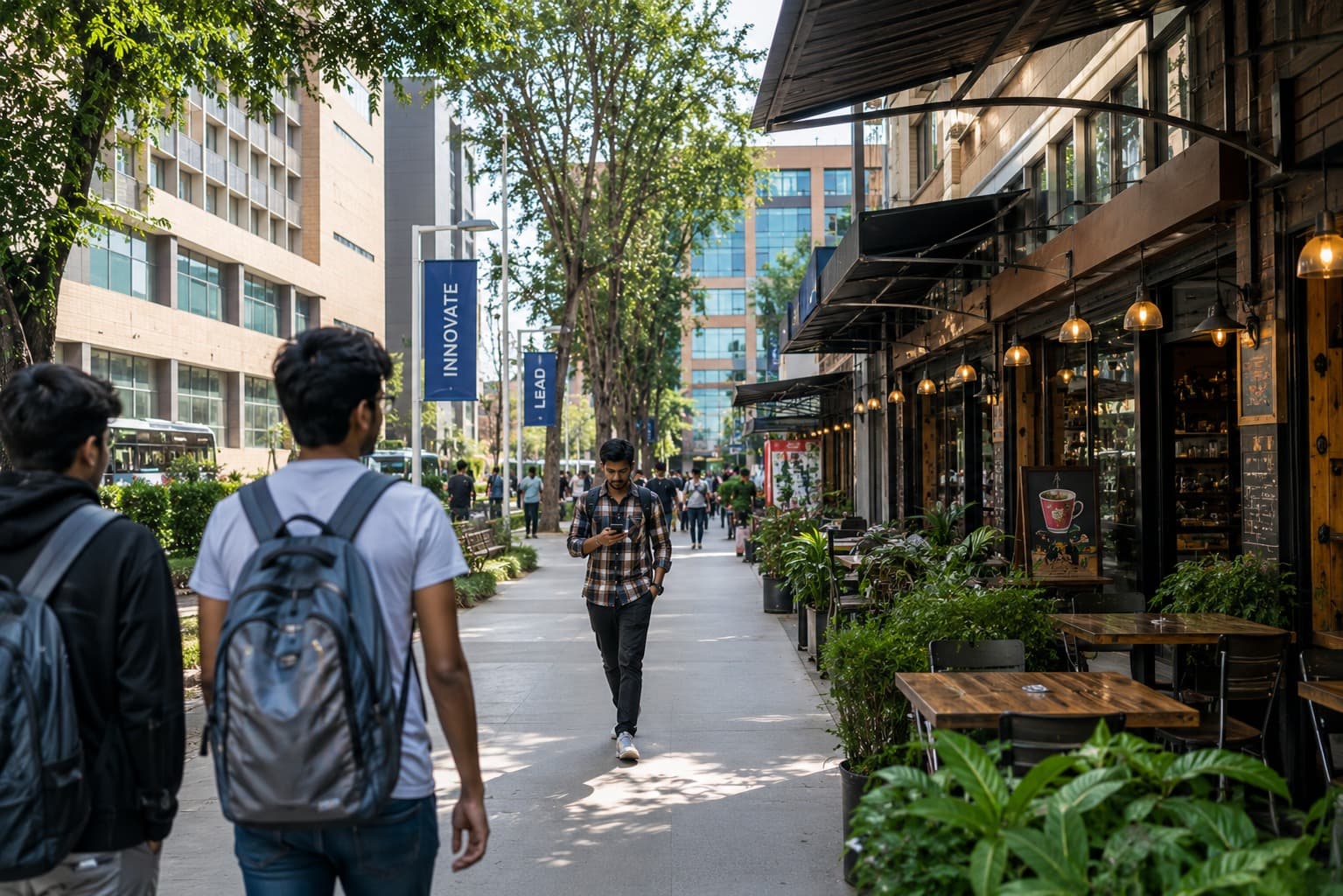
Rental demand near schools India shows this pattern clearly in transaction data. Localities within half a kilometre of major educational campuses consistently show lower commercial vacancy rates than comparable areas without the same institutional anchor. Stationary shops, food outlets, photocopy centres, coaching institutes, and affordable dining establishments form the first ring around any campus. Clothing retail, salons, pharmacies, and convenience stores fill the second ring. The economy keeps layering.

Pune: The Most Visible Example
Pune commercial property near universities demonstrates the education-real estate connection better than almost any other Indian market. Localities like Kothrud, Aundh, and the areas flanking Fergusson College Road have maintained commercial demand for thirty years because the student population feeding those streets has never meaningfully declined.
Rental yield commercial property near educational hubs in Pune's established university corridors runs between five and seven percent annually, which is strong for a Tier-1 city where residential yields typically sit around three percent. Property prices in these areas range from Rs 8,000 to Rs 15,000 per square foot for commercial units, and enquiries from café chains, coaching brands, and co-working operators keep demand consistently healthy.
Bengaluru: The Tech-Education Overlap
Bengaluru's educational institutions do not operate in isolation from its technology ecosystem. Areas like Koramangala, which sits adjacent to several engineering colleges and management institutions, show how campus proximity and corporate footfall can amplify each other into a genuinely powerful commercial demand driver.
Commercial real estate demand near universities India is partly a student story and partly an employer story in Bengaluru, because the city's major campuses feed directly into the talent pipelines of firms whose offices sit within the same corridors. That dual-demand structure gives commercial properties in these zones a resilience that purely corporate neighbourhoods do not have.
The Student Housing Opportunity
Beyond traditional commercial real estate, education driven property market India trends point toward a growing gap in purpose-built student accommodation. Most Indian cities have a significant undersupply of quality, managed student housing near premier institutions.
Co-living operators and private hostel developers have begun filling this gap systematically in cities like Pune, Bengaluru, Hyderabad, and Chennai. Investors who bought residential units near large campuses in these cities five to seven years ago have found rental income holding steady through market cycles that affected other micro-markets noticeably more.
What to Look For Before Investing
Not every educational institution creates the same commercial pull. A state university with a large, engaged campus community generates far more ground-level commercial demand than an autonomous institute with a small enrolment and a predominantly residential student body. Check enrolment numbers, hostel capacity, and whether the institution draws students from outside the city. Out-of-city students are the real commercial demand generators because they live, eat, shop, and spend entirely within the neighbourhood around their campus.
Summary
Commercial hotspots near educational institutions earn their resilience from a demand base that does not respond to economic cycles the way office or retail zones do. Pune's university corridors, Bengaluru's campus neighbourhoods, and equivalent zones in Hyderabad and Chennai deliver rental yields and occupancy consistency that anchor long-term commercial property portfolios effectively. For investors who want a commercial asset that keeps earning through recessions, leadership changes, and sector slowdowns, the neighbourhood around a thriving Indian campus remains one of the most genuinely dependable addresses available.