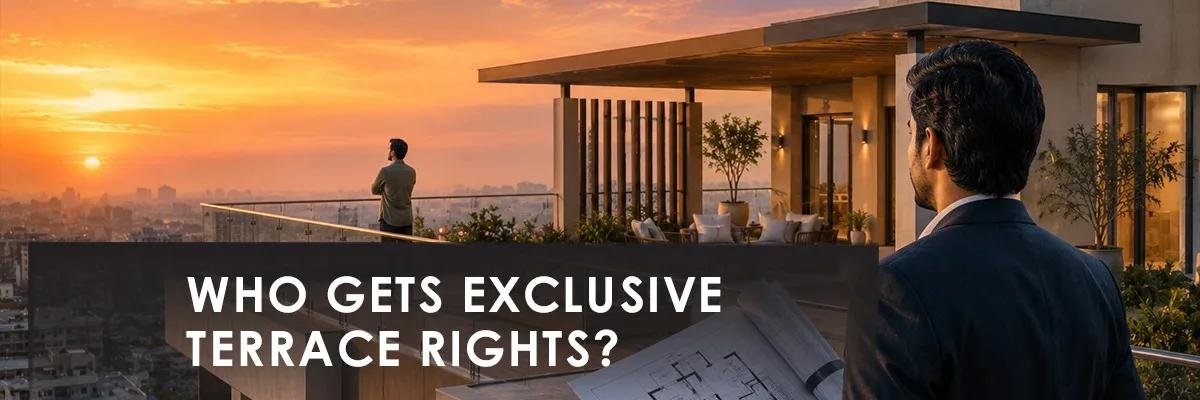
Buy a flat on the top floor of any Indian apartment building and someone in the family will eventually say, "Ab toh terrace bhi apna hi hai na." It feels logical. Your flat is right below it, your ceiling touches its floor, so surely it belongs to you? Except Indian law disagrees with that logic almost every single time, and a lot of buyers only find out the hard way.
Terrace rights in Indian apartments almost always default to the society or the collective ownership of all flat owners, not the top floor resident by default. Only a registered sale deed or an approved building plan showing exclusive use can shift that. RERA has made this even clearer by naming terraces a common area with undivided interest for everyone. Before assuming that terrace is yours, check the actual documents, not just the view from your balcony.
Under frameworks like the Maharashtra Ownership Flats Act and similar state level apartment ownership laws, a terrace is treated as a common area, meaning it belongs collectively to every flat owner in the building, not to whoever lives closest to the sky. The Real Estate Regulatory Authority law goes a step further and explicitly names terraces, staircases and roofs as shared spaces where each owner holds what's called an undivided interest.
Here's the part builders sometimes hope buyers won't read closely. RERA states that no developer, landowner or committee can quietly retain exclusive control over a common terrace, and if a sale deed tries to slip in a clause saying otherwise while contradicting this rule, that clause can be treated as void. Developers are also barred from selling common areas separately, they're required to hand these over to the apartment owners association once a completion certificate is issued, and that handover has to happen free of cost.

There is, however, a legitimate path to exclusive terrace rights, and it comes down entirely to paperwork. If the municipal sanctioned building plan specifically marks the terrace as an exclusive use zone for one unit, commonly a penthouse, and that terrace is accessible only through that private flat with no shared staircase leading to it, ownership can genuinely sit with that single owner. Without that documentation though, none of it counts, no matter what the builder verbally promised during booking.
Some housing societies allow a top floor resident to use the terrace after passing a general body resolution with the required majority vote. Fair enough, but that only grants a license to use the space under certain conditions, it never transfers actual ownership. And any structural addition up there, even something as simple as a small shed, still needs separate approval from the local municipal authority.
Indian courts have repeatedly ordered restoration of terrace access whenever a resident tried to lock it away for personal use. The reasoning stays consistent across judgments, a terrace is common property meant for shared enjoyment, and one member cannot override that simply because their flat happens to be the last one on the staircase.
This happens more often than people admit, particularly in older government housing colonies where top floor owners quietly convert part of the terrace into an extra room. It's risky. Permanent structures like a bathroom or bedroom built without approval are considered illegal, and municipal bodies can order demolition or impose penalties once flagged.
Buyers facing this issue have a few real options. A complaint to the Deputy Registrar of Cooperative Societies typically resolves within two to six months. A RERA complaint against the builder for misrepresenting common areas usually moves faster, often within sixty to ninety days. And for serious or repeated denial of access, a civil suit remains available, though it's worth speaking to a property lawyer before choosing which route fits your case.
Terrace rights in Indian apartments almost always default to the society or the collective ownership of all flat owners, not the top floor resident by default. Only a registered sale deed or an approved building plan showing exclusive use can shift that. RERA has made this even clearer by naming terraces a common area with undivided interest for everyone. Before assuming that terrace is yours, check the actual documents, not just the view from your balcony.


Find Detailed Answers to Frequently Asked Questions to Help You Make Smart and Confident Real Estate Decisions
In India, terraces are usually considered common areas, owned collectively by all flat owners, not just the residents on the top floor. This is supported by laws like the Maharashtra Ownership Flats Act and RERA.
No, builders cannot sell common areas like terraces separately. RERA law explicitly bars developers from retaining exclusive control over common terraces and requires them to be handed over to the apartment owners' association.
Exclusive terrace rights are only legitimate if the municipal-sanctioned building plan specifically designates the terrace for exclusive use by one unit (like a penthouse) and it's only accessible through that private flat.
A society resolution may grant a license for use of the terrace under certain conditions, but it does not transfer actual ownership. Structural additions still require municipal approval.
If your terrace access is blocked, you can file a complaint with the Deputy Registrar of Cooperative Societies, lodge a RERA complaint against the builder, or consult a property lawyer for a civil suit.
Illegal construction on terraces, such as adding permanent structures without approval, is risky and can lead to demolition orders or penalties from municipal bodies.