
What to Check Before Buying the Cheapest Flat: A Practical Guide for Indian Homebuyers
Summary
Buying the cheapest flat in India requires rigorous due diligence. This guide covers essential checks like RERA registration, title deeds, approved building plans, Occupancy Certificates, and hidden costs to protect your investment.

Introduction
The cheapest flat in any project or locality tends to attract the most buyers and the least scrutiny.
That is a dangerous combination.
When price is the primary filter, due diligence often gets compressed. Buyers assume that if something were seriously wrong, the flat would not be on the market at all. That assumption has cost many Indian homebuyers their savings, their possession timelines, and in some cases their legal ownership.
The cheapest flat in a project or neighbourhood is cheap for a reason. Your job, before signing anything, is to find out what that reason is.
Start With RERA Verification
Every residential project above a certain threshold in India must be registered under the Real Estate Regulation and Development Act.
Visit the official RERA portal for your state and search the project by name or registration number. Confirm that the registration is active, not expired or lapsed. Check the committed possession date stated in the RERA filing and compare it with what the sales team told you.
Under RERA, builders must deposit 70 percent of all collected funds into a dedicated escrow account for that specific project. This protects buyers from their money being diverted to another project. If a project is not RERA registered, that protection disappears entirely.
For affordable flats, RERA registration is not optional due diligence. It is the first and most basic filter.
Check the Title Deed Carefully
The title deed establishes who actually owns the land on which your flat is being built.
Ask to see the original title deed and trace the ownership chain through what is called the Mother Deed or Parent Deed. This document shows every previous transfer of the land. Any gap in the chain, any period where ownership is unclear, is a red flag.
Cross-verify what the deed says against land records held by the local revenue authority. In many cities, you can do this online through the state government's land record portal.
A title dispute does not have to be active to be dangerous. A dormant dispute can surface years after your purchase and result in legal proceedings that are expensive, slow, and not guaranteed in your favour.
Demand the Approved Building Plan
The building plan approved by the local municipal authority or development body governs how many floors can be built, the setbacks required from boundaries, the Floor Space Index used, and the permissible layout.
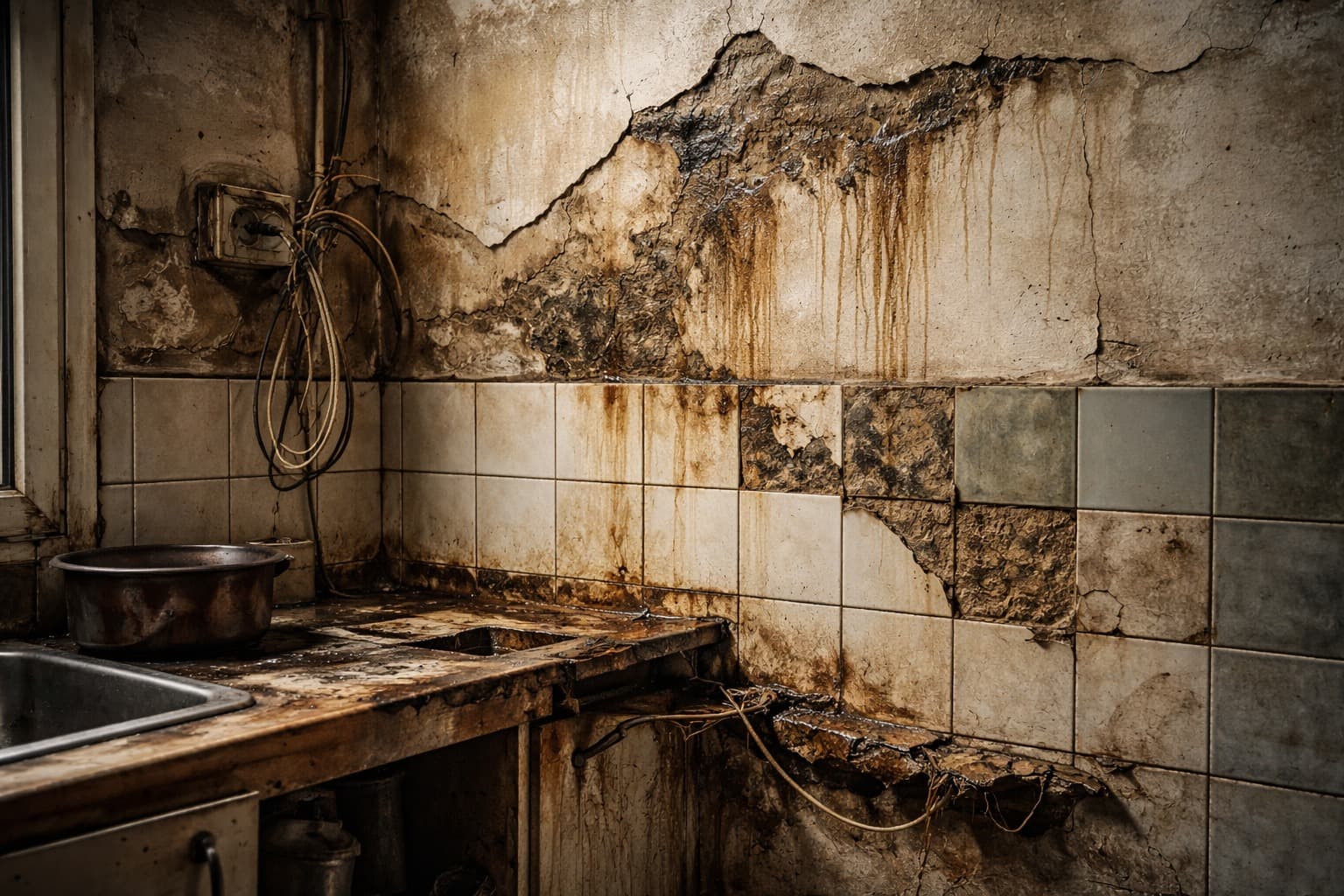
Ask to see the approved plan and compare it physically with the actual construction at the site. Are there extra floors built beyond what was approved? Do the common area dimensions match? Are there commercial units being built on floors designated as residential?
Any deviation from the approved plan creates the risk of partial or complete demolition orders. The Supreme Court has been consistent in ruling that illegal constructions must be demolished regardless of buyer investment. A cheap flat in a building with unapproved floors or deviations carries this risk silently.
Verify the Occupancy Certificate for Ready Properties
If you are buying a flat that is already built or nearing completion, the Occupancy Certificate is the single most important document after the title.
The OC is issued by the local authority after verifying that the building was constructed as per the approved plan and meets all safety standards. Without an OC, the building is legally unauthorised from an occupancy standpoint. Utility connections including electricity and water can be refused or withdrawn. Resale becomes legally complicated. And any future legal action can classify your occupation as an encroachment.
Many affordable flats are offered without a valid OC, with builders citing pending minor compliance as the reason. Do not accept verbal assurances. If the OC is not in hand, factor that legal risk into your decision.
Understand What You Are Actually Buying

The cheapest flat in a project is usually the cheapest for a physical reason as well as a legal one.
It may face north-west getting maximum afternoon heat. It may be on the ground floor facing a service lane with vehicle noise and minimal privacy. The carpet area may be five to ten percent smaller than comparable units. The layout may have an irregular shape that wastes usable square footage.
Always verify the RERA carpet area of the flat you are buying, not the super built-up area quoted in the brochure. RERA mandates pricing on carpet area, so any quoted price should be calculable per square foot of actual usable space.
Hidden Costs That Come With Cheap Flats
The sticker price of a cheap flat rarely represents the true cost of ownership.
Stamp duty is calculated on the higher of the agreement value or the government ready reckoner rate. Registration fees add further cost. GST at applicable rates applies to under-construction properties. Maintenance deposits, society formation charges, and parking fees are charged at possession. Interior fit-out for a bare-shell flat can add ₹3 to ₹5 lakh or more.
Before committing, ask the builder for a complete cost sheet that includes all statutory and non-statutory charges. A flat that looks cheap at ₹35 lakh may actually cost ₹42 to ₹45 lakh before you move in.
Summary
Buying the cheapest flat safely in India requires five non-negotiable checks: active RERA registration, clean title deed with a complete ownership chain, an approved building plan that matches actual construction, a valid Occupancy Certificate for ready properties, and a full cost sheet that includes every applicable charge beyond the base price. The cheapest flat in any project only becomes a good deal when you understand precisely why it is the cheapest and have confirmed that the reason is acceptable.