
What Makes a Real Estate Market Mature?
Summary
A mature real estate market is defined by predictable price behavior, transparency, institutional investment, and end-user dominance, not just high prices. It offers steady value, unlike speculative markets prone to wild swings, providing stability for long-term buyers.

Introduction
Ask ten property buyers what a mature real estate market looks like and you will get ten different answers. Some point to high prices. Others point to big-name developers. Neither answer is quite right. A mature real estate market is not defined by how expensive it is or how many glass towers line its skyline. It is defined by how it behaves when nobody is watching, when sentiment turns sour, when the next big infrastructure announcement has not yet landed.
Price Behaviour Tells You Almost Everything
The clearest signal of maturity sits in how prices move over time. An immature market swings wildly. One rumour about a metro line and prices jump 40 percent. One slowdown in IT hiring and the same locality corrects sharply. Real estate market maturity shows up as the opposite pattern: steady, modest, explainable price movement that tracks with actual income growth, rental demand, and construction cost inflation rather than speculation.
In a mature corridor, a five percent annual appreciation that holds consistently across multiple years is a far healthier sign than a sudden twenty percent spike followed by a long flat stretch. The boring chart is usually the trustworthy one.
Transparency Becomes the Default, Not the Exception
In an immature market, finding out who actually owns a piece of land, whether it has clear title, or whether the builder has the right approvals requires effort, contacts, and sometimes luck. A mature vs emerging real estate market comparison almost always comes down to information access.
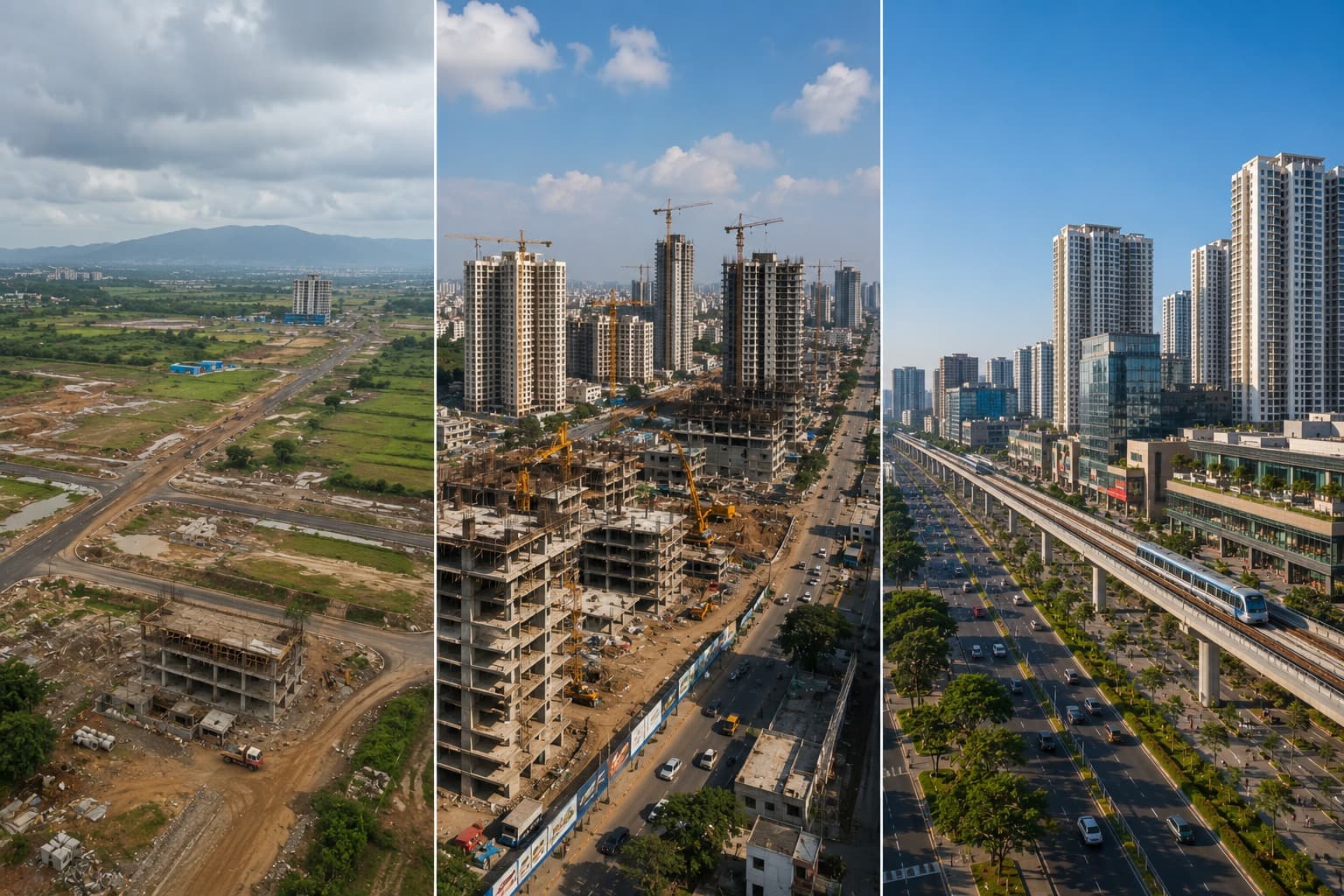
Mature markets have searchable land records, functioning RERA portals with real project data, and a buyer culture that expects and demands disclosure before money changes hands. When due diligence stops being an adventure and becomes a routine checklist, that is maturity quietly arriving.
Institutional Capital Starts Showing Up
Retail investors chase emotion. Institutional capital, the kind that comes from pension funds, REITs, and large private equity players, chases discipline. Signs of mature property market India include the steady presence of this kind of capital in office buildings, warehousing parks, and rental residential portfolios.
Institutions do not invest in markets where they cannot model risk reliably. Their presence is itself evidence that enough data, enough legal clarity, and enough operational predictability exists to support long-horizon underwriting. When a market starts attracting this kind of patient money rather than only short-term flippers, it has crossed a threshold.
Rental Yields Stop Being an Afterthought
In speculative markets, almost nobody asks about rental yield. The entire conversation is about appreciation, about flipping before possession, about the next launch. A mature market behaves differently. Buyers calculate yield. Developers design specifically for tenants, not just for owners who may never occupy the unit. Characteristics of stable real estate market behaviour include rental income becoming a serious, quoted, comparable metric rather than an afterthought mentioned once and forgotten.
The End-User Replaces the Speculator
Perhaps the most reliable marker of maturity is who is actually buying. Markets dominated by short-term investors hoping to sell before possession behave erratically because that buyer base panics easily and exits en masse at the first sign of trouble. Why some Indian cities have more mature real estate markets often traces back to a higher proportion of genuine end-users, people buying to live, not to flip.

End-user dominated markets correct more gently during downturns because the underlying demand does not evaporate. People still need somewhere to live regardless of market sentiment.
What This Means for a Buyer Today
How to identify a mature real estate market before investing comes down to asking a few honest questions before signing anything. Has this locality's price history been smooth or jagged over the past decade? Can you actually verify title and approvals without back-channel help? Are large institutional names already present in commercial or rental assets nearby? Is the buyer profile around you dominated by end-users or by quick-exit investors?
Summary
What makes a real estate market mature in India is rarely about glamour or headline price tags. It is about predictability, transparency, institutional confidence, and a buyer base anchored in genuine need rather than speculation. Difference between mature and speculative real estate markets India ultimately comes down to how a market behaves under stress, not how it performs during a boom. The most mature markets are often the quietest ones, steadily compounding value while louder, younger markets chase headlines. For a serious long-term buyer, quiet and dependable will usually outperform loud and unpredictable.