
What a Solar Home Actually Changes
Summary
Solar homes in India offer more than just lower electricity bills; they foster energy independence, significant environmental savings, and a conscious green lifestyle. With government subsidies driving widespread adoption, 2025 is the practical moment for homeowners to embrace rooftop solar.

Introduction
There is a quiet shift happening across Indian neighbourhoods. On rooftops that once collected dust and monsoon water, panels are now sitting silently and producing electricity every single morning. Solar homes India are not a niche concept anymore. They have crossed into the mainstream, and the families living in them are discovering that the change goes well beyond a lower electricity bill. It touches how they think about energy, waste, and the kind of sustainable living they want to model for their children.
The Size of What Is Already Happening
India crossed 11 gigawatts of residential rooftop solar capacity by mid-2025, and the pace of installation is still accelerating. The central government's PM Surya Ghar Yojana scheme pulled in over 57 lakh applications from households wanting to join the movement, with more than 25 lakh systems already commissioned across the country. These are not numbers from a pilot programme. This is a full-scale residential energy transition taking shape neighbourhood by neighbourhood.
What pushed so many families to act? A combination of rising electricity tariffs, an awareness that India averages close to 300 sunny days annually, and the fact that government subsidies have genuinely brought the entry cost down to manageable levels for middle-income households. A 2 to 3 kilowatt system now qualifies for direct subsidy support of up to Rs 78,000 credited straight to the buyer's bank account.
What a Solar Home Saves Every Month
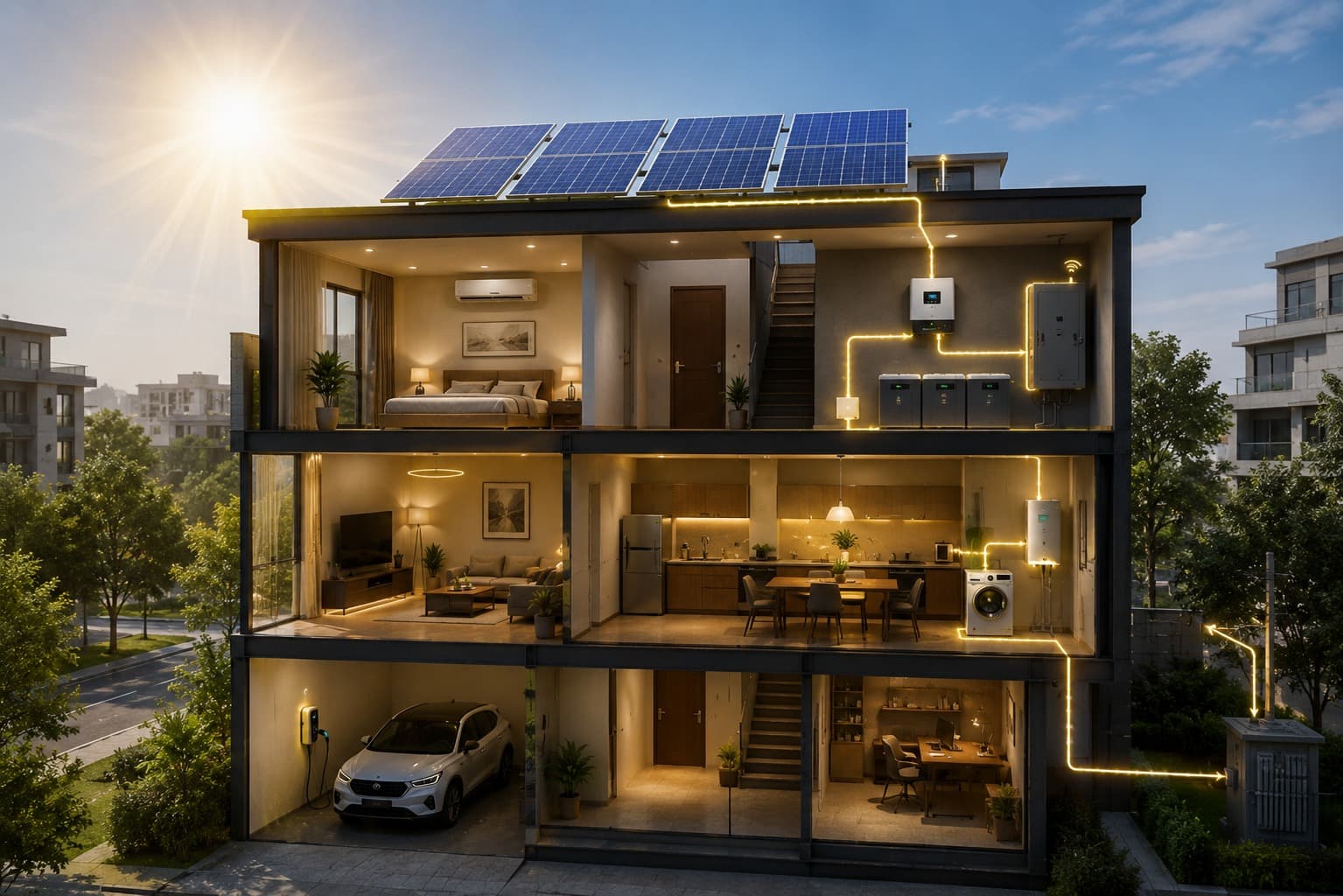
A 3 kilowatt solar energy home setup produces roughly 300 units of electricity in a month under typical Indian sunlight conditions. For most urban households, that wipes out a large portion of the monthly bill outright. And when the system generates more power than the family consumes, the surplus feeds back into the grid and the household earns credits through net metering arrangements with their local distribution company.
Over a twenty-five-year panel lifespan, the environmental arithmetic is equally striking. Residential solar installations at current scale are projected to prevent 720 million tonnes of carbon dioxide from entering the atmosphere. That is not a government projection designed to sound impressive. It reflects the straightforward reality of replacing coal-powered grid electricity with sunlight, unit by unit, home by home.
The Green Lifestyle Dimension Nobody Talks About Enough
Switching to solar energy home use changes the relationship a family has with electricity in ways that are subtle but lasting. When power comes from your own roof rather than a distant utility, consumption habits tend to shift. People become more conscious of what is running unnecessarily. Children grow up understanding that energy has a source, a cost, and a consequence.
That awareness is the core of what a genuine green lifestyle means in practice. It is not about grand statements. It is about daily decisions made differently because the household's infrastructure is aligned with a different set of values. Solar homes India owners report a stronger sense of energy independence, particularly during grid outages, especially when battery storage is added to the system.
Rooftop panels also reduce the heat absorbed by the roof surface itself, which translates to cooler indoor temperatures during summer months. In a country where air conditioning accounts for a growing share of domestic electricity consumption, that thermal benefit compounds the savings further.

The Financial Case Still Holds
Green home energy savings are real, but many buyers still hesitate because of the upfront cost. Under the PM Surya Ghar Muft Bijli Yojana subsidy for homeowners, a 1 to 2 kilowatt installation carries subsidised support between Rs 30,000 and Rs 60,000. Most households recover their net installation cost within five to seven years depending on local tariff rates, after which the electricity they generate is essentially free for the remaining two decades of the panel's life.
Solar panels for home India also add a measurable premium to resale value. Buyers in urban markets increasingly treat an active solar setup as a meaningful feature, not just a cosmetic addition.
Summary
Solar homes India are reshaping what green lifestyle means for everyday families. With over 25 lakh homes already running on rooftop solar and the PM Surya Ghar Yojana making solar energy home adoption financially accessible, the case is no longer purely ideological. Monthly bills fall, grid dependence reduces, carbon output shrinks, and the home itself becomes a small power producer. Green home energy savings build over years, and the environmental benefit compounds with every new installation. For any homeowner still on the fence, 2025 is genuinely the most practical moment India has ever offered to make the switch.