
Vastu Layout vs Area Efficiency: Balancing Home Design in India
Summary
Balancing Vastu principles with space efficiency in Indian homes is achievable by prioritizing geometry and key placements. Activity realignment and furniture adjustments often suffice, minimizing structural changes for a harmonious living space.

Introduction
Walk into a hundred Indian homes and you will find two camps. One insists that Vastu home design principles must govern every room placement decision, regardless of what that means for the usable space. The other dismisses Vastu entirely and optimises the flat purely for square footage. Both are making the same mistake from opposite directions. The more useful question is not whether to follow Vastu layout principles but how to apply them without surrendering the area efficiency that urban living demands. These two goals are not in conflict. They just need to be approached in the right sequence.
What Vastu Is Actually Governing
Before the trade-off question can be answered honestly, it helps to understand what Vastu floor plan principles are actually regulating. Vastu Shastra is a directional energy science that assigns specific life functions to specific zones of a house based on the eight cardinal and sub-cardinal directions. The North governs wealth and career flows and is best served by home offices and lockers. The South-East is the fire zone, making it the natural home for the kitchen. The South-West governs stability and is suited for the master bedroom. The North-East, called Ishaan, is the most sensitive zone, meant to remain open, light, and free of heavy structures. Toilets here are considered the single most problematic placement in modern apartment design.
These are not arbitrary rules. Most of them align with sensible spatial logic. A North-East opening invites morning light and cross-ventilation. A South-West bedroom places the heaviest occupants in the zone with maximum structural mass. A South-East kitchen keeps fire activity away from the home's energy zones. When Vastu directions happen to align with good climatic design, the two reinforce each other naturally.

Where the Space Efficiency Problem Actually Begins
Builders in Indian cities are optimising for one thing above everything else: maximum units per floor. That priority routinely produces floor plans where toilets land in the North-East, kitchens appear in the North, and the Brahmasthan, which is the energetic centre of the home, gets consumed by a common lobby or a staircase shaft. A buyer who cares about Vastu compliant flat India standards walks into these layouts and faces a genuine problem.
The tension is real but often overstated. The majority of Vastu room placement guide corrections do not require demolition or structural change. According to practitioners with decades of residential audit experience, most imbalances can be resolved through activity realignment, furniture positioning, internal zoning adjustments, and directional corrections. A toilet in a sensitive zone cannot be physically moved in a purchased flat, but sleeping direction, kitchen usage direction, and furniture placement can all be adjusted without touching a single wall. In a rented home, this approach addresses perhaps 60 to 70 percent of commonly cited Vastu home layout tips issues without any permanent modification.
The Shape of the Flat Matters More Than Direction Alone
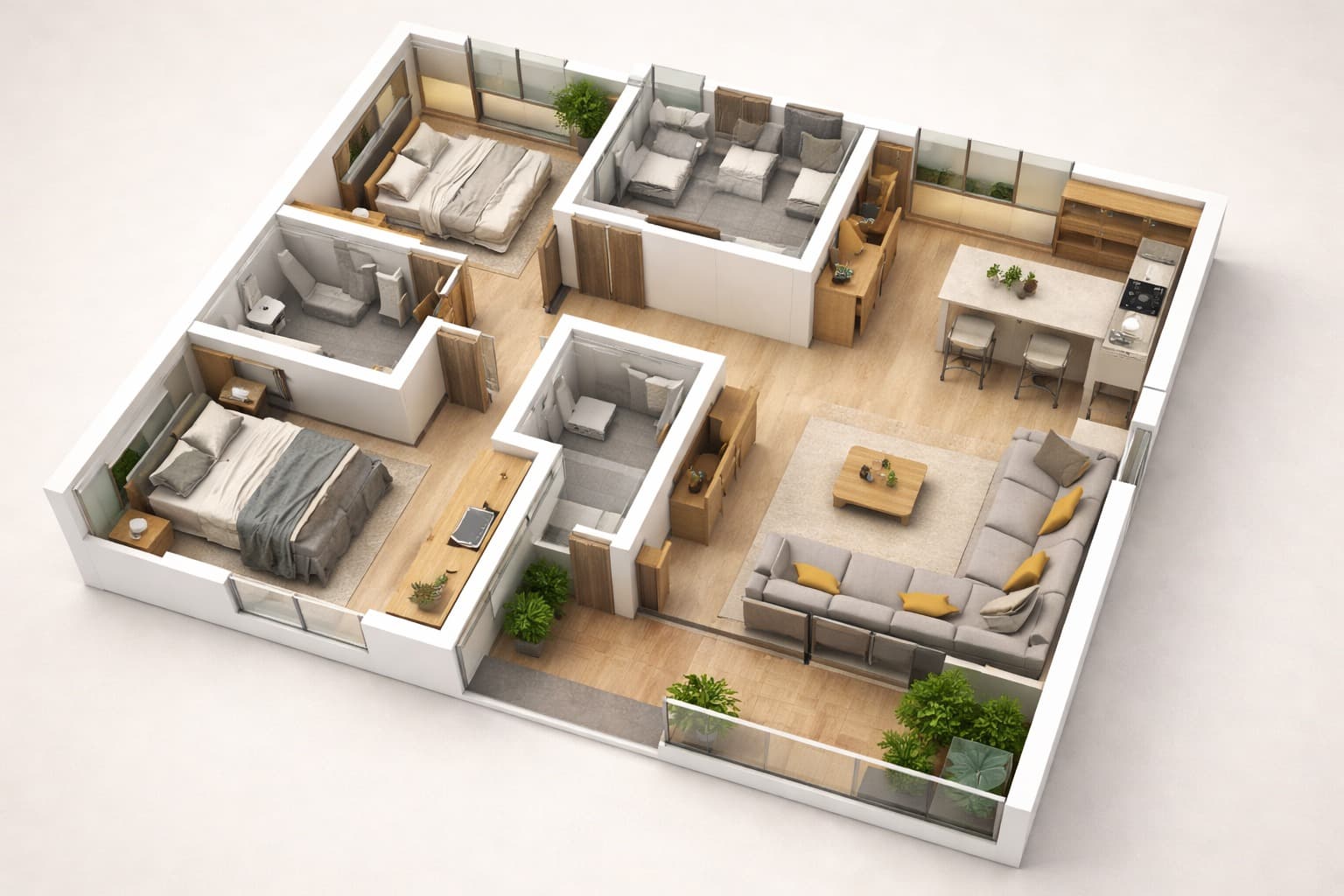
One of the most consistently underappreciated Vastu flat India principles is the importance of layout geometry. A square or rectangular floor plan is far easier to map onto a Vastu grid than an L-shaped or irregularly cut flat. Irregular extensions, particularly cut corners in the North-East or South-West, create directional voids that are difficult to address through remedies alone. When comparing two flats of identical carpet area, the one with a cleaner rectangular footprint is almost always the better Vastu investment, even if its room placements are slightly less ideal. Area and geometry work together.
How to Evaluate Vastu Without Sacrificing Space
How to check Vastu layout before buying a flat in India starts with the floor plan, not the salesperson's reassurance. Request the layout plan and overlay a basic directional grid using a compass reading at the main entrance. Check where the toilets fall first, since North-East toilet placement is the most commonly flagged structural issue in apartment audits. Then check the kitchen position relative to the South-East. Confirm that the master bedroom can realistically be used in the South-West zone. If the floor plan is roughly rectangular and these three elements are defensible, the flat is generally workable from a Vastu floor plan perspective without any structural compromise.
The living room and children's room are more flexible in directional terms. Heavy furniture in the South and West, open and light arrangements in the North and East, and a clutter-free North-East zone can be achieved in almost any layout through conscious interior arrangement.
Summary
How Vastu layout affects area efficiency in Indian homes comes down to one insight: the principles are directional, not dimensional. Following Vastu compliant apartment layout without wasting space is entirely achievable when buyers prioritise rectangular geometry, defensible toilet and kitchen placement, and a workable master bedroom zone. Balancing Vastu principles with space efficiency in Indian flats does not require sacrificing carpet area or adding dedicated ritual rooms. A Vastu room placement guide applied practically means activity realignment first, structural correction only when genuinely necessary. Buyers who check the floor plan early, verify directions accurately, and avoid North-East toilet placements will find that good Vastu home design and efficient space use are far more compatible than they are commonly believed to be.