
The Office Did Not Disappear. It Just Stopped Signing Long Leases.
Summary
India's commercial real estate has fundamentally shifted from long-term leases to flexible workspaces, now comprising 73% of total office demand. This structural change, with India leading globally, is driven by GCCs and enterprises prioritizing speed, making flex the new market standard.

A Market That Changed Its Own Rules
Not long ago, commercial real estate in India ran on a familiar and predictable rhythm. A company identified its space needs, a developer offered a building, a five-year lease was signed, and both parties moved on. That transaction model built skylines, funded developers, and gave institutional investors steady income for decades.
That rhythm has broken. Today, nearly three out of every four office space searches in India are focused on flexible workspace formats. Traditional leasing now accounts for less than 27 percent of total demand, according to a 2026 analysis of close to 400,000 verified workspace enquiries across 30 countries. The shift is not marginal. It is structural.
The Scale of What Has Already Changed
India's flexible workspace market crossed 110 million square feet in 2025, spread across approximately 2,600 centres nationwide according to a joint CBRE and FICCI report published in March 2026. The sector has grown at a compounded annual rate of 23 to 25 percent over five years, tripling in size since 2020.
The market is valued at roughly six billion dollars today and is on track to exceed eleven billion by 2030. That growth curve places India's flex office market among the most consequential sectoral stories in the country right now.
India also scored a perfect 100 on Cushman and Wakefield's global flexible workspace maturity index, ahead of the United Kingdom at 98, France at 97, and the United States at 81. India is now the most advanced flexible office market in the world by that measure.
Why Demand Keeps Growing
Two years ago there was a reasonable debate about whether the coworking boom was a pandemic-era reaction that would fade once traditional offices reopened. The data has since settled that argument firmly.
Coworking queries in India now outpace traditional office searches by a ratio of five to one. Searches for meeting rooms have jumped 187 percent compared to three years ago. Interest in virtual office arrangements has nearly doubled at 99 percent growth. Day pass demand has grown 20 percent. These are not small-company metrics. Large enterprises and multinationals are driving the bulk of this behaviour.
GCCs Are the Largest Force Reshaping This Market
Global Capability Centres have become the single most consequential demand driver in India's flex ecosystem. They account for 40 to 45 percent of all enterprise seat take-up in 2025, and that figure is expected to approach 50 percent over the next two years as GCC expansion into India accelerates.
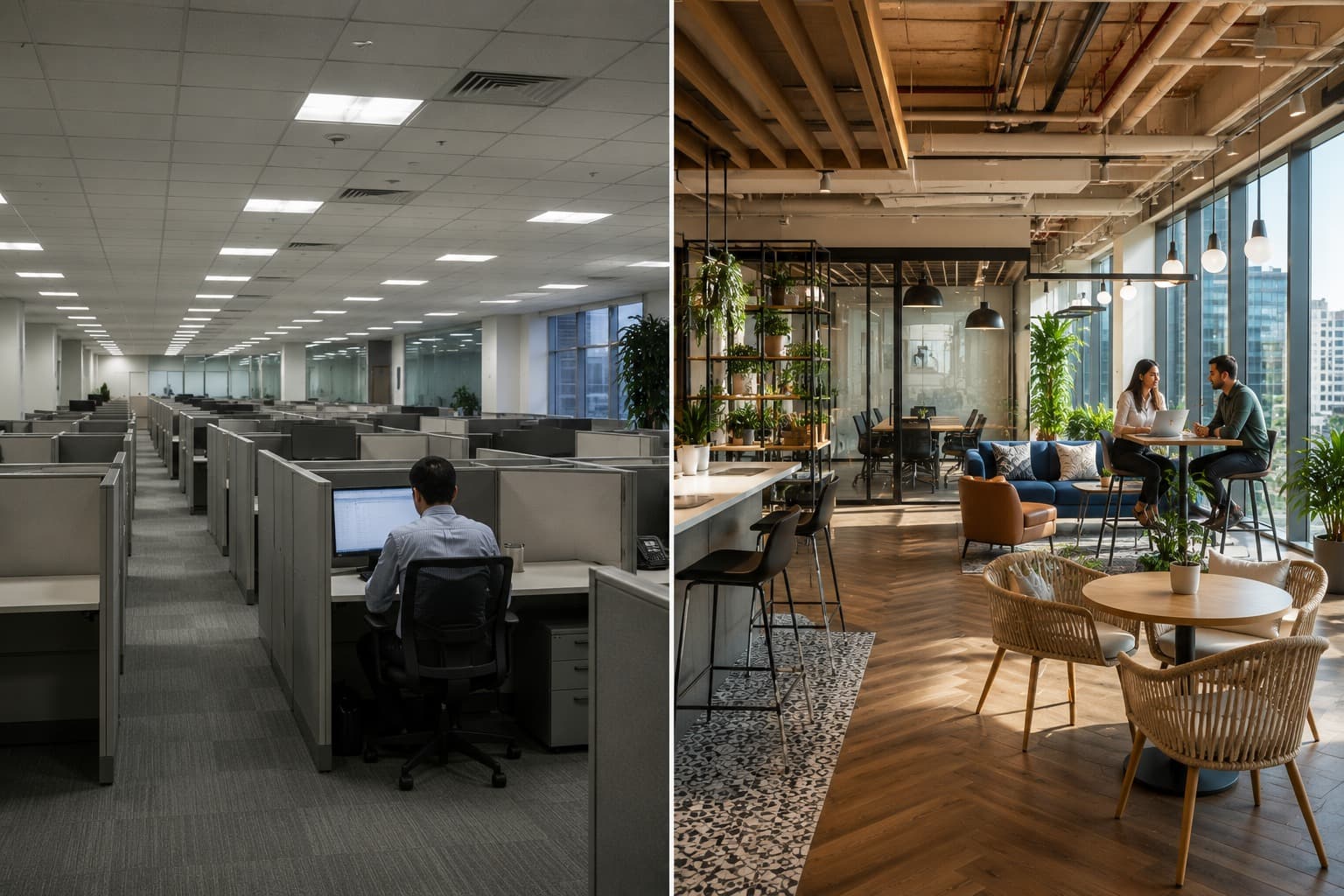
For a global company entering India, the conventional real estate journey involving site identification, construction, fit-out, and lease execution can take 18 to 24 months. A capable flex operator can deliver an enterprise-grade workspace in 60 to 90 days. For GCCs, that difference in speed is not a convenience. It is a competitive decision.
Operators have responded by building GCC-as-a-service models that bundle location strategy, regulatory compliance, workspace deployment, and global infrastructure standards into a single engagement. It removes the friction of local real estate navigation entirely.
Where the Flex Stock Lives
Bengaluru leads India's flex office market with 30 to 32 million square feet of operational inventory, the largest concentration in any single Asian city. Delhi NCR follows at 21 to 23 million square feet. Pune holds the highest flex penetration of any major Indian market at 14 to 16 percent of total office stock.
The top ten operators control approximately 67 percent of all flex inventory. Table Space leads at 11 to 12 million square feet, followed by Smartworks at 10 million and WeWork India at 8.2 million. These are not experimental coworking ventures. They are fully institutionalised real estate businesses drawing significant capital and corporate mandates.
Tier-2 Cities Are No Longer on the Sidelines
Demand for flexible commercial spaces in tier-2 cities is growing nearly twice as fast as in the top metros. Cities like Indore, Jaipur, Kochi, and Bhubaneswar are seeing rising search activity from both domestic businesses and decentralised enterprise teams that want quality workspaces without metro-level costs.
Around 3 percent of all office searches originating in India now come from users in the United States, United Kingdom, and UAE. Global firms are no longer limiting their India real estate conversations to three cities.
Green Buildings Have Become the Starting Point
Seven of the ten most-searched office parks in India are green-certified, accounting for over 66 percent of total office park search volume. Sustainability certification has stopped being a premium differentiator that operators charge extra for. It is now the baseline filter that businesses apply before they shortlist a workspace at all.
Summary
India's flexible workspace market has crossed 110 million square feet, earned a perfect global maturity score, and now drives 73 percent of all commercial real estate office demand in the country. With GCCs accounting for nearly half of enterprise flex take-up, coworking searches outpacing traditional office queries five to one, and tier-2 cities accelerating fast, flexible workspaces have stopped being a real estate trend and started being the standard. Developers and landlords still optimising for five-year leases are not just behind the curve. They are operating in a market that has already moved on.