
Solar Homes with Low-Maintenance Solar Panels: A Complete Guide for Indian Homeowners
Summary
Discover why Indian homeowners are increasingly adopting solar energy! Learn about low-maintenance solar panels, the PM Surya Ghar scheme subsidies, and how to make a smart, eco-friendly investment for your home.

Introduction
Something shifted quietly on Indian rooftops over the last two years. What was once the preserve of eco-conscious early adopters has become a mainstream home decision. Solar homes India are multiplying fast, driven by a combination of rising electricity tariffs, a landmark government scheme, and solar panel technology that has become genuinely low-effort to own. If you have been watching the trend and wondering whether the timing is right, the honest answer in 2025 is that it probably is. But the decision deserves a clear-eyed look at costs, maintenance realities, and what the government is actually offering.
Why Indian Homes Are Turning to Solar Now
India's solar energy capacity crossed 119 GW by mid-2025, up from under 3 GW a decade ago. That growth is not just utility-scale. Rooftop solar India has become a central pillar of the country's decentralised energy strategy, and residential adoption has jumped sharply since the government launched PM Surya Ghar: Muft Bijli Yojana in February 2024. By March 2025, over 10 lakh homes had been installed under the scheme alone. The economics are simple to understand: electricity tariffs keep rising every year, and a home solar system locks in your energy costs for 25 years once installed.

The PM Surya Ghar Scheme: What It Actually Offers
This is the most important financial context any homeowner needs before making the solar decision. The PM Surya Ghar solar scheme is described by the government as the world's largest domestic rooftop solar initiative. It targets one crore households by 2026 and 2027. For homeowners, the benefits are concrete. Subsidies of up to Rs 78,000 are available for systems up to 3 kW capacity, disbursed directly to your bank account within 30 days of installation and inspection. Collateral-free loans of up to Rs 2 lakh at a subsidised interest rate of around 6.75 percent are available through 12 public sector banks for those who need financing. Eligible households can receive up to 300 units of free electricity per month and earn Rs 17,000 to Rs 18,000 annually by selling surplus power back to the grid through net metering. For a 3 kW system that costs roughly Rs 1.3 to 1.5 lakh before subsidy, the post-subsidy outlay can come down to Rs 50,000 to Rs 70,000 depending on vendor and location.
Solar Panel Types and What Works Best for Homes
Not all panels are equal in an Indian context. Best solar panels for homes in India with low maintenance come in three main varieties. Monocrystalline panels are the current preference for residential rooftops because they deliver efficiency of around 19 to 22 percent, perform well in low-light and high-temperature conditions, and carry performance warranties of 25 years. They are the right choice for urban homes with limited rooftop space. Polycrystalline panels cost less and work reliably, but require more surface area for the same output. They suit homes with generous roof access. Thin-film panels are lightweight and flexible but significantly less efficient, making them unsuitable as the primary choice for most residential applications.
For a standard 3 to 4 BHK household running a refrigerator, washing machine, fans, lights, and basic appliances, a 3 to 5 kW system typically meets daily energy needs. A 5 kW system costs in the range of Rs 2.5 to 3.5 lakh before subsidy at 2025 rates.
The Low Maintenance Reality
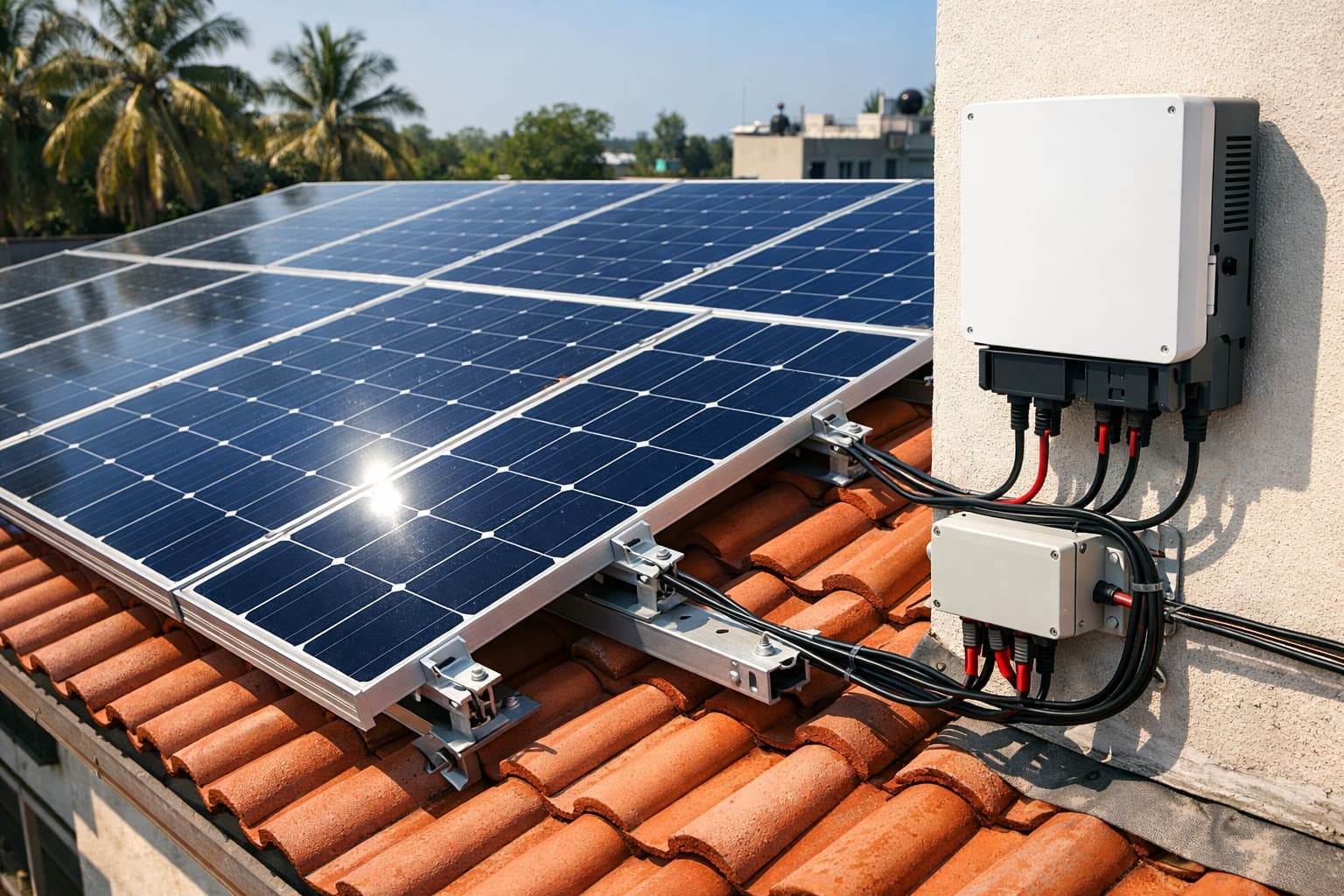
The phrase solar panel maintenance triggers concern in buyers who imagine complex systems requiring constant attention. The reality is considerably more relaxed. Modern panels are sealed units with no moving parts. The annual maintenance cost is close to zero in practical terms. What you actually need to do is clean panels two to three times a year to clear dust, bird droppings, and pollution deposits, which can reduce efficiency by up to 25 percent if left unaddressed. Some providers now offer self-cleaning technology that handles this automatically. The solar inverter, which converts the DC output of panels into usable AC power, typically lasts 8 to 10 years before needing replacement at a cost of Rs 20,000 to Rs 40,000. If you choose a system with battery backup, lithium-ion batteries last 7 to 10 years. Intelligent monitoring systems built into most modern installations flag any drop in output, so problems are identified early without manual inspection.
The Investment Case and Payback Period
Solar panel cost and savings for residential homes in India 2025 show a payback period of four to seven years depending on your monthly electricity bill, location, and system size. Homes paying Rs 3,000 to Rs 5,000 monthly typically recover their investment in four to six years. After the payback period, the electricity is essentially free for the remainder of the system's 25-year life. And how rooftop solar panels increase home value in India is increasingly measurable: solar homes attract higher buyer interest and command better resale prices in markets where buyers are energy-cost aware.
Summary
Low maintenance solar panels for homes India are no longer a luxury upgrade. With the PM Surya Ghar Muft Bijli Yojana subsidy benefits for homeowners making installation financially accessible, and monocrystalline technology delivering 25-year performance with minimal upkeep, solar panel installation cost India 2025 is among the most defensible home investments available. How to install low maintenance solar panels for homes in India starts with registering on the PM Surya Ghar portal, selecting an MNRE-approved vendor, and letting the subsidy process handle the financial heavy lifting. The rooftop is already there. The sun is not going anywhere. The economics finally make the decision easy.