
Short-Term vs Long-Term Office Lease: Pros, Cons, and the Right Call for Indian Businesses in 2026
Summary
Choosing between short-term and long-term office leases in India depends on growth certainty and capital. Short-term offers flexibility, while long-term provides cost savings and customization. Managed private offices offer a balanced hybrid solution for 2026.

Introduction
Signing an office lease India is one of those decisions that looks straightforward on the surface and gets complicated fast. Do you commit to a three or five-year lease and lock in a lower monthly rate? Or do you stay flexible with a shorter term and pay a premium for the freedom to leave? For Indian businesses in 2026, this choice carries real financial weight. Commercial office lease Mumbai Bengaluru and other major metros are not forgiving markets if you pick the wrong structure for your stage of growth.
Here is an honest breakdown of both options.
What Short-Term Leasing Actually Means
A short term office lease in the Indian context is typically anything under 12 months. Most serviced office operators and managed workspace providers in cities like Mumbai, Bengaluru, Pune and Hyderabad offer monthly or quarterly rolling agreements. Coworking spaces operate on this model by design. Some landlords in secondary commercial buildings also offer one-year leases, though these are less common in Grade A developments.
The defining characteristic is exit freedom. You can vacate with relatively short notice, usually 30 to 90 days, without triggering the kind of financial penalties that accompany a broken long-term lease.
Pros of Short-Term Leasing for Indian Businesses
The first and most obvious advantage is flexibility. A startup that doubles its headcount in six months cannot be trapped in a space built for its earlier size. A business entering a new city to test the market does not want to be locked into three years of rent on a location that may not work out. Short term vs long term office lease India decisions often come down to this one variable: how certain are you about your near-term needs?

The second advantage is speed. Most short-term office setups in India come fully furnished and operationally ready. Internet, air conditioning, meeting rooms, reception services and housekeeping are typically included. A team of ten can be operational within a week, compared to the two to three months a conventional fit-out demands.
The third advantage is capital preservation. There is no large upfront fit-out investment. Security deposits are smaller. Working capital stays available for product, hiring or growth rather than being tied up in office infrastructure.
Cons of Short-Term Leasing
The cost per sq ft is significantly higher on a monthly basis compared to a long-term lease for an equivalent location and specification. In Mumbai's BKC or Bengaluru's Outer Ring Road corridor, the effective monthly cost per seat in a managed short-term office can run 40 to 60 percent above what a comparable team would pay on a direct three-year lease.
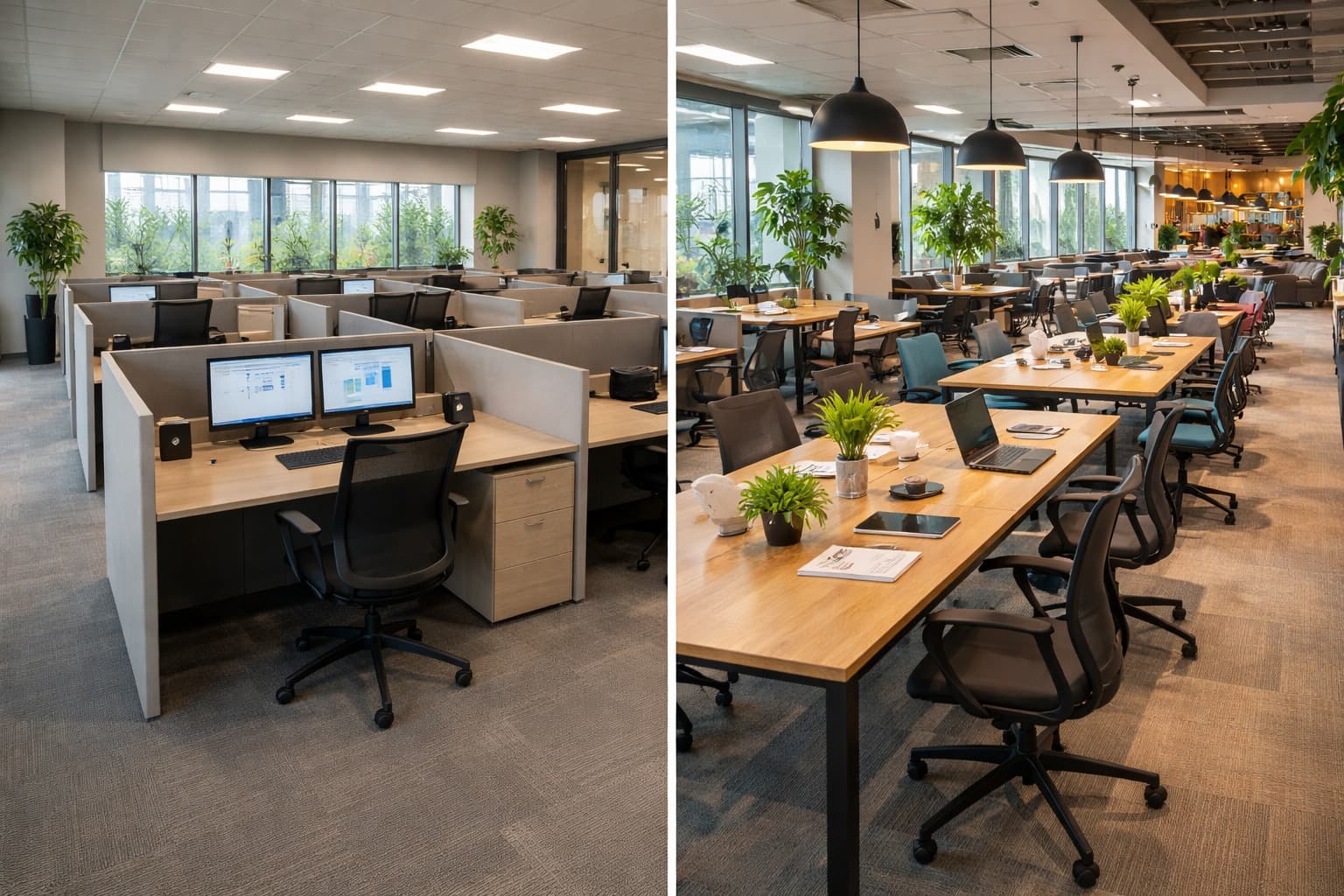
Brand identity is the other friction point. A business that wants to customise its office environment, install specific branding, build a reception desk that reflects its culture, or design a space that impresses enterprise clients will find short-term options very limiting. Most managed spaces offer standardised setups that all tenants share.
What Long-Term Leasing Delivers
A long term office lease in India typically runs three to nine years, with five years being the most common structure in prime commercial locations. The monthly rent is considerably lower than short-term alternatives for the same grade of space. Beyond the headline rate, landlords on longer agreements routinely offer additional benefits that are not available on short commitments.
Rent-free periods at the start of the lease, sometimes running two to four months on a five-year agreement, are standard in markets like BKC, Gurugram Cyber City and Bengaluru's Whitefield corridor. Fit-out contributions, where the landlord funds a portion of the interior setup cost, are common on large floor plate leases. These incentives can collectively represent 10 to 20 percent of the total lease value.
Customisation is the lifestyle advantage of long-term leasing. You design the space entirely around your team, your brand and your work culture. For businesses in creative industries, financial services or professional consulting, the office environment is a client-facing asset. A generic managed space simply cannot deliver what a purpose-designed office does.
Cons of Long-Term Leasing
The risk is commitment. If your headcount contracts, you are paying for empty desks every month. If you want to move to a better location mid-lease, you need to find a subtenant or pay a break penalty that can run to several months of rent. If your business model changes and you need a different type of space, you are stuck.
Security deposits in Indian commercial lease India structures are typically 10 to 12 months of rent, which is a significant capital lock-up for growing businesses. Add fit-out costs, which can run Rs 1,500 to Rs 2,500 per sq ft in most metros, and the entry cost of a long-term lease becomes genuinely substantial before a single employee sits down.
The Indian Market Context in 2026
India's flexible office lease India 2026 market has matured to the point where the distinction between short and long-term is no longer as binary as it once was. Managed office operators now offer hybrid structures: private suites within managed campuses on 18 to 36-month terms. These give businesses a middle path, lower monthly cost than pure short-term, more flexibility than a direct lease, and some ability to customise within a branded environment.
For teams between 15 and 50 people in particular, this middle-ground product is worth evaluating before defaulting to either extreme.
Summary
The short term vs long term office lease India decision comes down to growth certainty and capital availability. Short term office lease structures suit startups, project teams and market-testing businesses that need speed, flexibility and lower upfront commitment, but at a higher monthly cost per seat. Long term office lease benefits India include lower monthly rates, rent-free periods, fit-out contributions and full customisation, but require financial stability and headcount confidence over the lease horizon. For most Indian businesses in 2026, the right answer lies somewhere between the two: a managed private office on an 18 to 24-month term that preserves flexibility without the premium of a pure month-to-month arrangement.