
Seven Horses Painting: Does It Really Bring Success? Colour Psychology and Vastu Explained
Summary
The 7 horses painting's power for success stems from intentional Vastu placement and specific colour choices. This guide decodes its mythological roots and synergizes Vastu with colour psychology for career, wealth, and recognition.

Introduction
Walk into almost any Indian home with a Vastu-conscious owner and there is a reasonable chance a 7 horses painting hangs somewhere on the living room wall. Sometimes it is a large canvas with seven white horses galloping against a sunrise backdrop. Sometimes it is a smaller print, tucked beside the main door. The practice is widespread. But the understanding behind it is often thin. Does placing this painting genuinely create an impact, or is it simply a tradition that has outlived its explanation?
The answer, when you examine it through both Vastu Shastra and the psychological science of colour, turns out to be more grounded than most people expect.
The Mythology Behind the Number Seven
The 7 horses painting draws directly from Hindu mythology. Lord Surya, the Sun God, rides a celestial chariot pulled by seven horses, each named after a metre of Sanskrit verse: Gayatri, Brihati, Ushnik, Jagati, Trishtubh, Anushtubh, and Pankti. Together they represent the seven days of the week, the seven colours of visible light, and the continuous movement of time and cosmic energy. A painting of these seven horses is therefore not decorative symbolism. It is a representation of disciplined, forward-directed energy that is never stationary, never retreating.
Seven is also a number that carries auspicious weight across multiple traditions: seven oceans, seven sacred rivers, seven notes of music, seven vows in a Hindu wedding. The number carries an energy of completeness, and in Vastu, completeness is associated with stability and positive flow.
What Vastu Actually Says About Placement
Horse painting Vastu guidelines are quite specific, and ignoring them reduces the painting to wall décor with no deeper function. The East wall is recommended for buyers seeking career advancement and new opportunities. The North wall governs wealth flow and financial stability. The South wall is associated with fame, recognition, and the removal of professional obstacles.

The horses must always face inward toward the room, never toward the main door or a window. An outward-facing painting is considered to push energy out of the space rather than channelling it inward.
Certain locations are firmly off-limits. 7 running horses painting should never be placed in the bedroom, where its active energy disrupts rest and emotional calm. The pooja room, study room, bathroom, and any wall adjacent to a toilet are equally unsuitable. These are spaces of stillness, devotion, or drainage. The dynamic energy of running horses conflicts with the purpose of each.
Colour Psychology: Where Science Meets Tradition
This is where the conversation becomes genuinely layered. Colour psychology 7 horses painting choices are not arbitrary. Each background colour interacts with the human nervous system in measurable ways, and Vastu's directional recommendations align surprisingly well with modern colour psychology findings.
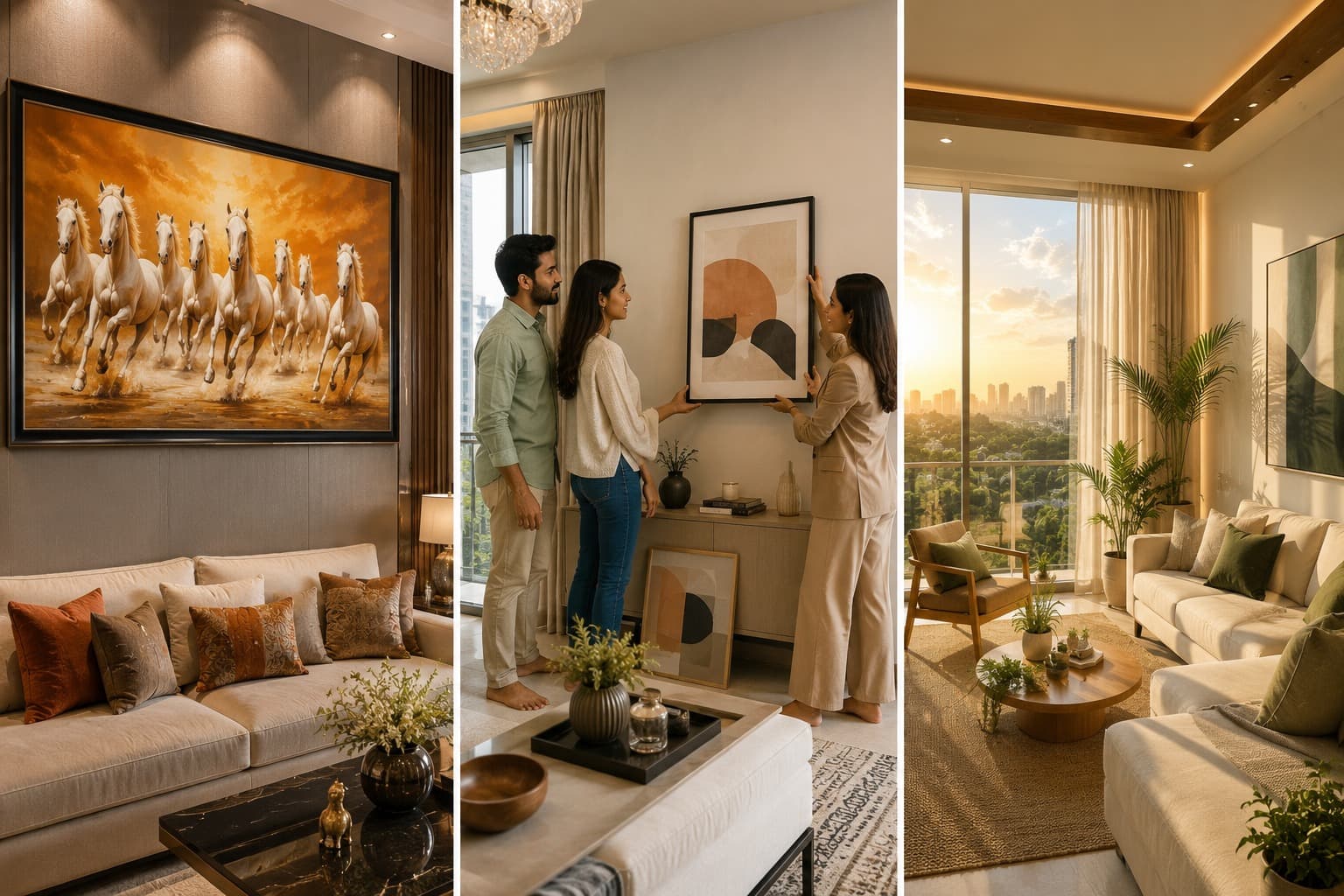
White horses against a bright background represent purity, mental clarity, and peaceful progress. White reflects light and psychologically creates a sense of openness. It is recommended for most general placements and for buyers uncertain about which colour to choose.
A sunrise backdrop in orange and gold introduces warmth, motivation, and the psychological sensation of fresh beginnings. Orange activates the brain's reward-seeking circuits. This combination is particularly effective on East walls where the intention is new opportunities and morning energy.
Blue backgrounds suggest emotional calm, focus, and steady professional growth. Blue psychologically slows the heart rate and supports clear thinking. A 7 horses painting with a blue or water-toned background placed on the North wall aligns Vastu water element symbolism with the proven calming effect of blue on the human mind.
Red and deep earth tones energise a space, associated in both Vastu and psychology with confidence, authority, and decisive action. These work on the South wall for those seeking visibility and career recognition.
What to Avoid
Horses depicted resting, walking slowly, or in conflict with each other carry no positive symbolic or psychological charge. Avoid backgrounds showing storms, dust clouds, a setting sun, or turbulent water. These are universally associated with endings and instability rather than forward movement.
Summary
Does 7 horses painting really bring success depends entirely on whether it is chosen and placed with intention. Which direction to hang 7 horses painting as per Vastu begins with purpose: East for new beginnings, North for wealth, South for recognition. What colour 7 horses painting brings success and wealth is answered by both tradition and psychology together: white for clarity, sunrise tones for motivation, blue for professional focus. 7 running horses painting meaning and placement guide India is not superstition dressed as décor. It is a system of intention, symbolism, and colour energy that has persisted across generations because, for many who apply it correctly, it continues to work.
Video will be embedded from: https://www.youtube.com/watch?v=5C0rrE5tSBc