
Rent or Buy a Ready-to-Move Home in 2026: The Honest Financial Comparison Indian Buyers Need
Summary
Should Indian buyers rent or buy a ready-to-move home in 2026? This guide provides an honest financial comparison, considering cash flow, tax benefits, life stability, and rent-to-price ratios to help you decide.

Introduction
The rent versus buy debate in Indian real estate has been running for decades and it shows no signs of producing a consensus answer any time soon. Partly because the correct answer genuinely depends on your city, your income, your life stage, and how long you plan to stay in one place. And partly because both sides of the argument attract people with strong opinions who present their preferred conclusion as universal truth. This blog does not do that. What it does is lay out the actual financial and lifestyle variables behind the rent vs buy India decision for a ready to move property, so you can run the numbers against your own situation and arrive at an answer that is yours rather than borrowed from someone else's circumstances.
Why Ready-to-Move Changes the Equation
The rent versus buy comparison gets significantly simpler when the property in question is ready to move. Under-construction comparisons introduce construction risk, EMI-plus-rent overlap periods, and possession uncertainty into the calculation. A ready to move property India eliminates all three. You know the exact product you are buying. You can move in immediately. And the EMI-to-rental comparison becomes a clean, direct exercise rather than a multi-variable projection.
This matters because the largest source of financial regret in under-construction purchases is the period where buyers pay both rent and EMI simultaneously for two or more years. That overlap disappears entirely with a ready-to-move purchase, which changes the effective cost comparison considerably.
The Monthly Cash Flow Reality
Start with what the market actually charges. In Mumbai's western suburbs, a decent 2 BHK in Thane West rents for Rs 22,000 to Rs 28,000 per month. A comparable ready-to-move unit in the same locality is priced at Rs 80 lakh to Rs 95 lakh. Taking an Rs 80 lakh home loan at 9% over 20 years produces an EMI of approximately Rs 72,000 per month. The monthly outgo difference between renting and buying in this example is Rs 44,000 to Rs 50,000.
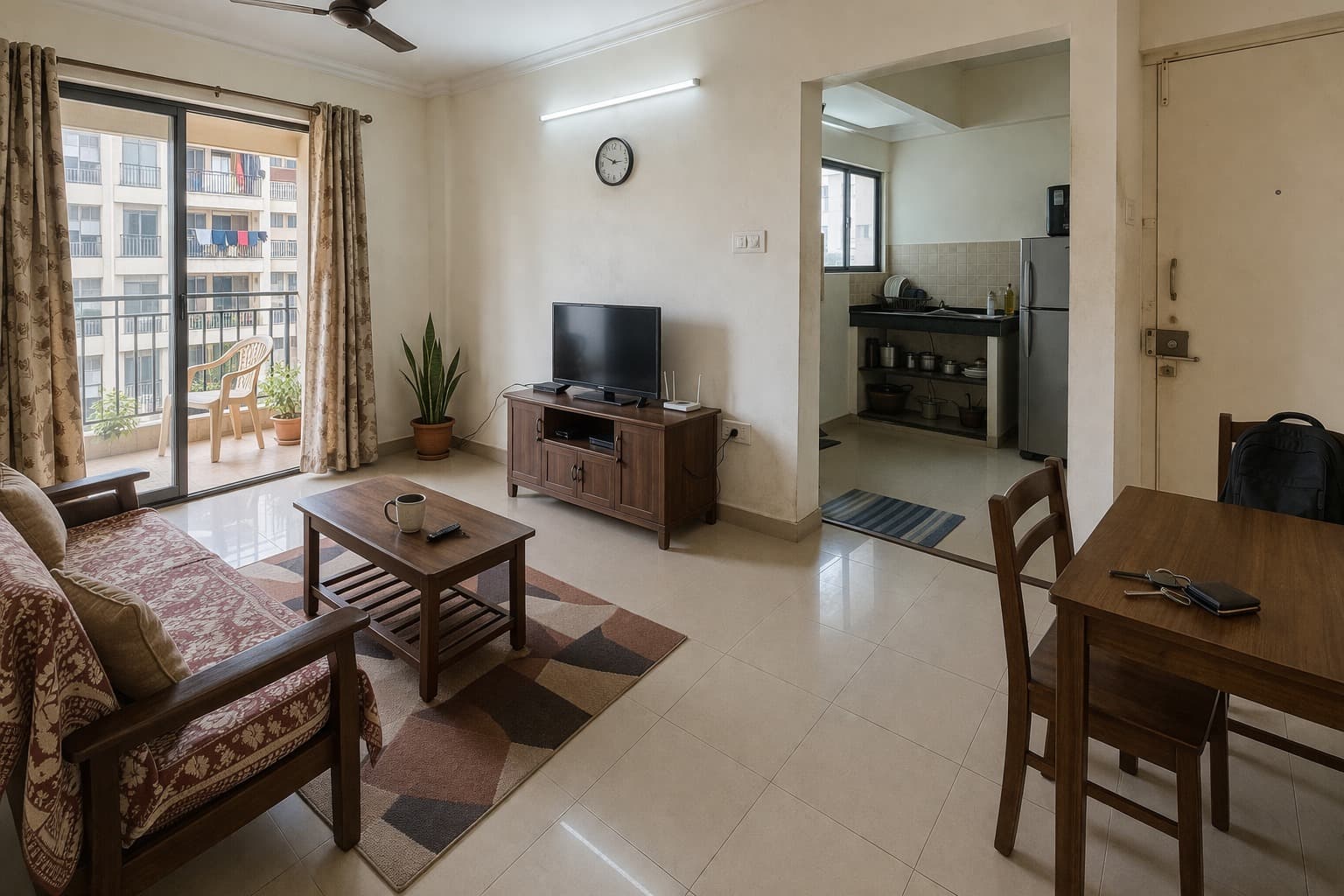
That gap is not small. But it is not the complete picture either. The renter's Rs 28,000 goes entirely to the landlord every month. The buyer's Rs 72,000 is partly interest expense and partly equity building. In the first year of an Rs 80 lakh loan, roughly Rs 60,000 of each monthly EMI is interest and Rs 12,000 is principal repayment. The Rs 12,000 is not a cost. It is savings being built into an owned asset.
The Tax Saving Layer
Buyers of ready to move home India on a home loan access two tax deductions immediately. Section 24(b) allows up to Rs 2 lakh annually on interest paid, and Section 80C accommodates principal repayment within its Rs 1.5 lakh ceiling. At the 30% tax slab, the combined maximum annual saving is Rs 1.05 lakh. That is Rs 8,750 per month effectively returned to the buyer's pocket, which reduces the real EMI outgo meaningfully.
Renters get no equivalent tax benefit on rental payments unless they are salaried employees claiming House Rent Allowance, which has its own ceiling and conditions.
Appreciation: The Variable Nobody Can Predict Honestly
Here is where most rent versus buy articles become wishful thinking. Property appreciation is real in India but it is not uniform, not guaranteed year on year, and not equally distributed across cities, localities, and building vintages. Mumbai's premium belt has delivered strong appreciation over a 15-year period. So has Bengaluru's IT corridor and Gurugram's NH-48 stretch. But there are plenty of projects in those same cities where buyers who paid 2012 prices are still waiting for meaningful capital gains in 2026.
The property purchase vs renting decision based purely on appreciation assumptions is speculation dressed as financial planning. Base your decision on the cashflow reality, the tax benefit, and your personal life stability. If appreciation arrives on top, it is a bonus. If it does not, you should have been comfortable with the purchase anyway.
The Life Stability Test
No financial model resolves the non-financial dimension of this decision. Buying a ready to move flat makes sense when you are confident about staying in that city for at least five to seven years, your income is stable enough to absorb an EMI without stress, and your family structure is unlikely to change in a way that makes the current configuration obsolete.

Renting makes complete sense when you are in a city on a temporary or uncertain posting, when you are between life stages, or when the specific location you need is simply too expensive to buy in at current valuations without overextending your finances.
When Buying Wins Clearly
The home buying decision India tilts decisively toward buying when the rent-to-price ratio in your target locality is below 3%. That means the annual rent divided by the property price is under 3%. In that scenario, buying almost always delivers better financial outcomes over a seven-year-plus horizon after accounting for tax benefits, equity building, and moderate appreciation.
In Mumbai, Delhi NCR, and Bengaluru's premium pockets, rent-to-price ratios of 2% to 2.5% are common, which is a clear mathematical signal favouring purchase over continued renting for buyers with stable income and a long horizon.
Summary
The rent vs buy decision for a ready to move property in India in 2026 comes down to monthly cash flow gap, tax saving through Section 80C and 24(b), personal life stability, and the rent-to-price ratio in your target locality. Renting wins when flexibility is the priority. Buying wins when income is stable, the holding period exceeds seven years, and the rent-to-price ratio sits below 3%. Run the numbers against your own situation before borrowing someone else's conclusion.