
Pickleball Courts: The New Must-Have Amenity in Luxury Indian Apartments
Summary
Pickleball courts are becoming a must-have amenity in luxury Indian apartments, driven by demand from young, affluent buyers. Developers are creatively integrating courts into designs, recognizing its lasting appeal beyond a passing fad.

Introduction
Not too long ago, the amenity checklist for luxury housing in India was fairly predictable. Swimming pool, gymnasium, multipurpose hall, maybe a tennis court if the developer was feeling generous. That list is quietly getting a new addition and it is one that a lot of people did not see coming.
Pickleball courts are showing up in premium residential projects across Mumbai, Bengaluru, Delhi NCR, and Hyderabad. On rooftops, in basements, carved into clubhouse layouts, sometimes occupying spaces that would have gone to squash or badminton just a few years ago. Developers are not doing this by accident. They are responding to a very specific buyer demographic that has made it clear this sport matters to them and they want it close to home.
What Pickleball Is and Why It Took Off So Fast
For those still catching up, pickleball is a paddle sport that borrows from tennis, badminton, and table tennis. The game does not need players to be super fit but does need a solid game plan, quick reflexes, and great hand-eye coordination, and its smaller space requirements make it an ideal fit for urban cities where free space is a luxury.
That last part is exactly why Indian developers are paying attention. A pickleball court takes up considerably less space than a tennis court, roughly a third of the footprint, which makes it viable even in high-density urban projects where every square metre of amenity space is expensive. India had around 200 operational pickleball courts in early 2024, a number that grew to over 1,200 courts by the first half of 2025, with three to four courts added every few weeks in major urban metros.
That growth trajectory is what gets a developer's attention.
The Young Buyer Is Driving This
The mid-market and mid-premium segments witnessed strong momentum fuelled by aspirational younger buyers seeking premiumisation, superior amenities, curated community experiences, and enhanced lifestyle value.
This is the buyer that pickleball speaks to most directly. The 28 to 42-year-old professional, likely working in technology, finance, or a senior corporate role, someone who travels internationally, plays a sport or two, and evaluates a home not just on size and location but on what their daily quality of life will actually look like inside the community.

This is also a buyer who has almost certainly encountered pickleball already, at a resort, a company offsite, or a friend's housing society. And once you have played it a few times, the appeal is immediate. It is social, competitive without being punishing, picks up quickly, and can be played in the evenings without the prep time that golf or tennis requires.
When this buyer walks into a site office and sees a dedicated pickleball court in the amenity plan, it registers differently than a gym or a yoga room. It signals that the developer genuinely understands how this generation spends its leisure time.
From Rooftops to Basements: Where the Courts Are Going
The interesting design challenge is fitting a pickleball court into the spatial vocabulary of a luxury apartment project. Developers are solving this in several creative ways.
Rooftop courts are the most visually striking. A well-designed rooftop pickleball court with city views is a marketing asset that photographs exceptionally well and creates genuine word-of-mouth among residents. Projects in Mumbai's premium corridors have started featuring rooftop courts as headline amenity in their launch materials, placed prominently above swimming pools and gyms in the brochure hierarchy.
Basement courts solve a different problem. In land-constrained city projects where the plot does not allow for a large ground-level amenity zone, converting basement floors into sports and recreation spaces has been a growing trend. Pickleball courts work particularly well underground because the sport does not need natural light to be enjoyable, and acoustic treatments in basement spaces handle the characteristic paddle-and-ball sound effectively.
New launch luxury apartments now prioritise elevated experiences through features such as grand entry, rooftop swimming pools, and curated retail zones, with landscaped outdoor areas including pickleball courts and reflexology walks catering to multigenerational living.
Is This a Passing Fad or a Lasting Amenity?
Fair question. India's luxury housing market has seen amenity trends come and go. Squash courts, bowling alleys, virtual golf simulators, each had their moment in brochures before becoming the empty, underused rooms that maintenance staff quietly dread.
Pickleball feels structurally different for a few reasons.
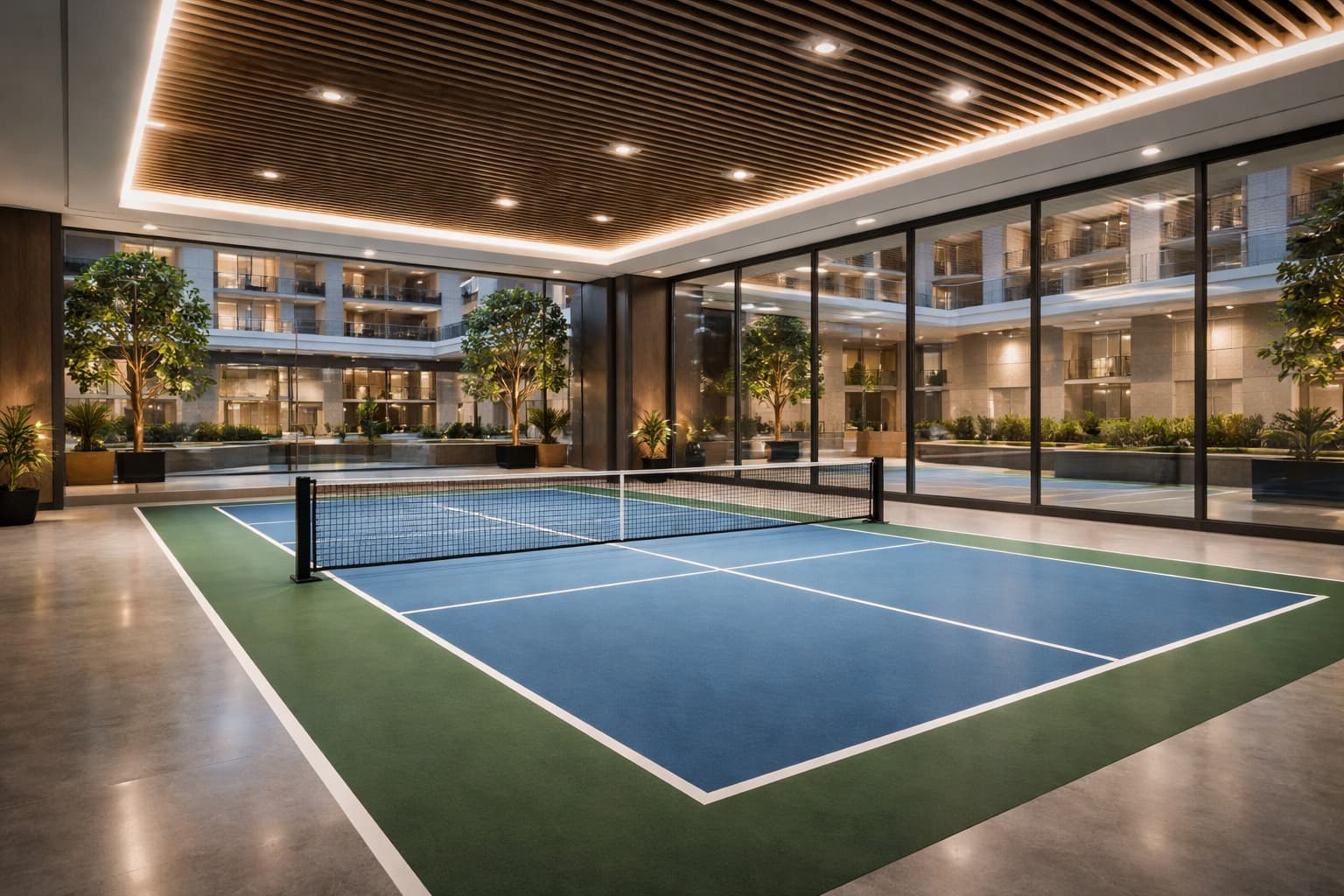
The game's smaller space requirements, inclusive nature, and appeal across age groups make it an ideal fit for residential societies. It is genuinely multigenerational in a way that few sports are. A 65-year-old and a 30-year-old can play together meaningfully. In a housing society where residents range from young couples to retired parents who move in with their children, that inclusive quality matters practically, not just in theory.
Real estate experts believe pickleball courts are not a residential fad, noting the sport is popular now and may moderate somewhat, but residential pickleball courts will never be a net negative for sellers, drawing comparisons to basketball courts but with more value since pickleball is an all-ages sport.
What Developers Are Actually Doing
Several major Indian developers have already moved beyond treating pickleball as a footnote. It is appearing as a named, featured amenity in project brochures across Mumbai's South and Central corridors, Bengaluru's Sarjapur and Whitefield zones, and Gurugram's Golf Course Road developments.
Affluent buyers want homes that understand their routines, with gyms and gardens that genuinely get used and communities that feel safe, green, and humming with life. A pickleball court that actually gets used daily by residents does exactly that. It creates community, generates energy in the common spaces, and gives residents a reason to come downstairs and interact with their neighbours in a way that a swimming pool used by five people on Sunday simply does not.
Summary
Pickleball courts are emerging as one of the most effective luxury housing selling points in India, particularly for attracting young homebuyers in their late 20s to early 40s who play the sport recreationally. With India's pickleball court count surging from 200 in early 2024 to over 1,200 by mid-2025, and active players projected to cross one million by 2028, the sport is firmly past the novelty stage. Developers across Mumbai, Bengaluru, and Delhi NCR are embedding courts on rooftops and in basements, and the amenity is holding its own as a genuine differentiator rather than a brochure gimmick. For the premium residential market, pickleball may well be the amenity that defines the 2026 to 2030 luxury housing cycle the way swimming pools defined the decade before it.
Video will be embedded from: https://www.youtube.com/watch?v=M6azictgwaY