
Office Spaces for Co-Located Companies: India's Smartest Commercial Real Estate Strategy
Summary
Co-located office spaces are a smart strategy for companies in India, offering cost efficiency and flexibility. With rising rents and falling vacancy, sharing office spaces provides access to prime locations and reduces capital investment.

Introduction
There is a quiet revolution happening on Indian office floors. Companies that once insisted on standalone branded campuses are increasingly sharing buildings, infrastructure, and even floors with peer organisations. Co-located office India strategies are not about compromise. They are about deliberate cost efficiency and operational intelligence. In a market where Grade A office rents in prime locations hit nearly Rs 90 per square foot in 2025 and vacancy has fallen to historic lows, the argument for co-location office arrangements has never been more financially compelling.
What Co-Location Actually Means in a Commercial Context
The phrase covers several distinct arrangements that are worth separating clearly. The first is shared campus leasing, where multiple companies take space in the same Grade A park, sharing common infrastructure like lobbies, parking, and food courts while maintaining separate floors or wings. The second is managed workspace co-location, where a flex operator like Smartworks, IndiQube, or WeWork consolidates multiple enterprise clients under one managed umbrella. The third is strategic co-location, where companies in complementary sectors deliberately choose to occupy adjoining spaces to facilitate talent sharing, vendor proximity, or collaboration opportunities.
All three arrangements reduce the per-seat real estate cost by spreading fixed infrastructure costs across a larger occupying base.

The Market Context Driving This Trend
India's office sector recorded a historic net absorption of 61 million square feet in 2025, a 25 percent year-on-year increase according to Cushman and Wakefield. Average office rents crossed Rs 90 per square foot per month across top cities, with Mumbai's BKC and Bengaluru's Outer Ring Road commanding premium rates. Vacancy fell to 15.7 percent by Q1 2025, the seventh consecutive quarter of decline. In this environment, shared office space India arrangements give growing companies access to high-quality addresses that direct leasing at similar scales simply cannot deliver at the same cost per seat.
Flexible workspace operators leased a record 12.4 million square feet in 2024 alone, absorbing space in Grade A parks and reoffering it to enterprise clients on managed terms. Benefits of co-located office space India are most visible in this segment, where a company of 200 people can access a Bengaluru Manyata Tech Park address without committing to the floor plate, fit-out costs, and multi-year lock-in that a direct lease would demand.
Why GCCs Are Leading the Co-Location Shift
Global Capability Centres deserve particular attention here. GCCs accounted for 43 percent of office absorption in Hyderabad's record Q1 2026 and are projected to lease 45 to 50 million square feet across India over the next two years. Many of these centres, particularly mid-sized ones being set up for the first time, are choosing managed workspace co-location India as their initial operating model. A US financial services firm setting up a 150-seat India centre does not want to negotiate a direct 5-year lease, manage facility operations, and handle statutory compliance from day one. A co-located managed campus handles all of that while allowing the GCC to prove out its India model before committing to dedicated infrastructure.
The Real Estate Cost Arithmetic
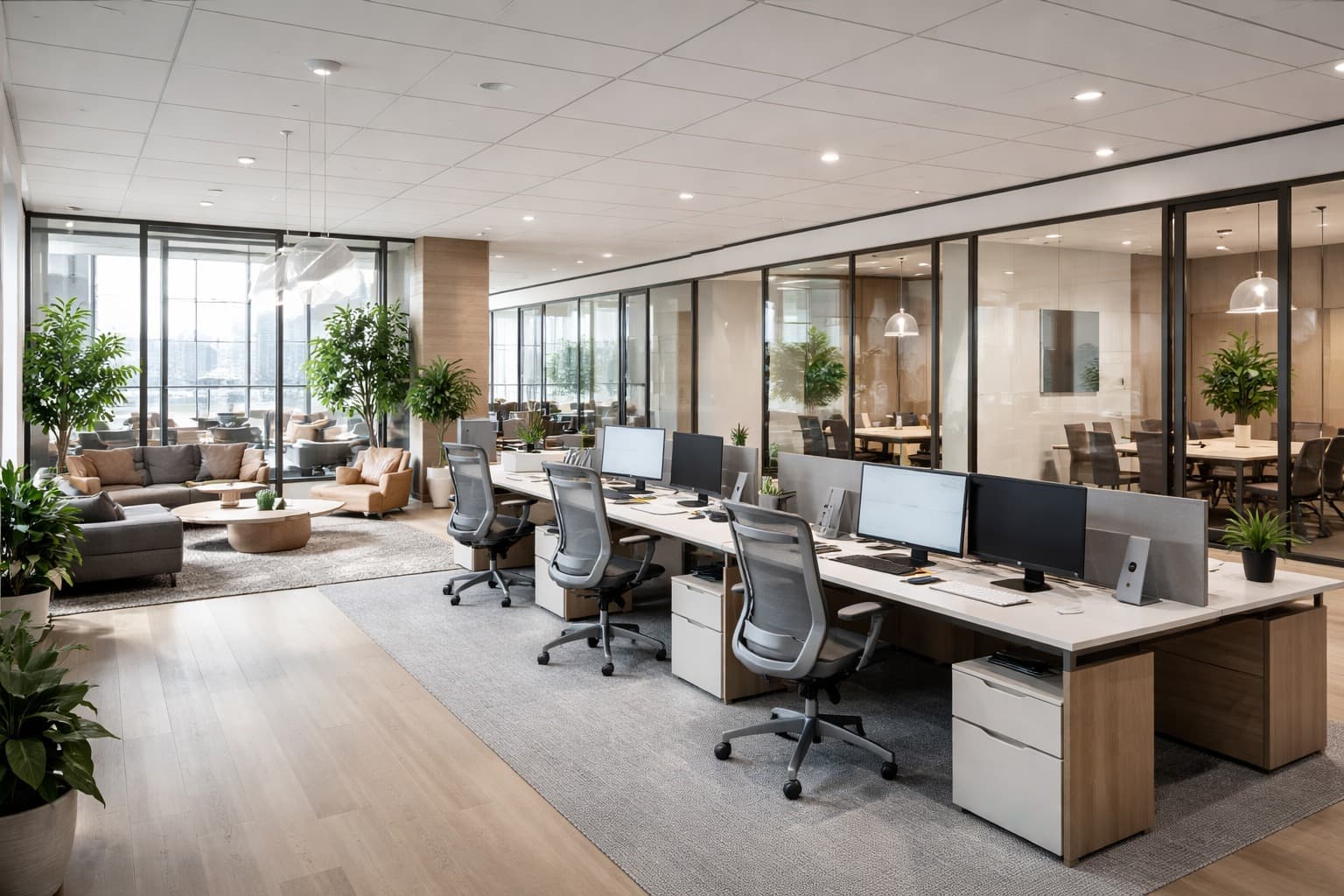
How co-location office strategy reduces real estate cost in India is most visible in three line items. First, fit-out capital. A direct lease of 10,000 square feet in a Grade A Bengaluru building requires fit-out investment of Rs 1,200 to Rs 2,000 per square foot, totalling Rs 1.2 to Rs 2 crore. A managed co-location arrangement delivers a fully fitted floor with no upfront capital commitment. Second, security deposit. Direct leases typically require six to ten months of rent as deposit. Managed operators require two to three months at most. Third, exit flexibility. A direct lease with a five-year lock-in exposes a company to significant penalty if headcount drops. Co-location agreements typically allow contraction with 90 to 180 days notice.
Where Co-Location Works Best in India
Best managed workspace options for co-located companies in India are concentrated in established tech corridors. Smartworks' network of 48 operational centres, IndiQube's expanding footprint across South India, and UrbanVault's positioning within Manyata Tech Park represent anchor options for enterprise co-location. Bengaluru, Hyderabad, and Pune collectively account for the largest share of managed co-location demand, driven by GCC activity and IT sector growth. Delhi-NCR's Gurugram and Noida corridors serve BFSI, consulting, and engineering sector co-locators.
Summary
Why companies choose co-located office spaces in India comes down to three realities that define the post-2024 commercial real estate market: rising rents, falling vacancy, and the premium placed on operational flexibility. Co-located office campuses GCC India 2025 2026 represent the fastest-growing segment of managed workspace demand. Shared office infrastructure benefits for Indian businesses span capital savings, address quality, exit flexibility, and speed to market. For any company evaluating a new Indian presence or expanding an existing one, office spaces for co-located companies India offer a financially disciplined entry point into a market where direct leasing premiums have never been higher.