
Low-Emission Building Materials: The Future of Sustainable Construction in India
Summary
Indian construction faces the challenge of rapid growth with reduced emissions. Low-emission materials like fly ash bricks, AAC blocks, geopolymer concrete, and recycled steel are becoming essential for sustainable building practices, driven by regulation and economic viability.

Introduction
Buildings in India are responsible for roughly 25% of the country's total carbon emissions. That number sits uncomfortably alongside another: India is expected to add over 35 billion square feet of new built space by 2050, nearly double what exists today. These two figures together define the central challenge of Indian construction — how to build massively while emitting far less. Low emission building materials are no longer a premium add-on for architects chasing green ratings. They are fast becoming the practical, regulatory, and financial default across residential and commercial projects in 2026.
Why the Material Choice Matters More Than Most Builders Think
Most sustainability conversations in construction focus on operational energy — the electricity a building consumes once occupied. But a significant portion of a building's total carbon footprint is locked in before a single resident moves in. This is called embodied carbon, and it sits in every bag of cement poured, every steel beam erected, and every fired clay brick laid. Traditional Portland cement alone accounts for close to 8% of global CO₂ emissions. Steel adds another major share. Together, cement and steel represent the single biggest emissions lever available to any developer making material selection decisions. Choosing better here is not a marginal gain. It is the ballgame.
Fly Ash Bricks and AAC Blocks: The Accessible Entry Point
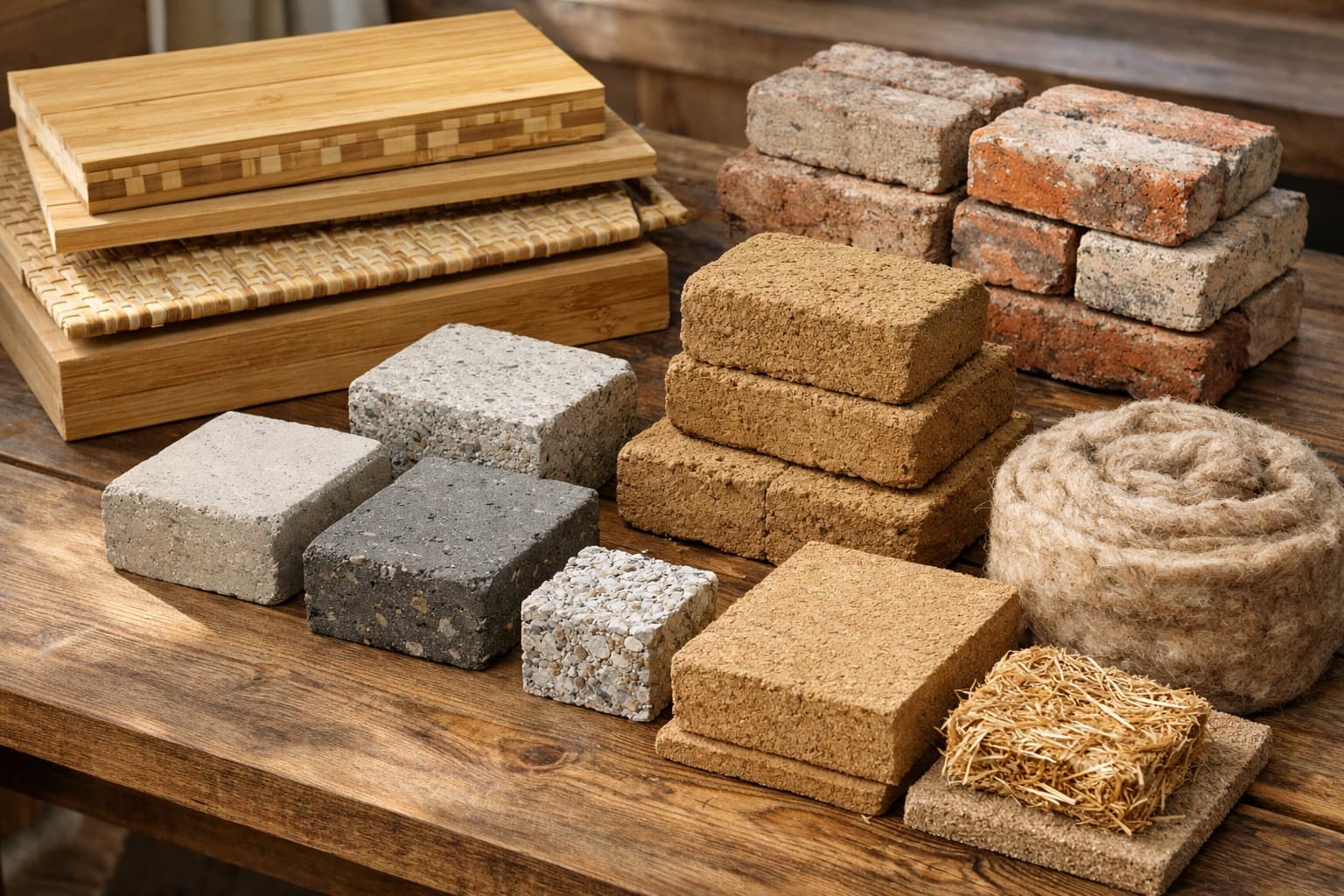
For most Indian builders, the practical first step into sustainable construction India runs through two materials: fly ash bricks and autoclaved aerated concrete blocks. Fly ash bricks are manufactured using waste generated by thermal power plants, diverting industrial residue from landfills and converting it into a structurally sound substitute for conventional clay bricks. They are harder, more dimensionally accurate, and carry lower embodied carbon than kiln-fired clay units.
AAC blocks take this further. Made from sand, cement, lime, and fly ash bound together under steam pressure, AAC is significantly lighter than conventional brick, dramatically better at thermal insulation, and capable of reducing wall thickness without sacrificing strength. Thinner walls mean less material overall and lower dead loads on slabs and foundations. PMAY-U now mandates low-carbon materials including both fly ash bricks and AAC blocks in affordable housing projects, which means these are no longer niche choices. They have crossed into mainstream specification.
Geopolymer Concrete: The Material Serious Developers Should Track
One step up in technical sophistication is geopolymer concrete. Instead of Portland cement as the binding agent, geopolymer uses industrial by-products like fly ash and ground granulated blast furnace slag, both of which would otherwise need disposal. The chemistry produces a binder with strength comparable to conventional concrete but with emissions that can be 40% to 80% lower depending on mix design and activator chemistry.
The cost premium remains a barrier at smaller scales, but at project scale — large residential towers, commercial podiums, infrastructure civils — the material economics are shifting. Several large infrastructure contractors are actively piloting geopolymer applications, and certification frameworks under the Bureau of Indian Standards are catching up with actual market availability.
Recycled Steel and the Case for Circular Construction
India generates an estimated 150 to 500 million tonnes of construction and demolition waste every year. Less than 1% of that is formally recycled. This is both a problem and an opportunity. Recycled steel, produced through electric arc furnace technology rather than the blast furnace route, emits a fraction of the carbon of virgin steel production. As hydrogen-based green steel manufacturing scales industrially, the emissions differential will widen further.
For sustainable construction materials in high-rise residential and commercial projects, specifying recycled or low-carbon steel wherever structural engineers allow it is one of the highest-leverage material decisions a developer can make. It requires no compromise in performance and increasingly no significant premium at volume.
Low-VOC Paints, Laterite Stone, and the Finishing Layer
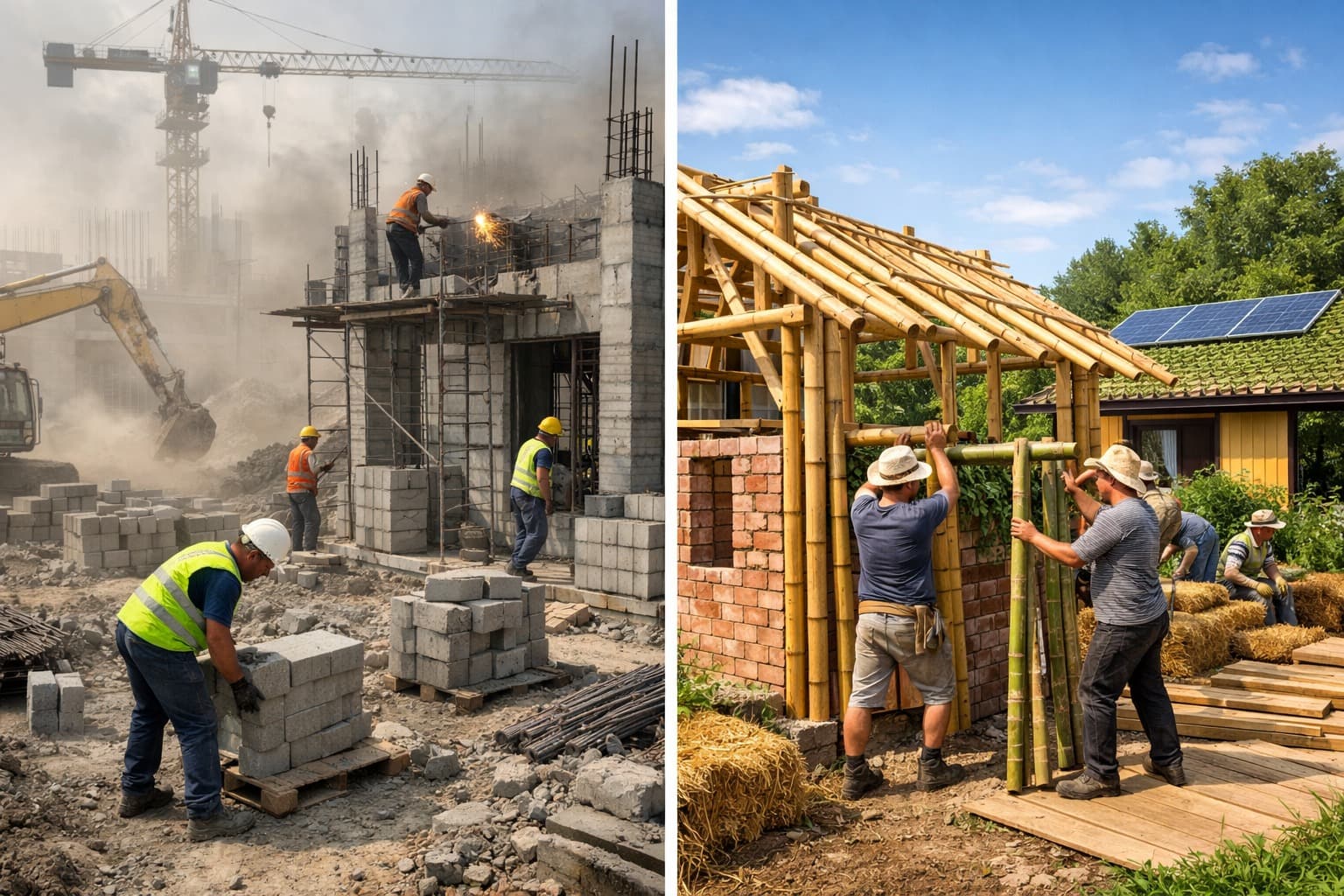
The inside of a building carries its own emissions story. Conventional paints and adhesives release volatile organic compounds into indoor air for months after application. Low-VOC formulations, now widely available from major Indian paint manufacturers, address both indoor air quality and the health of construction workers during application. The choice costs almost nothing extra and has measurable occupant health benefits.
Laterite stone, locally quarried across coastal Maharashtra, Karnataka, Kerala and Goa, is naturally insulating, requires minimal processing energy, and eliminates long-distance transport emissions. Using it in regions where it is readily available is a textbook application of the embodied carbon principle: the best material is often the closest one.
The Regulatory Framework Pushing This Forward
India's Energy Conservation Building Code, the ECBC, sets minimum performance standards for commercial buildings. The IGBC LEED green building India certification frameworks create market incentives by separating certified green buildings from conventional stock in the eyes of institutional buyers and tenants. The Extended Producer Responsibility norms being phased in from 2026 onward will require secondary material usage in major projects, starting at 5% and rising to 25% by 2030. The direction of regulation is unambiguous.
Summary
Low emission building materials are no longer an ethical aspiration sitting outside normal project economics. Fly ash bricks, AAC blocks, geopolymer concrete, recycled steel, and locally sourced materials like laterite stone all carry practical, cost-comparable cases at the scales Indian developers operate. With embodied carbon now under regulatory and institutional scrutiny, and India's green building materials market projected to reach $70–80 billion by 2030, every project that delays material rethinking is simply accumulating future liability. The transition is already underway — the question is which developers lead it and which ones follow.