
Long-Term Investment Hotspots With Low Entry Cost
Summary
India's best long-term real estate investments with low entry costs are shifting to non-metro, tier 2 cities. These cities, like Indore, Jaipur, and Coimbatore, are outpacing metros in appreciation and job growth, driven by new infrastructure and strong economic fundamentals. This presents a prime opportunity for investors before the window closes.

The Metro Trap Most Investors Fall Into
Every property investor knows the feeling. You look at Mumbai or Bengaluru prices, do the math on what entry costs, and quietly wonder whether you have missed the boat entirely. Maybe you have, at least for the kind of returns that early investors in those cities enjoyed.
But that is precisely where the conversation about non-metro real estate investment in India becomes genuinely interesting. A new set of cities is building serious fundamentals. Property prices are still accessible. And the infrastructure story is only getting started. That combination does not come around forever.
Why the Tier 2 Shift Is Real This Time
India has talked about tier 2 city growth for years without it fully materialising. What is different now is the evidence behind the claim.
Magicbricks data from mid-2025 shows average capital appreciation of 17.6 percent in tier 2 cities, actually outpacing Delhi's 15.7 percent in the same period. Housing sales value across India's top 15 non-metro cities rose 6 percent to over ₹40,000 crore in Q1 2025. These are not projections. These are actual transaction numbers from actual buyers.
Job creation is driving a lot of it. Between September 2024 and February 2025, tier 2 cities saw a 42 percent rise in job openings compared to 19 percent in metros. When employment arrives, housing demand follows. It always has.
Indore: Consistency Over Glamour
Indore does not make flashy headlines. But as an investment city, it has been quietly delivering. Property prices currently average around ₹5,550 per square foot, substantially below comparable metro neighbourhoods. Annual appreciation has run between 8 and 12 percent over the past five years across most localities.
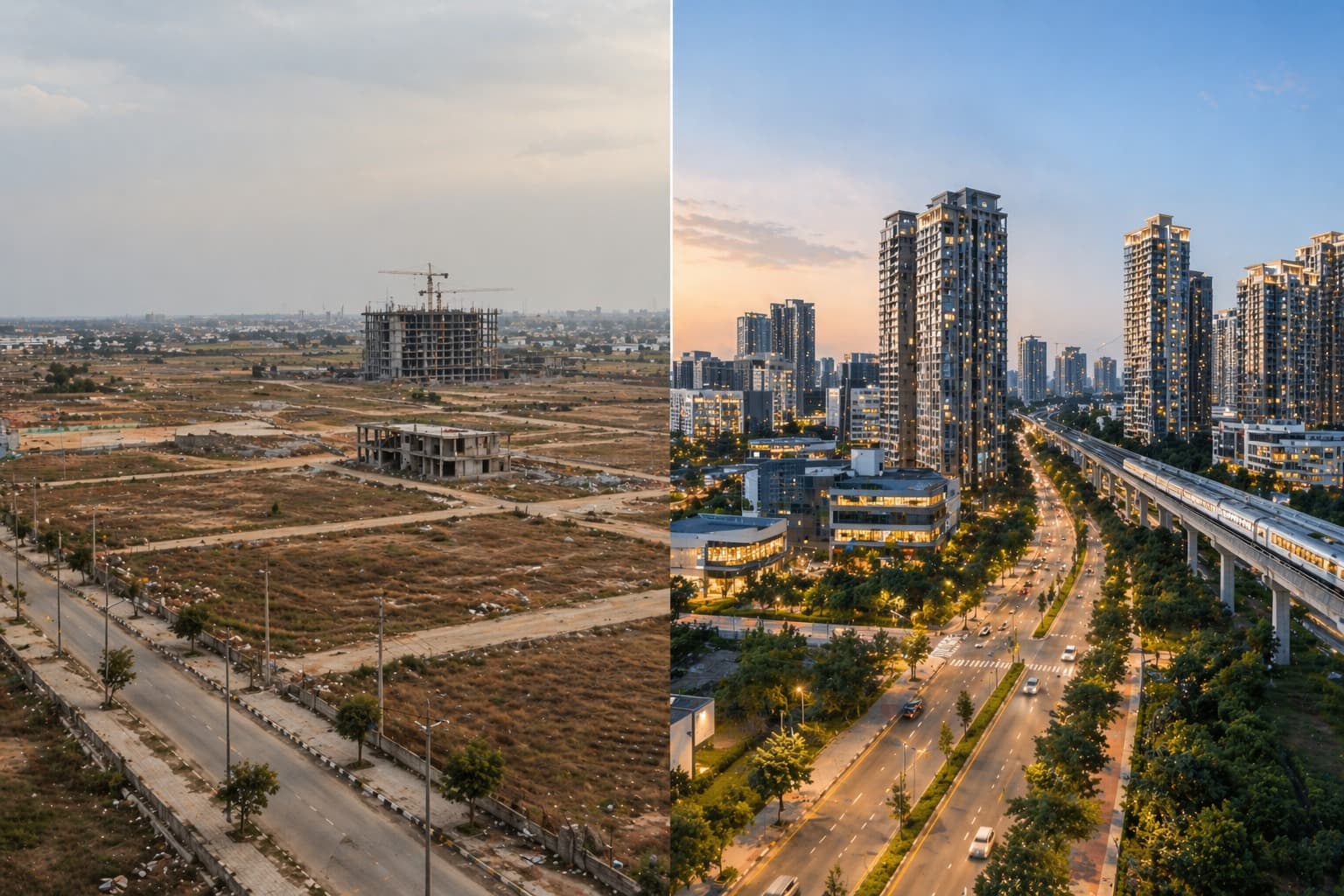
The Super Corridor is the zone to watch. It sits between the city and the upcoming metro alignment, carries IIM Indore and IIT Indore nearby, and is attracting IT campuses and logistics operators who want central India access at a fraction of Bengaluru costs. Office rents in Indore run roughly 60 percent cheaper than Bengaluru. That gap does not narrow without property values in Indore moving upward. For the investor buying today, that is the opportunity.
Jaipur: Tourism and Tech Making an Unlikely Partnership
Jaipur is an unusual market because it draws demand from two completely different directions simultaneously.
On one side, it has a tourism-driven economy that supports short-stay hospitality, vacation homes, and commercial retail. On the other, Mahindra World City and expanding IT parks are pulling corporate tenants into the city. Both forces push residential demand upward in their own way.
Property prices in Jaipur grew roughly 65 percent between 2020 and 2025 by market estimates. Corridors like Jagatpura, Ajmer Road, and Tonk Road Extension are still at entry-friendly price points while offering credible appreciation potential. The Delhi-Jaipur Expressway and Jaipur Metro Phase 2 are adding connectivity that historically unlocks dormant pockets. Investors who bought on the Yamuna Expressway before infrastructure was complete know how this plays out.
Nagpur: The Geography Advantage No One Can Replicate
There is a reason Nagpur keeps appearing on every serious investor's radar. It sits almost exactly at the geographic centre of India. Every major freight corridor either passes through it or connects to it. The Delhi-Mumbai Industrial Corridor touches the city. So does the Samruddhi Expressway.
Nagpur and Surat together saw a 30 percent rise in residential sales in the first half of 2025. Rental yields in Nagpur are among the strongest in the non-metro category, making it attractive for investors who want income alongside appreciation rather than purely betting on price movement.
Lucknow: Government Backing Doing the Heavy Lifting
Lucknow benefits from something most Indian cities do not have in equal measure. It is the state capital of Uttar Pradesh, which means every major infrastructure decision flows through it. Metro expansion, ring road development, educational institutions, and government employment all concentrate here and drive steady residential demand.

Housing sales value in Lucknow jumped 48 percent in Q1 2025, one of the strongest performances among all non-metro cities tracked that quarter. Entry prices remain relatively accessible, and the city's expanding middle class is generating genuine end-user demand rather than purely investor-driven activity.
Coimbatore: South India's Underrated Performer
People tend to talk about Kochi and Chennai when discussing South India's non-metro opportunities. Coimbatore deserves equal attention. It posted a 52 percent year-on-year increase in housing sales value in Q1 2025, the highest among all tracked non-metro cities.
The manufacturing base is deep. Automotive, textile, and engineering industries provide employment stability that speculative markets simply cannot replicate. The Coimbatore Metro project and industrial parks along the Avinashi Road corridor are generating new residential clusters with current prices still between ₹3,500 and ₹6,500 per square foot.
Summary
The most compelling long-term real estate investments at low entry cost in India today sit outside the metros. Indore, Jaipur, Nagpur, Lucknow, and Coimbatore each carry a distinct economic engine, improving connectivity, and property prices that still allow genuine upside. With tier 2 cities collectively outpacing metro appreciation rates in 2025 and job growth running at more than twice the metro pace, the window for low-entry, high-potential non-metro property investment is open. But windows have a habit of closing.