
India's Most Interesting Commercial Property Story Right Now
Summary
India's commercial property market is witnessing a powerful convergence of maturing REITs and booming co-working spaces. This synergy, significantly driven by Global Capability Centre (GCC) demand, presents a compelling investment story in high-occupancy, flexible office assets across the country.

Introduction
Two trends have quietly converged in Indian commercial real estate, and not enough people are talking about the combined effect. REITs India have matured from a curious new instrument into a genuinely mainstream investment option. And co-working spaces have evolved from glorified coffee shops into serious enterprise-grade infrastructure that multinationals now build entire workforce strategies around.
Put these two forces together and you get one of the more compelling investment stories in the country right now. Let us walk through what is actually happening.
REITs Have Grown Up in India
When Embassy Office Parks became India's first publicly listed REIT back in 2019, most retail investors barely knew what to make of it. Today, the picture looks very different. India has four listed REITs covering commercial office and retail assets, with a combined operational portfolio crossing 105 million square feet as of mid-2025.
The three office investment India focused REITs — Embassy, Mindspace, and Brookfield — have collectively delivered over 15 percent capital appreciation in the twelve months leading into mid-2025, according to Cushman and Wakefield data. Committed occupancies across all three crossed 90 percent, with Mindspace Business Parks targeting 95 percent before the end of the fiscal year.
By law, REITs must distribute at least 90 percent of their rental income to unitholders. That makes them one of the few instruments where an ordinary investor can access Grade-A commercial rental income without buying a full office floor outright. Yields of 6 to 7 percent annually from REIT investment India 2025 compare favourably with fixed deposits while offering the additional possibility of capital growth.

The Co-Working Explosion Running Underneath
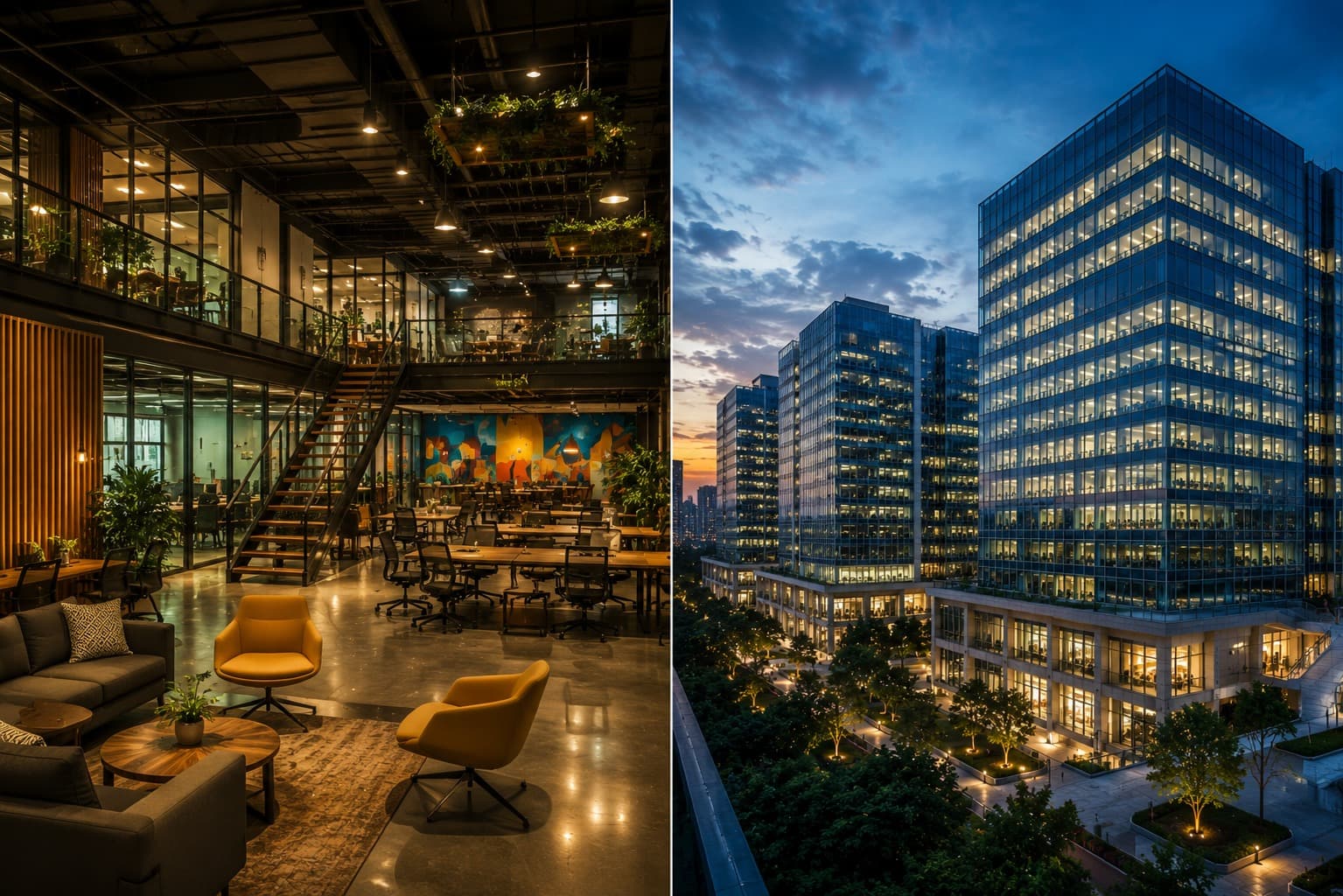
Here is what adds real fuel to the REITs India story: co-working spaces are no longer a niche category catering to freelancers and small startups. They have become a core occupancy driver within the very buildings that listed REITs own and operate.
WeWork India operated 7.67 million square feet across 114,000-plus desks as of June 2025. Awfis, the homegrown flex operator, ran approximately 8.4 million square feet and 164,000 seats across 243 centres by March 2025. Both companies report that Global Capability Centres now account for 35 to 45 percent of their entire portfolio demand. That is a dramatic shift from just three years ago when GCC clients were a minor slice.
India flex office growth 2025 projections suggest the total flexible workspace stock could reach 140 to 145 million square feet within two fiscal years, requiring investment of Rs 4,000 to Rs 4,500 crore from operators expanding into Tier-2 cities.
How the Two Stories Connect
The relationship between REITs and co-working spaces in India is symbiotic rather than separate. Embassy Group's acquisition of WeWork India for around Rs 700 crore illustrates this directly. A major REIT-backed developer folded a flex operator into its own structure so that the same portfolio of buildings could serve both conventional long-lease tenants and flex occupiers within a single asset. That flexibility improves occupancy stability across business cycles.
Multinational corporations setting up GCCs frequently prefer REIT-owned buildings because institutional landlords offer service levels, sustainability certifications, and maintenance standards that smaller landlords cannot match. Cushman and Wakefield noted explicitly that MNCs are disproportionately choosing REIT assets for their India capability centre locations. This preference circle feeds directly back into Embassy REIT and its peers maintaining the high committed occupancy rates that sustain distributions to unitholders.
Where Growth Is Heading
Co-working space demand India is expanding well beyond its original Bengaluru and Delhi NCR base. WeWork India's Chennai centre opened in early 2025 with 2,000 seats and reportedly reached 60 percent pre-leasing within three months, an unusually fast uptake for a secondary market. Tier-2 cities like Ahmedabad, Coimbatore, Indore, and Chandigarh are entering conversations among operators who previously focused exclusively on the six main commercial hubs.
A fourth office-focused REIT was expected to list by late 2025, with Sattva Group and Blackstone's Knowledge Realty Trust having filed its draft documents. More listings mean more publicly accessible vehicles for investors to participate in this ecosystem without the barrier of buying whole commercial units.
What Investors Should Actually Take Away
REIT investment India 2025 makes most sense for investors who want commercial property income without the capital requirement or management complexity of direct ownership. Yields are meaningful, liquidity is far better than physical property, and the underlying demand from GCCs and flex office India operators provides genuine structural support.
For those tracking co-working space demand India from a developer or developer-investor standpoint, the message is equally clear. Hybrid work is permanent. Corporate real estate strategies built around flexibility rather than fixed long-term leases are now the default, not the exception. Buildings that cannot accommodate flexible tenancy arrangements will gradually lose competitive relevance.
Summary
REITs and the future of co-working spaces in India are two stories that have merged into one. Embassy REIT, Mindspace, and Brookfield REIT are seeing high occupancies and steady distributions as GCC demand driving co-working and REIT growth India creates a reinforcing cycle of premium office absorption. WeWork India and Awfis are scaling toward combined capacities that could reach 140 million square feet within two years. For investors, the convergence of REIT investment India 2025 income and flex office India structural growth represents one of the cleaner long-term commercial property opportunities available today.