
How Zoning Laws Affect Office Space Availability in India
Summary
Zoning laws significantly impact office space availability in India. Understanding these regulations, including FSI and change of land use processes, is crucial for businesses seeking commercial property and can impact rental costs and location choices.

Introduction
Ask any business owner who has ever tried to set up an office in a new city about the process, and you will almost certainly hear something about permissions, zones, and approvals that seemed to come out of nowhere. That frustration has a name. It is called zoning, and it quietly controls far more of the office space availability landscape in Indian cities than most people realise.
Zoning laws India wide are the foundational rules that determine what can be built where, how tall it can be, how much of a plot can be developed, and what activities can legally happen inside a building. They are enforced by city development authorities and municipal corporations through documents called Master Plans. And the way those plans are drawn, or not updated in time, has a direct and daily impact on how much office space is actually available for businesses to rent or buy.
What Zoning Actually Does to the Market
At its simplest, commercial zoning designates certain land parcels for business use and keeps others off-limits. A plot classified as residential cannot legally house a full-scale office operation without formal conversion approval. A plot in an industrial zone may not permit professional services firms at all. And areas without any specific commercial designation often sit in regulatory limbo, making developers unwilling to invest.
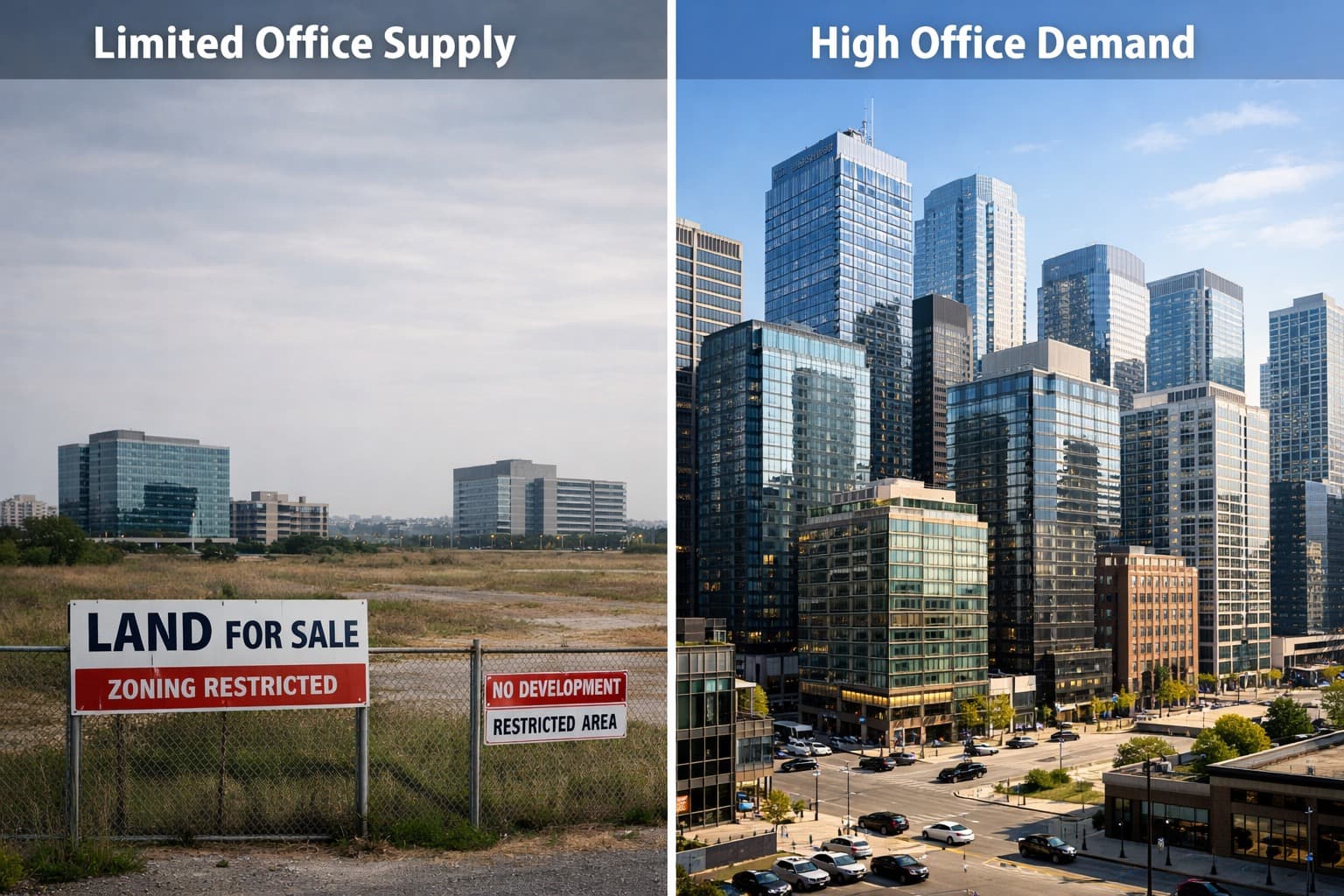
This creates an artificial ceiling on office space availability in cities where demand is growing fast but zoning maps have not kept pace. The result is a paradox that many Indian corporate occupiers know well: land exists in the right location, but it cannot be developed for office use because the land-use classification has not caught up with the city's own growth.
Bengaluru is a useful example. The city absorbed millions of square feet of new office demand in 2025, yet certain high-potential corridors remained underdeveloped because Master Plan designations had not been revised to permit commercial development at the scale the market needed. The bureaucratic lag between actual urban growth and regulatory recognition of that growth creates bottlenecks that push rents higher and force businesses into fewer, more congested micro-markets.

FSI: The Other Half of the Equation
Zoning tells you where you can build. FSI, or Floor Space Index, tells you how much you can build. In Indian commercial zoning, FSI is arguably the more powerful lever affecting actual office space supply.
FSI is the ratio of permissible built-up area to the size of the plot. A plot of 10,000 square feet with an FSI of 2 allows a maximum of 20,000 square feet of construction across all floors. Increase the FSI and you can build more without needing more land. Restrict it and supply stays tight regardless of how much vacant land exists in the vicinity.
In Mumbai, commercial zones like the Bandra Kurla Complex benefit from FSI allowances of up to 5, enabling the dense, high-rise office development that makes BKC function as a genuine business district. The suburban residential zones surrounding it, however, carry FSI limits of 1.33 to 2, which is why housing and low-rise development dominates those pockets rather than office towers. The FSI rules office space Mumbai BKC framework is essentially what made BKC possible and what keeps it distinct from the rest of the city.
Maharashtra has been progressively revising its Development Control and Promotion Regulations, known as DCPR 2034, to increase FSI in key commercial corridors and encourage vertical development. Delhi's Master Plan 2041 similarly proposes higher FSI in areas connected to metro stations under the Transit-Oriented Development framework. Bengaluru and Chennai are moving toward mixed-use zoning reforms that allow commercial and residential development to coexist on the same parcel, which directly increases the pool of viable office space without requiring entirely new commercial designations.
The Change of Land Use Problem
One of the most persistent challenges in Indian land use regulations is the Change of Land Use process, commonly referred to as CLU. When a business wants to operate out of a building that sits on residentially or industrially zoned land, it must apply to the relevant municipal or development authority for a formal conversion.
The process requires documentation, site inspections, compliance verification, and often a waiting period that can stretch from months to over a year. Many smaller businesses simply skip this step and operate informally, exposing themselves to legal risk. Penalties for violating zoning laws India include heavy fines, property sealing, and in serious cases, eviction orders.
This creates a visible gap in the market. Large corporations can absorb the time and legal cost of proper CLU approvals. Startups and growing businesses often cannot, which leaves them either paying premium rates for already-approved commercial stock or operating out of misclassified premises that carry ongoing regulatory risk.
Mixed-Use Zoning and What It Offers
The most practical reform that has quietly improved office space availability in several Indian cities is the expansion of mixed-use zoning. Under mixed use zoning India commercial frameworks, a single building or neighbourhood can legally accommodate office use, retail, and residential together. This is how cities like Pune's Koregaon Park or certain corridors in Hyderabad have been able to host thriving office clusters without requiring every building to sit on a plot formally designated as commercial.
Mixed-use zoning reduces the pressure on designated commercial zones by distributing office demand across a broader geographic area. It lowers entry barriers for smaller developers who might not have the capital to develop large standalone commercial campuses. And it gives businesses more location choices, which naturally brings rents down through competition.
Summary
Zoning laws India cities enforce are not abstract planning concepts. They directly determine how much office space availability exists, where new commercial zoning can unlock development, what FSI rules office space Mumbai BKC and other business districts permit developers to build, and how the change of land use approval process shapes the choices available to businesses of every size. For any company looking to lease or invest in office space, understanding the land use regulations India applicable to their target location is not optional. It is the foundation of a sound commercial property decision.