
How to Choose the Right Flat Size: A Practical Guide for Indian Homebuyers
Summary
This practical guide helps Indian homebuyers choose the ideal flat size by evaluating current and future household needs, aligning with budget, understanding location-vs-size trade-offs, and prioritizing layout efficiency. Make an informed decision for long-term comfort and avoid common pitfalls.

Introduction
Walk into any new project site across Mumbai, Bengaluru, Pune, or Hyderabad and you will find a range of flat configurations on offer. 1BHK starting at Rs 45 lakh, 2BHK at Rs 80 lakh, 3BHK at Rs 1.5 crore. The sales team will have opinions about which one you should pick. Your parents will have opinions. Your colleague who bought last year will have opinions. But the only opinion that actually matters is a clear-eyed look at your own household, your finances, and the next seven to ten years of your life. Choosing the right flat size is not complicated. It just requires asking the right questions.
Start With Who Actually Lives There
The most reliable starting point for choosing a flat size is your current household and its realistic near-term trajectory. A couple with no children has different space requirements from a family of four with school-going kids. A professional who works from home five days a week needs a dedicated room in a way that a daily office commuter simply does not.
A single working professional can live comfortably in a well-designed 1BHK flat of 450 to 550 square feet of carpet area. A couple in the first few years of marriage typically finds a 2BHK the right balance, giving them a bedroom, a separate room that works as a study or guest room, and enough common space to feel settled.
Once children arrive, the 2BHK begins to strain. A family of four, especially with children above the age of six or seven who need their own study space, genuinely needs a 3BHK flat to live without constant compromise.
Think Five Years Ahead, Not Just Today
This is the mistake first-time buyers make most often. They buy for the household as it exists on the day of purchase rather than what it will look like at possession or five years after moving in. A couple buying a 1BHK today planning to start a family within three years is buying a flat they will outgrow before the loan is half paid off.
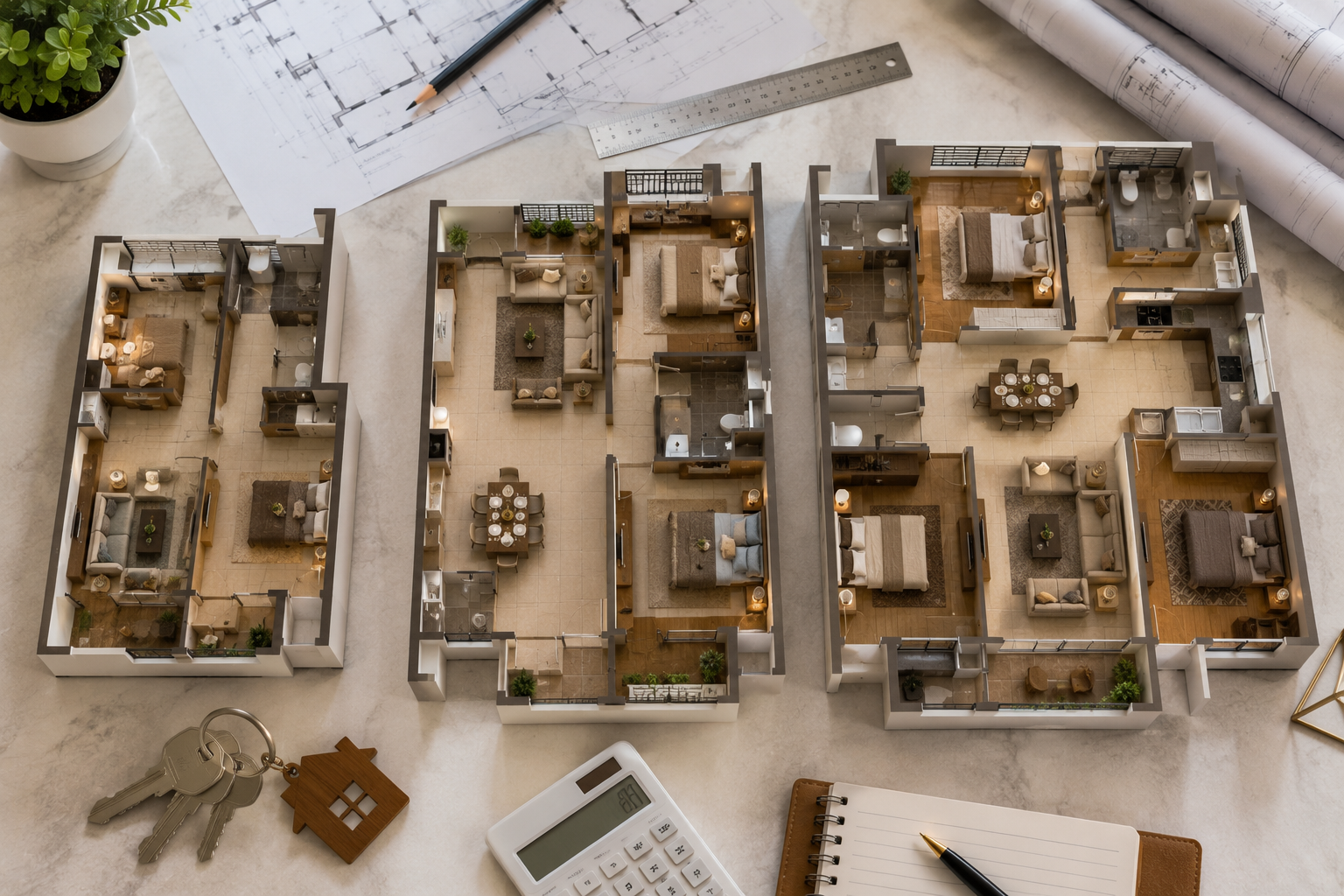
If children are part of your plan, add one bedroom to whatever configuration feels right for your current household. The extra EMI over a lifetime of the loan is far less disruptive than moving in five years, paying stamp duty and registration again, losing the tax benefits of a continuous ownership, and dealing with the physical and emotional toll of relocating.
Match Size to Budget Honestly
There is a version of this conversation where buyers stretch to the largest flat they can possibly afford and spend the next decade feeling financial pressure. That is not a good quality of life. A flat size decision must live comfortably within a budget that leaves room for furnishing, maintenance, children's education, and a reasonable emergency fund.
A practical guideline used by financial advisers is that your total home loan EMI should not exceed 35 to 40 percent of your monthly take-home income. Work backwards from that number to a loan amount, and from there to a property budget. Once you have that range, the flat size in India that fits within it is your realistic starting point.
Do not ignore ongoing costs. A larger flat means higher maintenance charges, higher property tax assessments, larger utility bills, and more furniture spend. A 3BHK that you buy at the edge of your budget and then cannot afford to furnish or cool properly is not a comfortable home.
Location versus Size: The Trade-Off That Matters
In most Indian cities, the choice between a better location with a smaller flat and a larger flat at a greater distance from your workplace is one of the most consequential decisions a buyer faces. There is no universal right answer, but there is a useful way to frame the choice.
Calculate what the distance actually costs you in time. If you are losing two hours of your day to commute because you bought a larger flat fifteen kilometres further from your office, that is roughly 500 hours a year, the equivalent of more than sixty full working days. That is a significant quality-of-life cost that a bigger bedroom does not offset.
Layout Efficiency Matters as Much as Area
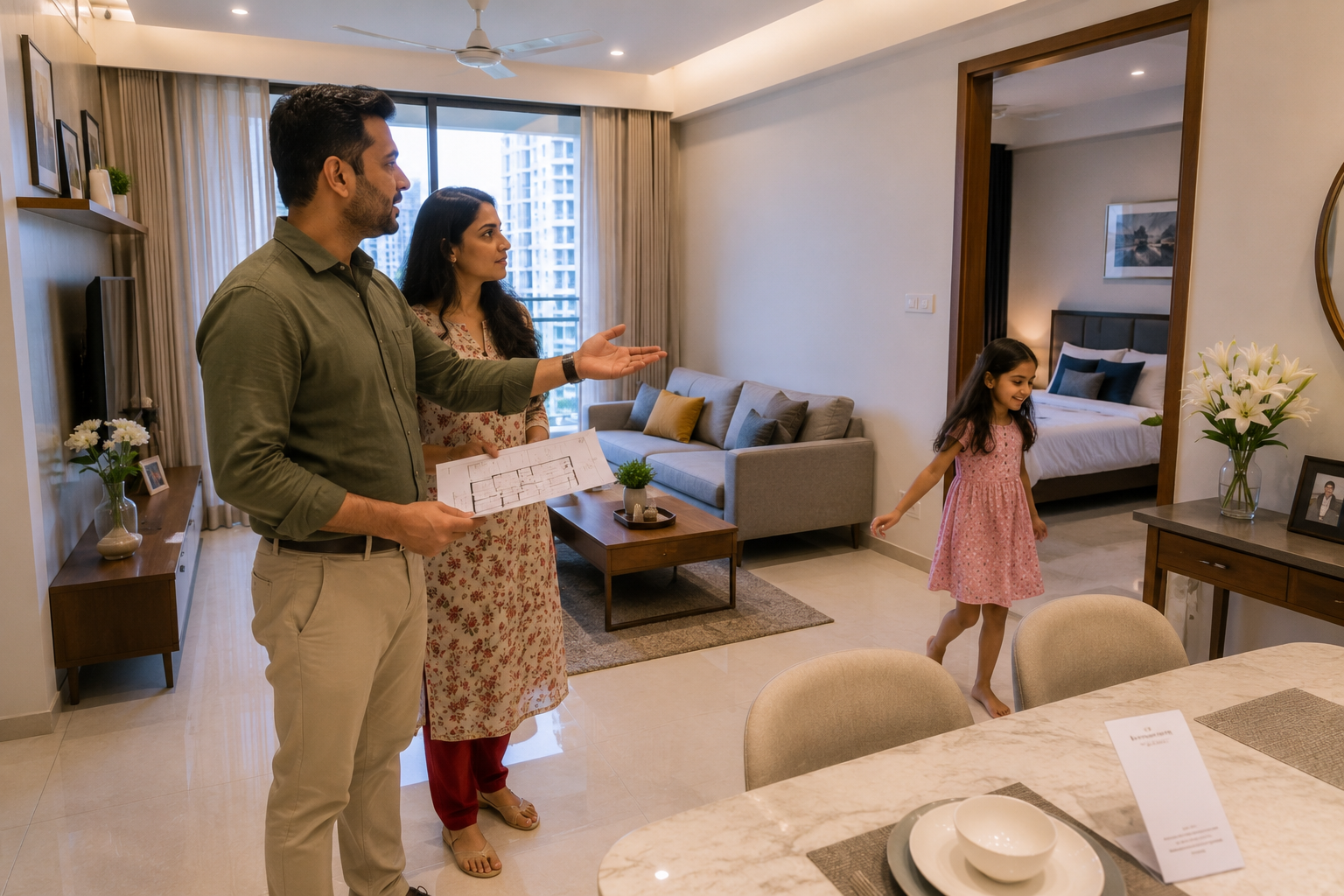
Two 2BHK flats with identical carpet areas can feel completely different depending on their layouts. A flat with square-shaped rooms, minimal passage waste, natural light reaching every room, and cross ventilation will feel generous at 700 square feet. A flat with long corridors, awkward angles, and a kitchen that opens onto a dark internal shaft will feel cramped at 850 square feet.
When evaluating any flat, walk through it with your actual furniture dimensions in mind. Will your double bed fit in the master bedroom with space to walk around? Can you fit a dining table comfortably in the dining area? Are the balconies usable or purely ornamental? Layout efficiency answers these questions more reliably than raw area figures.
Summary
Choosing the right flat size in India comes down to four variables: your current household composition and its five-year trajectory, your honest EMI-to-income budget, the location versus size trade-off in your target city, and the layout efficiency of the specific flat you are evaluating. A 1BHK suits single buyers and couples at the start. A 2BHK works for couples with short-term family plans or a work-from-home requirement. A 3BHK flat becomes necessary for families of four or households needing multiple functional rooms. Buy for the life you will be living in three years, not the one you are living today.