
How to Check the Carpet Area in a Sample Flat Before You Sign Anything
Summary
Don't be fooled by sample flats! Learn how to accurately check the carpet area using RERA guidelines, measuring techniques, and document verification to avoid costly misunderstandings when buying property.

Introduction
The sample flat is designed to impress you. Clever lighting, premium finishes, carefully chosen furniture scaled slightly smaller than real life, and a salesperson standing by to answer every question except the one that actually matters most. What is the real carpet area of the apartment you are about to spend one to three crore rupees on? Most buyers walk through a sample flat looking at the kitchen finish and the view. Almost none of them walk through with a measuring tape and a clear understanding of what RERA carpet area means versus the super built-up area number the developer has been quoting all along. That gap between what you think you are buying and what you are actually getting is where some of the most expensive misunderstandings in Indian real estate live.
What RERA Says About Carpet Area
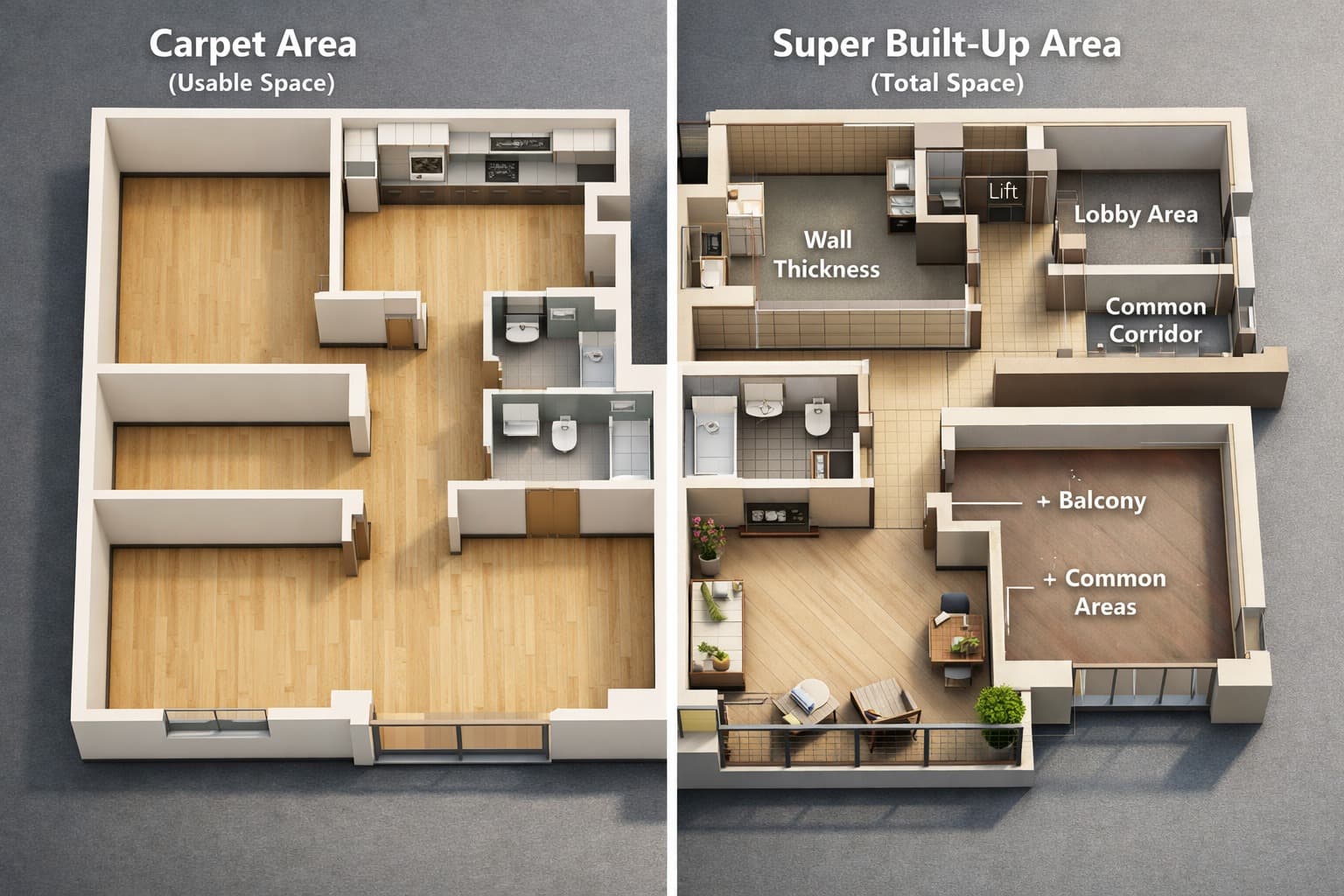
The Real Estate Regulatory Authority definition of carpet area is precise and legally binding for all registered projects. It is the net usable floor area inside the apartment walls, including the area covered by internal partition walls but excluding external walls, balconies, terraces, exclusive open terraces, and common areas. This definition was introduced specifically to end the practice of developers quoting super built-up area figures that included proportionate shares of lobbies, staircases, lift shafts, and other common spaces as part of what the buyer was supposedly purchasing.
Under RERA, every developer must disclose the carpet area calculation India for each unit in the registered project documentation. If the number on the brochure is a super built-up area figure, ask for the RERA carpet area specifically and get it in writing.
Why the Sample Flat Can Be Misleading
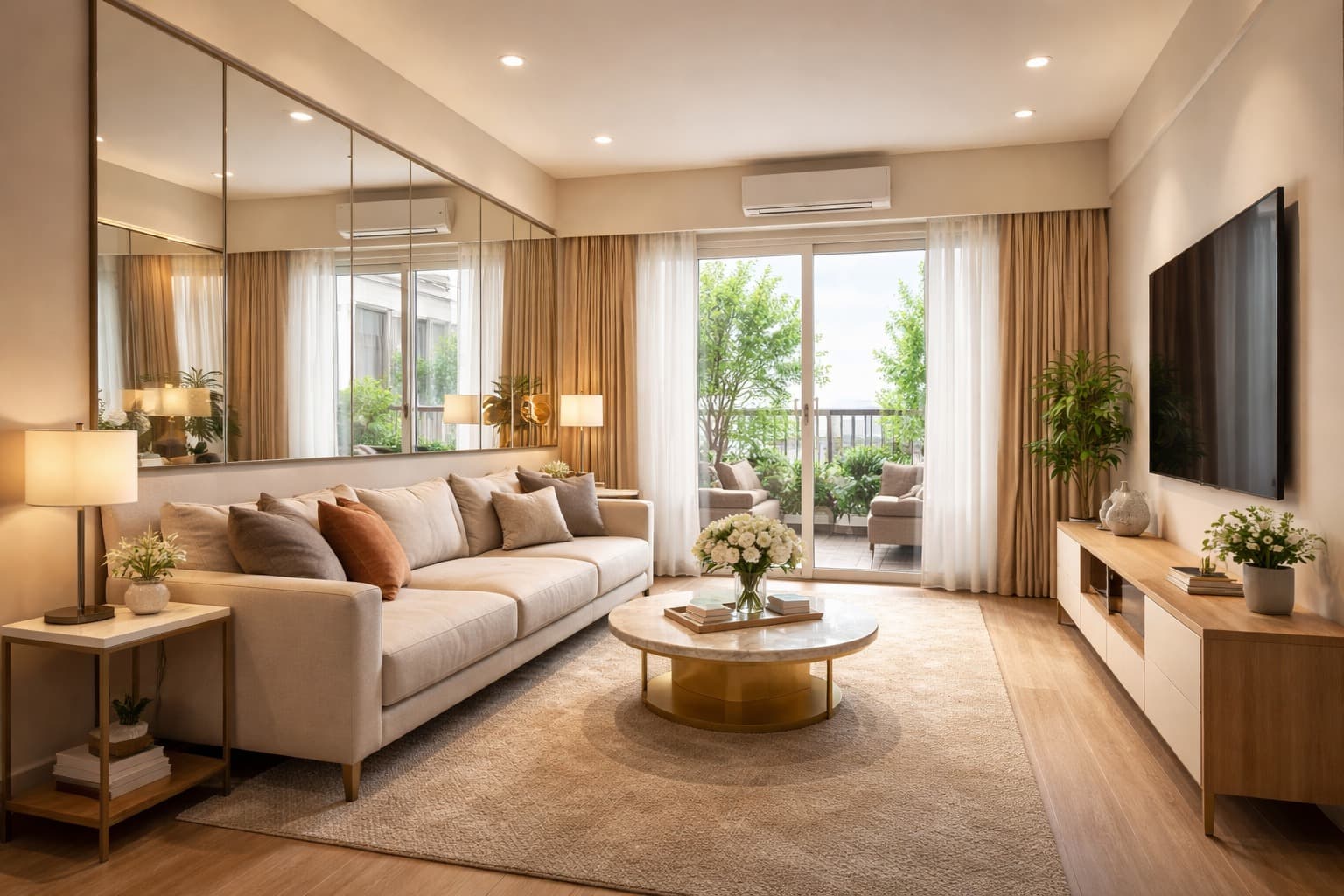
Developers use furniture and design tricks in sample flats that make spaces look larger than they are. A 3-seater sofa scaled to 85% of normal dimensions, a dining table built for four placed in a room that cannot comfortably fit one for six, and mirrors on walls that create an illusion of depth are all standard sample flat techniques. None of these are illegal. But they do make it very easy to overestimate how much space you are actually getting.
The sample flat also rarely shows the actual unit you are buying. It shows a representative or aspirational version. The floor, orientation, and exact dimensions of your specific unit may differ from what you walked through.
How to Measure Carpet Area Yourself in the Sample Flat
Carry a laser distance measuring device or a standard measuring tape when you visit. Check carpet area apartment by measuring each room from internal wall to internal wall, not from the centre of the wall. Measure the length and width of every room including the kitchen, bathrooms, and any storage areas. Multiply length by width for each space and add all the figures together.
Do not include the thickness of internal walls in your measurement of usable floor space, but do be aware that RERA's definition does include the area under internal partition walls themselves. For practical purposes, measuring wall to wall inside each room gives you a close approximation of the usable space.
The Carpet Area vs Super Built-Up Area Gap
The loading factor, which is the percentage by which super built-up area exceeds carpet area, varies significantly across projects and cities. In Mumbai, loading factors of 25% to 35% are common, meaning a flat sold as 1,000 square feet of super built-up area may have a carpet area of only 650 to 750 square feet. In Pune and Bengaluru the loading tends to be slightly lower but still significant.
Always convert the price per square foot to a price per square foot of carpet area before comparing two projects. A project priced at Rs 12,000 per super built-up square foot with 30% loading is actually costing you Rs 17,000 per carpet area square foot. Another project priced at Rs 14,000 per super built-up square foot with 20% loading costs you Rs 17,500 per carpet area square foot. The comparison looks completely different once you apply the correct denominator.
Cross-Check With RERA Registration Documents
Every RERA-registered project in India has publicly accessible registration documents on the respective state RERA portal. These documents contain the declared carpet area for each unit type in the project. Before visiting the sample flat, download the RERA registration document and note the carpet area for the configuration you are considering.
When you visit and measure, compare your measurement with the declared RERA figure. A significant discrepancy between the two is a red flag that warrants clarification before any booking amount changes hands.
What to Do if the Numbers Do Not Match
If your on-site measurement produces a number meaningfully different from the RERA-declared carpet area flat India, raise it with the sales team in writing, not verbally. Request the floor plan drawing with dimensions and cross-check it against your measurement. Discrepancies of 2% to 3% are normal given measurement methodology differences. Discrepancies above 5% require a formal explanation.
Summary
Checking carpet area in a sample flat is one of the most practical and most overlooked steps in the Indian home buying process. Carry a measuring device, understand the RERA carpet area definition, cross-check the developer's declared figure on the state RERA portal, and always compare project pricing on a carpet area basis rather than super built-up area. The sample flat is a sales tool. Your measuring tape is the only honest instrument in the room.