
How to Check Railing Height for Child Safety: A Guide for Parents and Home Buyers
Summary
Ensure child safety by checking balcony railing height (min 1 meter) and spacing (max 100mm) against NBC standards. Prioritize vertical bar or glass railings to avoid climbing risks, and demand laminated safety glass.

Introduction
Parents who move into a new apartment with young children do a thorough check of the kitchen cabinet locks, the electrical socket covers, and the general layout. Very few of them get out a measuring tape and check the one feature that carries the most serious fall risk in any residential building: the balcony and staircase railing height. A railing that is two inches too short or has gaps wide enough for a small child to squeeze through is not a cosmetic issue. It is a structural safety failure that the developer installed, the inspection authority may have missed, and the buyer is now living with. Understanding what the correct numbers are and how to check them takes fifteen minutes. The consequences of not knowing can be permanent.
What the National Building Code Says
India's National Building Code, the NBC, is the primary technical standard governing construction safety in residential buildings. The NBC specifies a minimum railing height of 1,000 millimetres, which is one metre or approximately 3.3 feet, for balconies, terraces, and external corridors in residential buildings. For staircases inside the building, the minimum handrail height is 900 millimetres measured vertically from the stair nosing to the top of the rail.
These are minimum standards. They represent the floor below which no building should be constructed, not a recommended comfortable height. Many architects and developers exceed these minimums in projects targeting families, and that additional height genuinely matters for child safety in ways that the minimum alone does not fully address.
How to Measure Railing Height Correctly
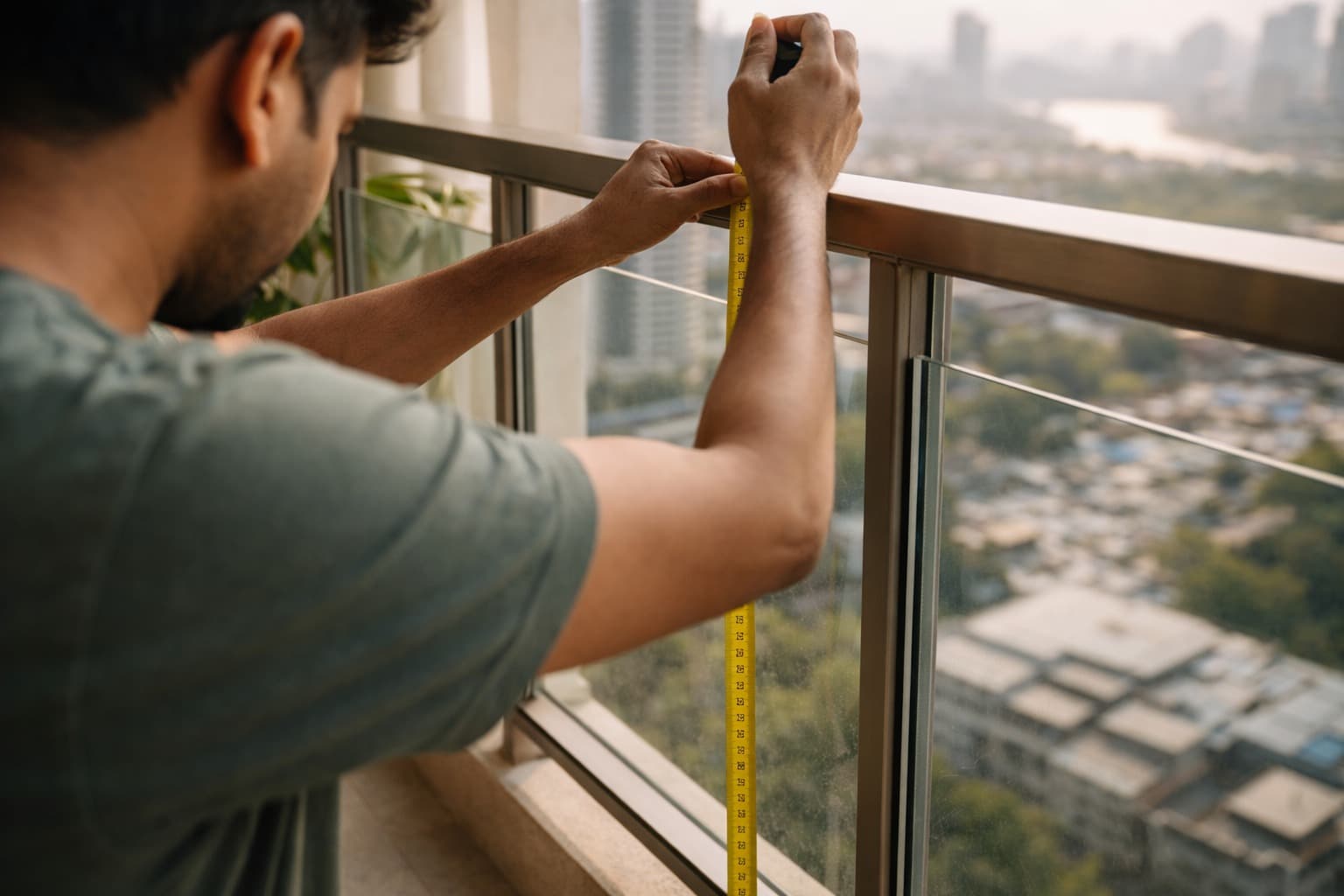
Measuring railing height sounds simple but the reference point matters. Height is always measured vertically from the finished floor level to the top of the railing cap or the highest continuous horizontal element. It is not measured along the slope of a staircase or from the base of a railing post.
Stand with your back to the railing, place a tape measure flat on the floor directly beneath the railing's top edge, and extend it vertically upward. One metre at this point means the railing meets the NBC minimum. Anything below 900 millimetres on a residential balcony is a clear non-compliance with national standards regardless of what the developer's completion certificate says. Bring a two-metre measuring tape when visiting any apartment if you have or plan to have children.
The Spacing Between Vertical Bars: Often More Dangerous Than Height
Railing height gets all the attention but the gap between vertical bars is where child safety failures are actually most common. A child who cannot climb over a railing at one metre height can still squeeze through widely spaced vertical bars or get their head trapped between them. The NBC and international child safety research both point to a maximum gap of 100 millimetres, which is ten centimetres, between any two vertical elements of a balcony railing.
The simple field test for this is a 100 millimetre diameter ball or cylinder. If it passes through any gap in the railing, that gap is wide enough to create a head entrapment risk for a young child. Run this check across the full length of the balcony railing, not just the sections nearest the door, because gaps in decorative metalwork at the ends or corners of a balcony railing are often wider than the central section.
Horizontal Rails: The Climbing Problem
Railing designs with multiple horizontal elements running parallel to the floor are visually common in Indian apartments, particularly in projects from the 1990s and early 2000s. These designs create a ladder effect. A three or four year old child can climb a railing with horizontal bars more easily than scaling a flat wall, and the point at which they become unbalanced is exactly the height at which a fall becomes life-threatening.
Child safe railing apartment design avoids horizontal intermediate rails entirely or places them at spacing and angles that do not provide a foothold. Vertical bar railings, frameless glass panels, and cable railings that run under adequate tension are all safer options for families with young children. If your apartment has horizontal intermediate rails, a temporary safety net or mesh covering is the most practical retrofit solution while longer-term modifications are planned.
Glass Railings: Strength and Fixings Matter
Glass panel railings are increasingly common in premium Indian apartments and they can be excellent for child safety when correctly specified and installed. The glass must be laminated safety glass, not standard float glass or even tempered glass alone. Laminated glass holds together when broken rather than shattering into dangerous fragments.
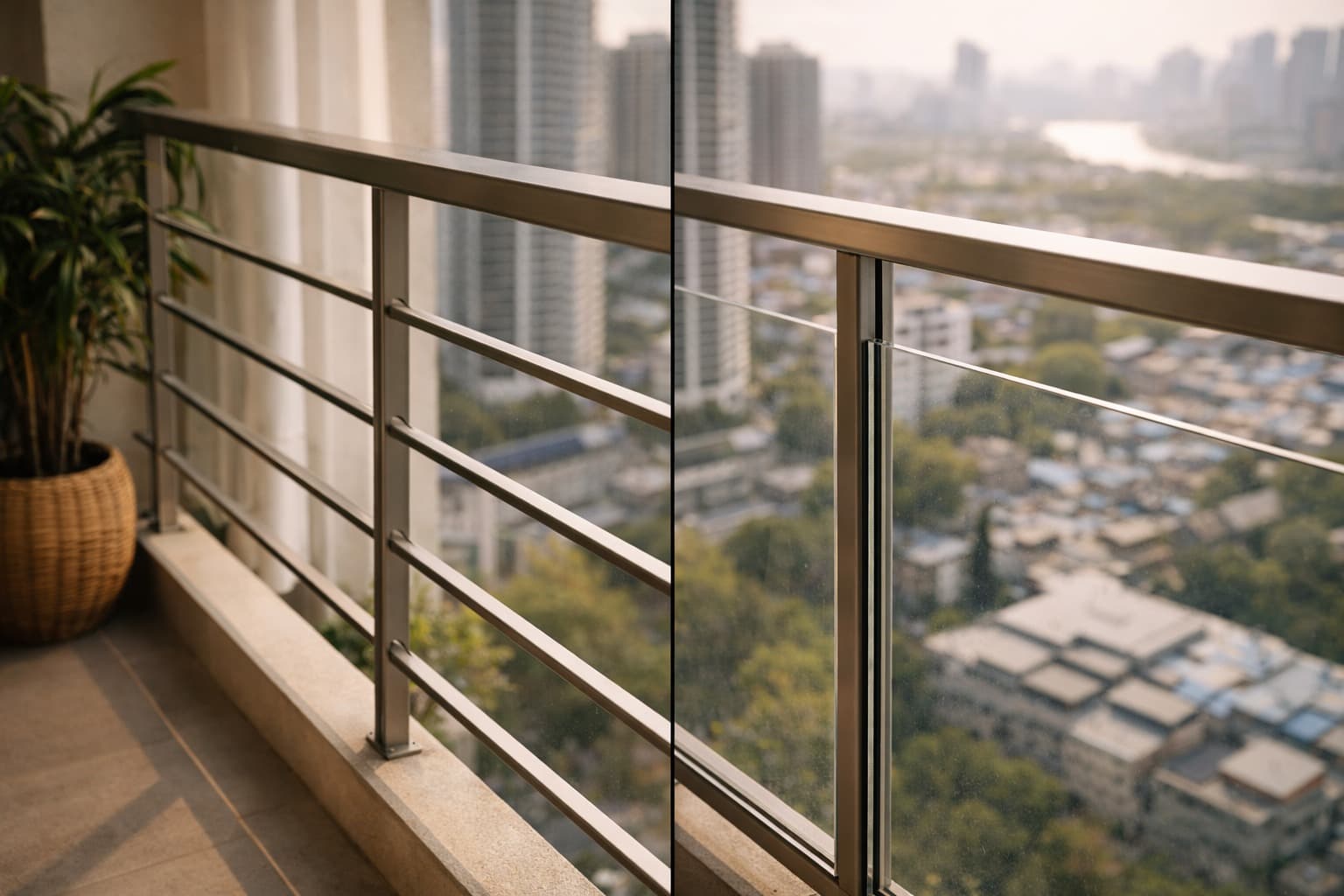
The fixing system at the base of a glass railing panel carries the entire load during an impact. Bottom channel fixed systems that grip the glass from below are generally stronger than point-fixed systems where bolts pass through the glass at individual points. Ask the developer for the glass specification and fixing detail before accepting that a glass railing is structurally adequate.
What to Do if Your Railing Fails the Check
A railing that does not meet the one metre height standard or has gaps exceeding 100 millimetres is not something to accept as a permanent condition. In a new building, raise the non-compliance in writing with the developer before possession acceptance. Document it with photographs and measurements. Developers are legally responsible for delivering buildings that comply with NBC standards.
In an existing apartment, a structural fabricator can weld additional height extensions onto metal railings and fill gaps with vertical bars. These modifications should be inspected by a qualified structural engineer before children are allowed to use the balcony unsupervised.
Summary
Railing height child safety in Indian apartments requires verification against the NBC minimum of one metre for balconies and 900 millimetres for staircases. Gap spacing between vertical elements must stay within 100 millimetres to prevent head entrapment. Horizontal intermediate rails create climbing risks that vertical bar and glass panel designs avoid. Glass railings require laminated safety glass with robust bottom-channel fixings. Every parent buying or renting an apartment should measure railings and check gap spacing before moving in with young children. It takes minutes and the information it provides is non-negotiable.