
How Much Carpet Area Does Your Family Actually Need? A Practical Guide for Indian Homebuyers
Summary
Determine the ideal carpet area for your Indian family with this practical guide. Learn benchmarks, government standards, and how lifestyle affects your space needs to make an informed home buying decision.

Introduction
Every homebuyer eventually runs into the same nagging question. Is this flat big enough for us? The builder quotes a super built-up area, the bank sanctions a loan based on that number, but the actual space where your family will cook, sleep, study, and argue is something else entirely. That usable space has a name: carpet area. And understanding how much carpet area is required per person in an Indian home is one of the most practical things you can do before you sign a property agreement.
The answer is not one-size-fits-all. It depends on your family's lifestyle, the city you are in, and frankly, what you can afford. But there are reasonable benchmarks, and this guide walks you through all of them.
What Carpet Area Actually Means
Before talking about how much you need, it helps to be clear about what carpet area India regulations actually count. Under the RERA Act, carpet area is the net usable floor space enclosed within the inner walls of your apartment. It excludes balconies, terraces, the thickness of outer walls, and all common areas like lobbies and staircases. When a builder says 1,200 sq ft, they almost always mean super built-up area. The carpet area of that same flat is typically somewhere between 65 and 75 percent of that figure.
So if someone tells you they have a 1,200 sq ft flat, you are probably looking at roughly 780 to 900 sq ft of space you can actually use. Keep that gap in mind every time you evaluate a property.
The National Building Code Baseline
India's National Building Code, commonly referred to as the NBC, sets the legal floor for how small a habitable room can be. Where a home has two or more rooms, the larger one must have a minimum area of 9.5 square metres. The secondary room can be as small as 7.5 square metres. These are not comfortable living standards. They are the legal minimums below which a builder cannot go.
In practical terms, 9.5 square metres is roughly 102 square feet. That is a small bedroom. The NBC baseline tells you what the law permits, but not what a family can live comfortably in. Those are two very different things.
The Government's Own Benchmarks by Income Group
The Pradhan Mantri Awas Yojana framework offers a useful income-linked reference for carpet area required for a family of 4 in India. Families with an annual household income below Rs 3 lakh are eligible for units with a carpet area between 30 and 45 square metres. That translates to roughly 322 to 484 square feet. Families earning between Rs 3 and 6 lakh are catered to with units up to 60 square metres, or about 645 square feet.
Move up to the Middle Income Group I bracket, covering households earning Rs 6 to 12 lakh annually, and the eligible carpet area extends to 160 square metres. For MIG-II households earning up to Rs 18 lakh, the ceiling goes up to 200 square metres. These numbers tell you something important: even the government recognises that comfortable living space scales with family size and income.
A Practical Rule of Thumb Per Person
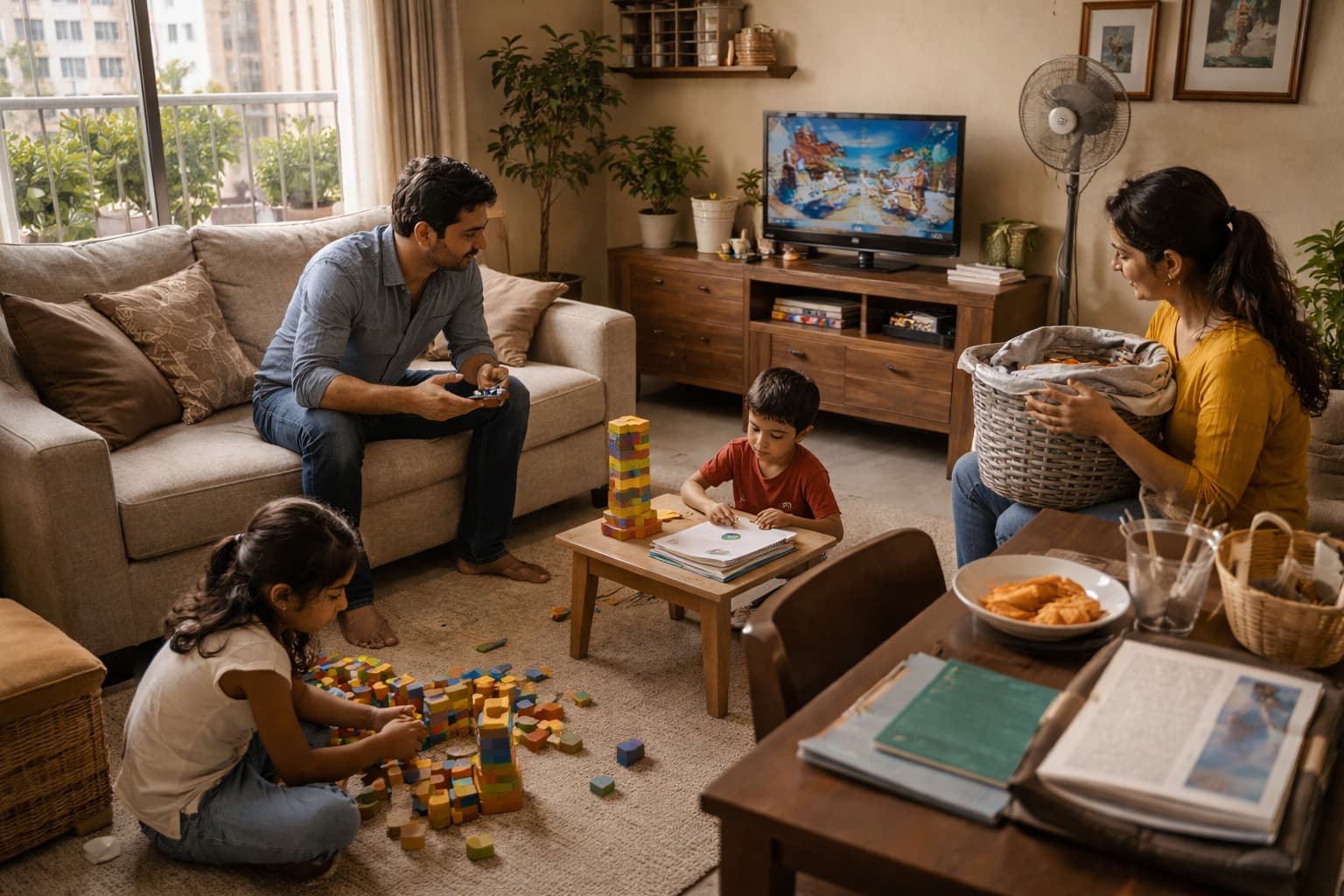
Real estate practitioners in India commonly use a working benchmark of around 100 to 150 square feet of carpet area per person as a comfortable minimum. For a family of four, this translates to a range of roughly 400 to 600 square feet of pure usable space. A well-designed 2BHK flat with a carpet area of around 650 to 700 square feet can comfortably house a family of four. That is a reasonable starting point for how to calculate carpet area needed for a family in India.
But context matters. A family with two young children has different needs from a household with two working adults and a senior parent. Do you need a study room? Does anyone work from home? These functional requirements push the number upward.
Mapping Family Size to Flat Configuration
If you are a couple just starting out, a 1BHK with a carpet area of 380 to 450 square feet is workable, though not spacious. Add one child, and a 2BHK with 550 to 650 square feet becomes necessary for comfortable daily life. A family of four or five, particularly one with older children who need their own study space, really should be targeting a 3BHK with at least 850 to 950 square feet of carpet area for a family of four or more.
And if you have a senior parent living with you, that changes the floor plan requirements too. An older person needs easy bathroom access, ideally a room closer to common areas, and certainly enough space to move around without feeling crowded.
Why City and Lifestyle Change the Equation
The ideal carpet area for a family of four in Mumbai is not the same as in Indore or Coimbatore. In Mumbai, where per-square-foot costs in established localities can run anywhere from Rs 15,000 to Rs 35,000, a family of four might live in a 650 sq ft carpet area flat quite contentedly because they spend more of their life outside the home. In a tier-two city where the home is also a social space, the same family might expect 900 sq ft.
Lifestyle choices determine space requirements as much as headcount does. A family that entertains regularly at home, keeps books and equipment, or runs a home business needs more room than one that eats out often and travels frequently.
What Overcrowding Actually Costs You
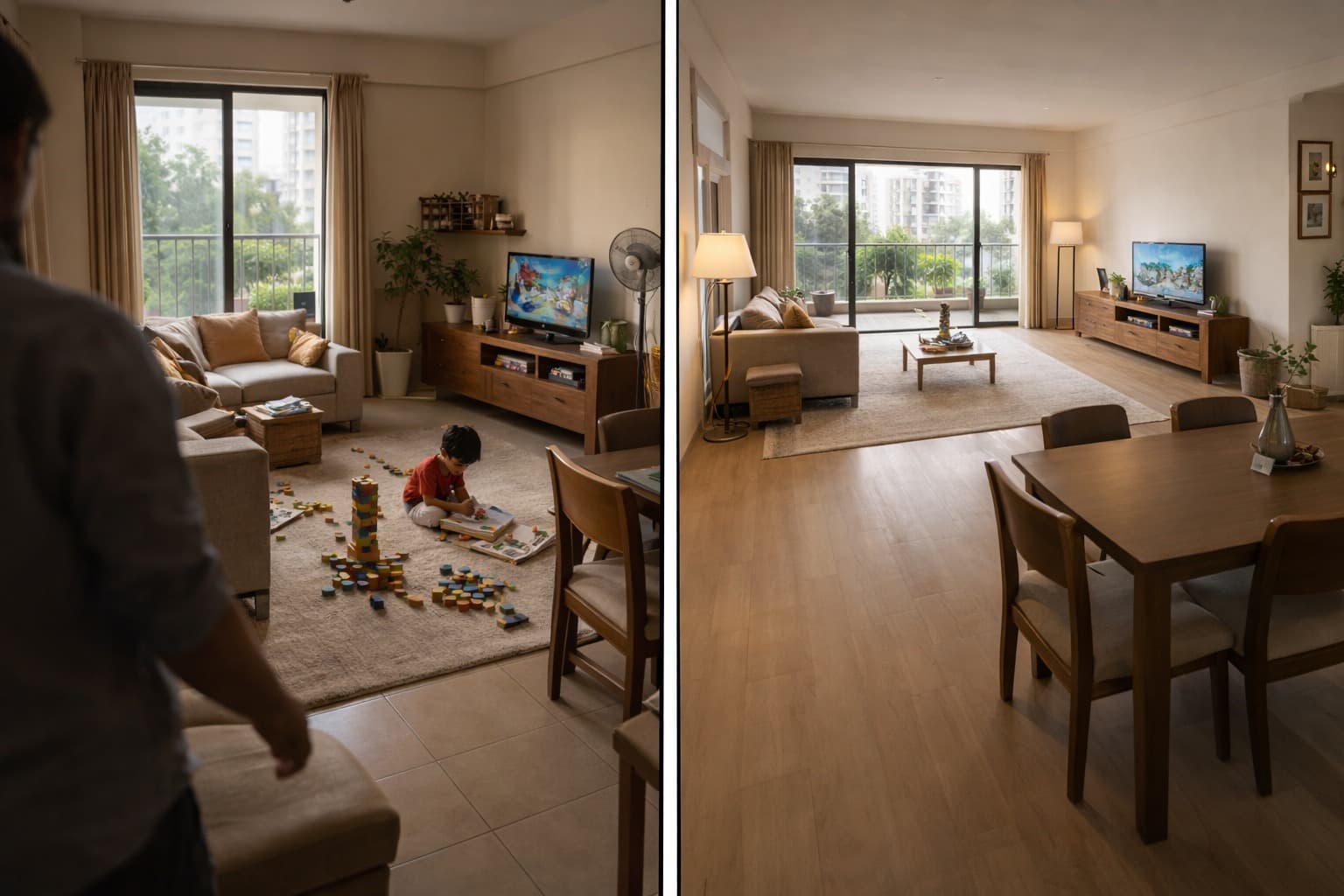
There is a reason urban planners and health researchers take overcrowding seriously. Families living in genuinely cramped spaces face a higher incidence of stress, interrupted sleep, and friction in daily routines. Children studying in the same room where the television runs, or where younger siblings play, lose concentration and productive time. These are real costs, even if they do not show up on a balance sheet.
The right carpet area per person is not a luxury calculation. It is a quality-of-life decision that affects your family every single day.
The Smart Way to Verify Before You Buy
When evaluating any flat, ask the builder for the RERA carpet area specifically. Many builders advertise super built-up area because the number sounds more impressive. Once you have the actual carpet area, divide it by the number of family members you expect to live there. If the number falls below 100 square feet per person, think carefully about whether that works for your household.
Also walk through the flat at different times of day. Open the doors between rooms. Check whether the natural light reaches every habitable room. A technically compliant flat that feels dark and cramped is not the bargain it seems.
Summary
Understanding carpet area required per family member India is the foundation of any sensible home purchase decision. The NBC sets the legal minimum at 9.5 square metres per primary habitable room, while PMAY benchmarks link minimum carpet area per person flat eligibility to household income. Practically, 100 to 150 square feet per person is a workable comfort standard. For a carpet area required for a family of 4 in India, targeting a well-designed 2BHK or 3BHK with at least 600 to 900 square feet of actual usable space ensures daily comfort, functional space for children, and the room your family deserves.