
Hidden Storage Solutions for Your Living Room
Summary
Maximize living room space with hidden storage! Discover clever solutions like under-sofa drawers, ottoman storage, and built-in TV units to declutter without sacrificing style in Indian homes.

Introduction
The living room carries more daily burden than any other space in an Indian home. It is the family gathering zone, the guest reception area, the children's play spillover, and frequently the homework station and work-from-home overflow. And yet most living rooms are designed purely for appearance, with nowhere near enough storage to handle the actual volume of things that accumulate in them daily. Hidden storage living room design solves this without sacrificing how the room looks. Done well, you cannot tell the storage is there until you need it.
Under-Sofa Storage: The Most Underused Rectangle in Your Home
The average 3-seater sofa sits on a frame that wastes anywhere between 15 and 25 cubic feet of completely accessible floor space. Under sofa storage drawers or pull-out trays convert this dead zone into organised space for extra linen, seasonal items, board games, or the assorted objects that otherwise collect on every visible surface. Custom sofa frames with integrated drawer mechanisms are now available from most Indian furniture manufacturers at reasonable incremental cost over standard frames.
Hydraulic lift sofas, where the entire seat base rises to reveal a deep cavity underneath, are particularly effective in compact apartments where a separate storage room is not an option. A single hydraulic sofa can hold the equivalent of a large suitcase worth of contents without occupying any additional floor space.
Ottoman Storage: Multifunctional and Invisible
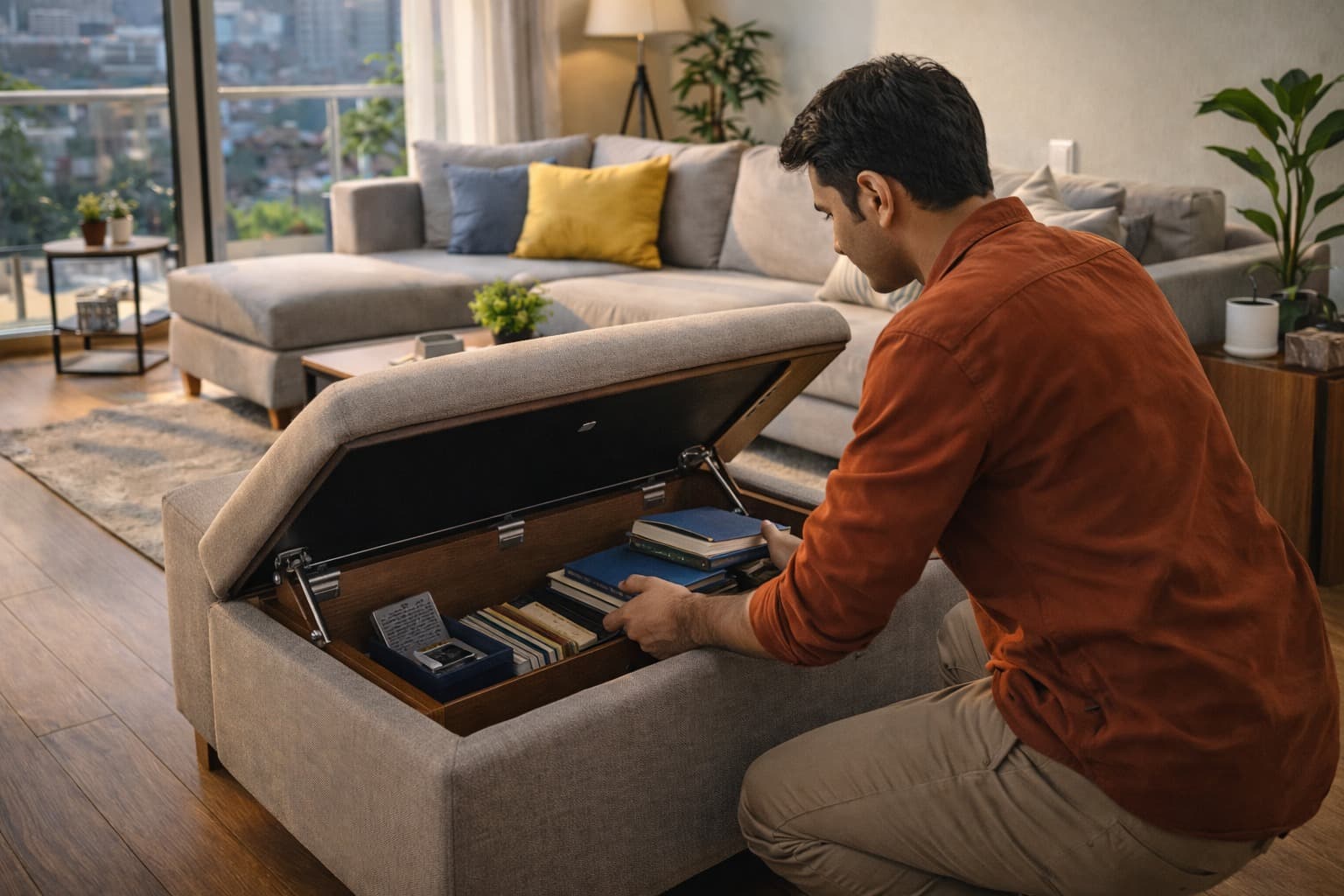
A storage ottoman is one of the simplest and most effective smart storage solutions for any living room. It serves as a footrest, an additional seat when guests arrive, a coffee table surface with a tray on top, and a storage cavity for remotes, magazines, chargers, and children's toys. The lid closes and none of it is visible.
Large cube ottomans in fabric or faux leather blend seamlessly into most living room aesthetics. Placed at the centre of a seating arrangement, they work harder than any dedicated storage furniture piece precisely because they do not look like storage at all.
TV Unit Design With Built-In Cavities
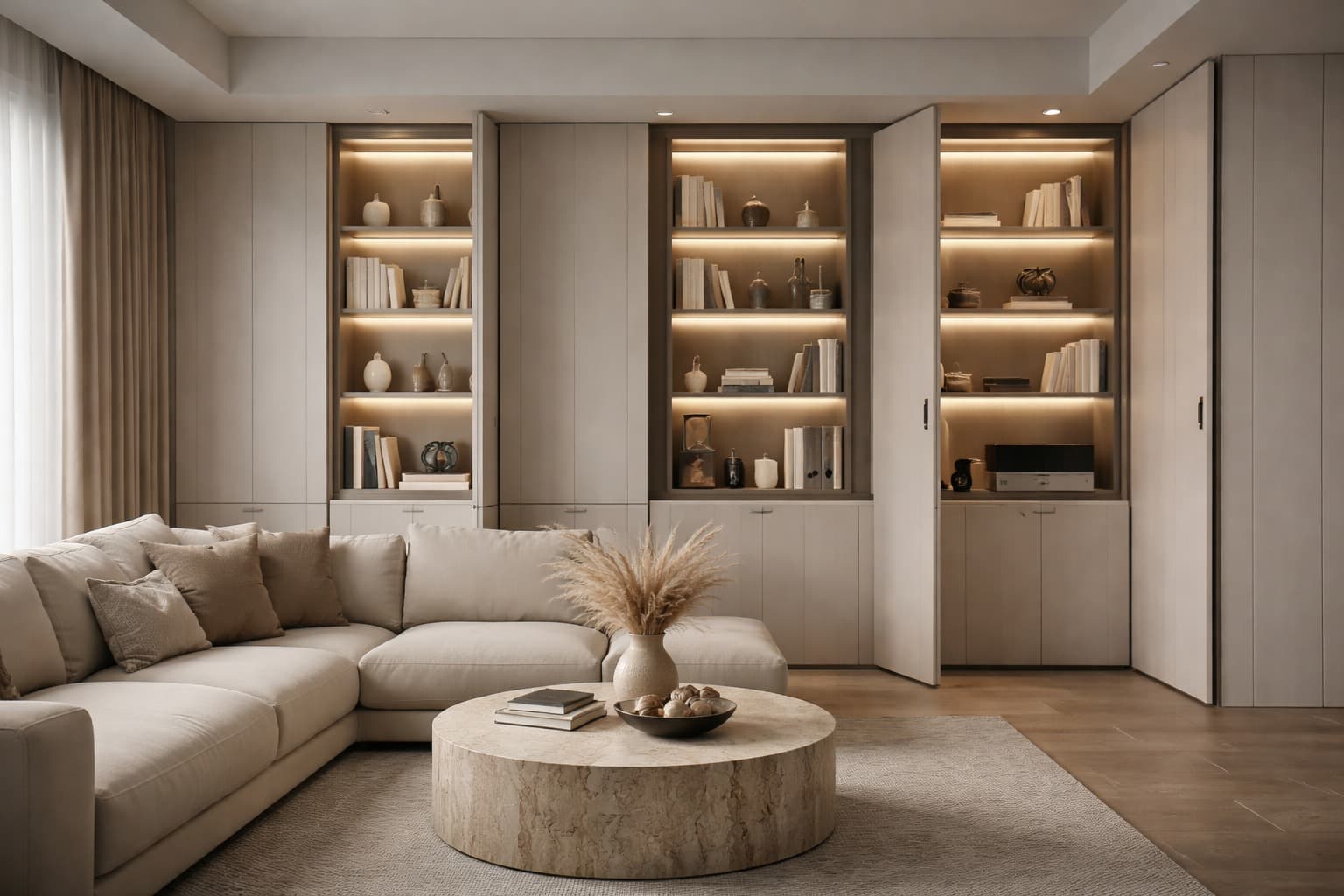
The television wall is the focal point of most Indian living rooms and also its most significant storage opportunity. A well-designed built-in storage living room TV unit extends from floor to ceiling with a combination of open display shelves, closed cabinet sections with push-to-open mechanisms, and concealed wire management channels. The closed sections handle everything from router equipment and set-top boxes to stationery, documents, and seasonal decorative items.
Push-to-open or magnetic touch latches eliminate the need for handles, keeping the surface visually clean and allowing the cabinets to disappear into the design. When the entire wall from corner to corner is treated as a built-in unit rather than a standalone piece of furniture, the storage capacity increases dramatically while the room actually feels less cluttered.
Window Seat With Storage Below
If your living room has a window bay or a low-sill window wall, a built-in window seat with a hinged or drawer base beneath it converts what is typically wasted corner or perimeter space into both a seating feature and a substantial storage zone. Space saving living room window seats are particularly effective in Mumbai and Bengaluru apartments where balconies are small and alternative seating space is limited.
Cushion the top for comfort, add a bolster pillow, and the window seat reads as a designed lifestyle element. The storage underneath handles bulky items like spare pillows, extra bedding, festival decoration boxes, and anything else that needs a home but does not need to be accessed daily.
Floating Shelves With Hidden Depth
Standard floating shelves display objects. Deep floating shelves with a front-facing profile do the same while storing items behind the displayed row. Installing floating shelves with a depth of 12 to 14 inches instead of the standard 8 to 10 inches creates a natural front-and-back organisation zone. Books or decorative objects face outward while stationery, files, or functional items sit behind.
Living room organisation using this method keeps shelves looking intentionally styled while doubling their actual utility. Pair them with small baskets or fabric bins tucked in the rear section and the back row becomes completely invisible from normal standing height.
False Ceiling Niches and Recessed Wall Panels
Recessed wall niches, essentially shallow cavities cut into non-load-bearing walls and finished with plaster or cladding, create display and storage pockets that occupy zero floor space. A niche flanking a TV unit or running along an accent wall can hold books, art objects, speaker equipment, or small plants without adding any visual bulk to the room.
Multifunctional furniture living room design in 2026 increasingly incorporates these architectural storage solutions at the construction or renovation stage, where the cost of adding them is lowest and the integration looks most intentional.
Summary
Hidden storage solutions in a living room work best when they are designed into the furniture and architecture rather than added as an afterthought. Under-sofa drawers, hydraulic bases, storage ottomans, floor-to-ceiling built-in TV units, window seats, deep floating shelves, and recessed wall niches all increase storage capacity without adding visual clutter. In compact Indian apartments where every square foot is doing double duty, the difference between a living room that feels organised and one that feels chaotic is almost always a question of how much invisible storage the design has quietly built in.