
Flood-Ready Housing Features Every Indian Homebuyer Should Look For
Summary
With increasing monsoon floods in Indian cities, homebuyers need to prioritize flood-ready features. This guide outlines essential housing specifications—from plinth height and ground-floor infrastructure to drainage design and advanced waterproofing—to ensure a safe and dry home, urging buyers to ask specific questions.

Introduction
Every monsoon, the same footage appears. Parked cars floating past ground-floor windows. Apartment lobbies turned into wading pools. Residents carrying belongings above their heads on staircases. For homebuyers in Mumbai, Chennai, Hyderabad, Bengaluru and every other city that floods with increasing frequency and intensity, flood ready housing is no longer a niche consideration. It is a practical checklist that belongs in every site visit, every conversation with a builder, and every reading of a project's technical specifications.
Start With the Ground Floor Question
The most vulnerable part of any residential building during a flood is everything at or near ground level. Before buying in any project, ask specifically what sits on the ground floor and what sits above it. Parking should be at or above road level, or better, on a raised plinth. Electrical infrastructure including transformers, distribution boxes and meter rooms should never be in a basement or ground-floor location vulnerable to water ingress.
Projects that place parking in a basement without a flood barrier at the ramp entry are a risk that becomes apparent only when a drainage system backs up during a heavy downpour.
Plinth Height Matters More Than It Sounds
The plinth is the raised platform on which a building sits above the surrounding ground. RERA and local building codes mandate minimum plinth heights, but the minimum is rarely enough for cities that see sustained rainfall over multi-day periods.
Look for projects where the plinth is at least 600 millimetres above the surrounding road or natural ground level. Some developers in flood-prone zones build plinths of 900 to 1,200 millimetres. That additional height is not an architectural choice. It is the difference between a dry lobby and a flooded one after three days of heavy rain.
Check the Drainage Design
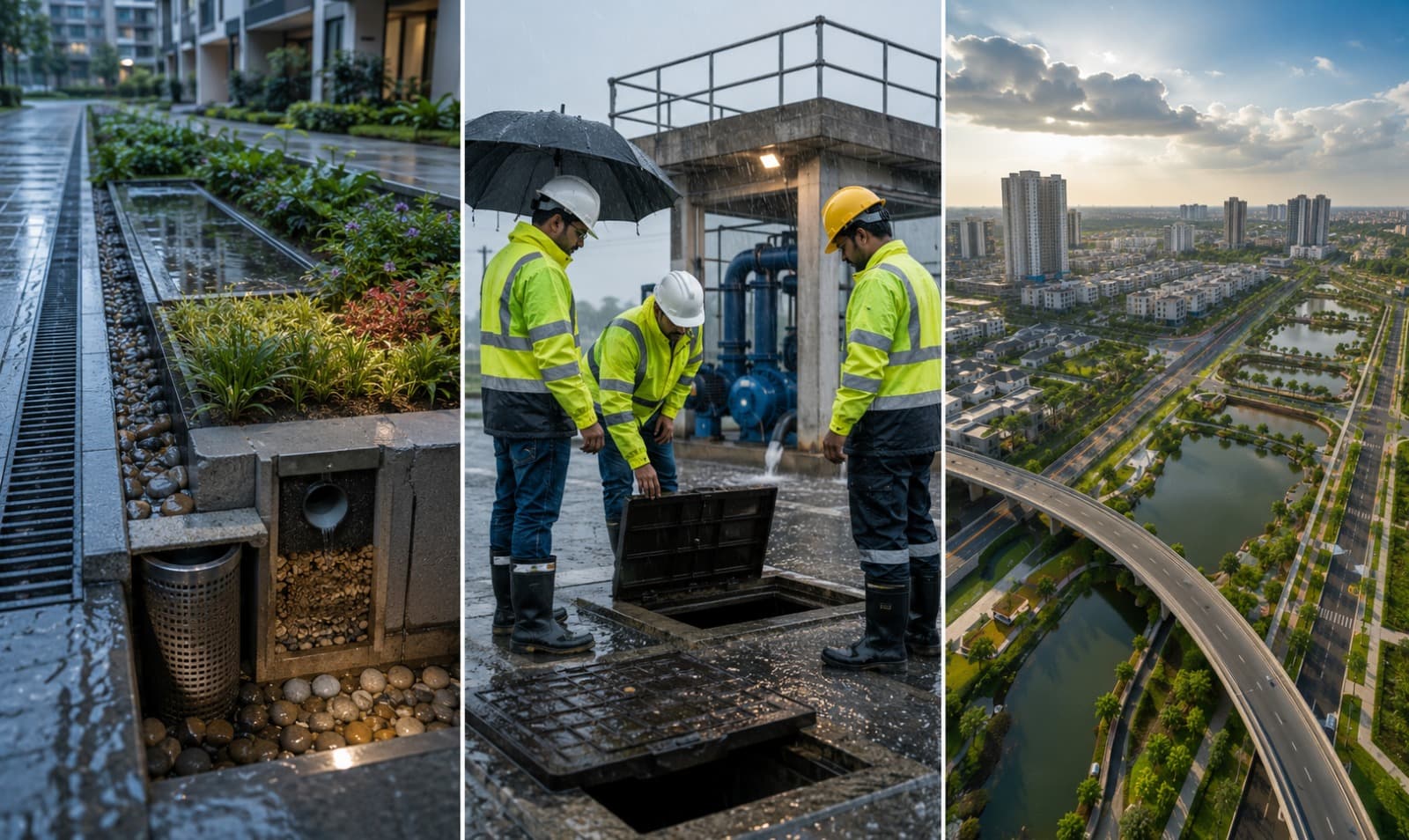
A well-designed flood resistant construction apartment will have gravity-fed drainage that does not depend on pumps to function. Storm water drains around the building perimeter should be wide enough to handle peak rainfall and should connect directly to municipal drainage rather than relying on on-site retention pits that overflow under sustained rain.
Ask the developer for the storm water drainage layout during your site visit. If they cannot produce it, that tells you something. If the layout shows drains routed through the basement or connected to areas that regularly flood in the surrounding neighbourhood, factor that risk into your decision.
Waterproofing in the Right Places
Waterproofing home features India in serious residential projects go beyond standard bathroom waterproofing. Retaining walls around the building perimeter should be waterproofed on the exterior face. The terrace and all exposed flat surfaces should have properly graded waterproofing membranes with inspection access for maintenance.

Shear walls and external walls should be treated with water-resistant plaster or cladding materials that do not absorb moisture during extended wet periods. Ask whether the project has a waterproofing warranty and for how long. Five years is a reasonable minimum.
Smart Features That Make a Difference
Modern flood proof apartment features increasingly include sump pumps in basements with automatic activation above a defined water level, non-return valves on drainage pipes that prevent municipal floodwater from backing up into the building, and elevated electrical switch panels inside individual flats that place switches above the knee-level flood mark.
Some projects in Chennai and Mumbai now include early warning water-level sensors in basements that alert facility managers before flooding becomes critical. These are inexpensive installations that make a large operational difference.
Summary
Flood ready housing features worth checking before buying include minimum 600-millimetre plinth height, ground-floor electrical infrastructure above flood level, gravity-fed storm water drainage, exterior wall waterproofing with warranty, basement non-return valves and elevated electrical panels. For buyers in monsoon proof home features India markets like Mumbai, Chennai and Hyderabad, these are the specifications that separate a flat that stays dry from one that repeatedly floods. Ask specifically, inspect personally and do not accept vague assurances about waterproofing. The specifications either exist or they do not.