
Financial Benefits of Solar Homes for Indian Families in 2025
Summary
Rooftop solar offers significant financial gains for Indian families in 2025, moving beyond just environmental benefits. With PM Surya Ghar subsidies up to Rs 78,000, quick 3-5 year payback, and net metering, families enjoy substantial annual savings and increased property value. This makes solar a smart long-term investment for middle-class households.

Introduction
Most Indian families think about rooftop solar India installations as an environmental choice. Clean energy, fewer emissions, a greener planet. All of that is real. But the financial story is what nobody talks about loudly enough.
A family that goes solar today is making one of the smartest money moves available to a middle-class household in India right now. The savings are concrete, the government support is substantial, and the returns stretch across two and a half decades of virtually free electricity. Here is what the numbers actually look like.
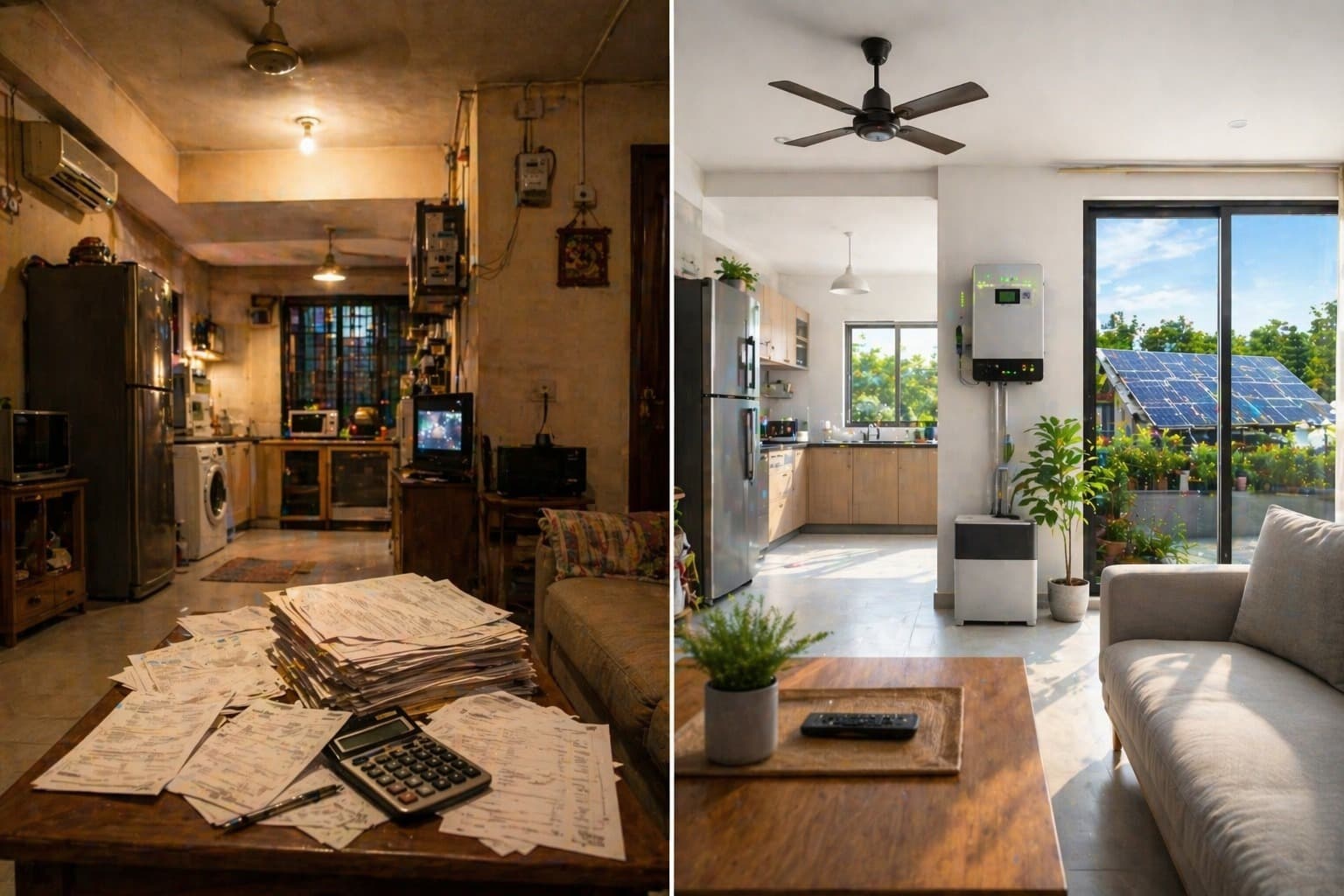
The Electricity Bill Problem Is Getting Worse Every Year
India's grid electricity tariffs have historically risen between 8 and 12 percent annually. That means a family paying Rs 5,000 per month today could be paying Rs 11,000 or more within a decade if they stay fully dependent on the grid.
Solar breaks that cycle completely. Once panels are installed and working, the cost of generating electricity drops to near zero. The sun does not send bills. And that certainty is worth a great deal to any family trying to plan household finances over the long term.
The PM Surya Ghar Scheme Changes the Math Dramatically
The government launched PM Surya Ghar Muft Bijli Yojana in February 2024, and it remains one of the most generous residential energy schemes India has ever offered. As of March 2025, over 10 lakh homes had been solar-powered under this initiative, with Rs 4,770 crore in subsidies already disbursed.

The solar subsidy India structure is direct and meaningful. For systems up to 2 kW, families receive Rs 30,000 per kilowatt. For the third kilowatt, the subsidy is Rs 18,000. The total subsidy is capped at Rs 78,000 for systems of 3 kW and above. This single benefit shortens the payback period by 12 to 18 months compared to buying without any government support.
On top of this, the scheme offers collateral-free loans of up to Rs 2 lakh at a subsidised interest rate of 6.75 percent through public sector banks. A family that cannot pay upfront still has a clear, affordable route to going solar.
What the Payback Period Actually Looks Like
This is where rooftop solar ROI India becomes genuinely exciting for middle-class buyers. For a typical 3 kW residential system installed after the Rs 78,000 subsidy, the net outlay lands somewhere around Rs 1 lakh to Rs 1.3 lakh depending on location and vendor.
Most residential systems pay for themselves within 3 to 5 years. In high-tariff states like Maharashtra, Karnataka, and Gujarat, payback can happen in as little as 3 to 4 years. After that point, the electricity generated is essentially free for the remaining life of the system, which runs 25 years or more.
One real example from 2025 tells the story clearly. A family running a 6 kW system saw their annual electricity bill drop from roughly Rs 90,000 to just the fixed meter charge of around Rs 6,000. Their net annual saving in the first year alone crossed Rs 84,000. The system paid for itself in under four years.
Net Metering Turns Your Roof Into an Income Source
Under net metering, any electricity your panels generate beyond what your household consumes gets exported to the grid. Your electricity provider then credits this against your consumption during night hours or cloudy days.
In states like Gujarat and Maharashtra, the export rate runs between Rs 3 and Rs 4.50 per unit. Families with well-sized systems frequently bring their monthly electricity bills down to zero and sometimes receive a net credit. This mechanism is what transforms a solar homes India installation from a pure savings device into something closer to a productive asset.
Solar Panels Add Value to Your Property
Solar panel property value India is a conversation that the real estate market is only beginning to have seriously. International data consistently shows that homes with solar installations command a 3 to 5 percent premium over comparable non-solar properties. Emerging evidence from Indian metros suggests the same pattern is beginning to take hold here.
As electricity costs climb and buyer awareness grows, an energy-independent home becomes a selling point rather than a curiosity. For families who may sell their property in the coming decade, the solar energy benefits extend well beyond monthly bill savings.
What Families Should Do Next
The application process runs through the official PM Surya Ghar portal. Families register with their electricity consumer number, select an MNRE-approved vendor, and the subsidy is transferred directly to their bank account within 30 days of successful DISCOM inspection. The entire process is digital.
Delaying the decision has a real cost. Every month without solar means paying grid tariffs that compound upward every year.
Summary
The financial benefits of solar homes for Indian families in 2025 are clear and compounding. Government subsidies under PM Surya Ghar Muft Bijli Yojana of up to Rs 78,000, payback periods of 3 to 5 years, annual solar panel savings exceeding Rs 80,000 for active households, net metering income, and rising solar panel property value India together make rooftop solar India one of the strongest financial decisions any middle-class family can make today.