
DMIC and Maharashtra Property Prices: The Industrial Corridor Reshaping Real Estate
Summary
The Delhi Mumbai Industrial Corridor (DMIC) is poised to impact Maharashtra's real estate, particularly around Shendra-Bidkin (Aurangabad) and Dighi Port (Raigad). This industrial development promises long-term property appreciation for patient investors.

Introduction
Most infrastructure conversations in Maharashtra revolve around metro lines, expressways, and the new airport in Navi Mumbai. What gets far less attention is a project operating on an entirely different scale. The Delhi Mumbai Industrial Corridor, a 1,504-kilometre industrial and freight superhighway connecting India's capital to its financial capital, passes through Maharashtra with two significant nodes that are already beginning to move the real estate needle. DMIC Maharashtra real estate impact is not yet the loudest story in the market. But for buyers and investors willing to look five to ten years out, it may turn out to be one of the most consequential ones.
What the DMIC Actually Is
The Delhi Mumbai corridor property story begins with understanding what DMIC is trying to build. This is not a road project or a metro extension. It is a planned economic ecosystem stretching across six states, built on the spine of the Western Dedicated Freight Corridor between Dadri in Uttar Pradesh and JNPT in Navi Mumbai. Along that spine, the government is developing integrated industrial townships, smart cities, logistics hubs, multimodal transport nodes, and special economic zones designed to attract global manufacturing investment at a scale India has not previously attempted.
The total estimated investment runs to approximately ninety billion dollars. Japan and South Korea have already committed significant foreign direct investment, with several companies establishing manufacturing presence in the first operational nodes. Maharashtra sits at the southern end of this corridor, which means it receives both the infrastructure benefits and the employment creation that follows industrial clustering.
Shendra-Bidkin: Maharashtra's Most Advanced DMIC Node
The Shendra Bidkin real estate story is the most immediately relevant for property investors tracking DMIC in Maharashtra. The Shendra-Bidkin Industrial Area near Aurangabad, also known as AURIC or the Aurangabad Industrial City, spans 18.55 square kilometres and is the state's primary DMIC industrial township. Trunk infrastructure work at the site is nearing completion. Land allotments have been initiated and several companies have already begun production within the zone.
DMIC Aurangabad property prices in the surrounding areas have been responding to this progress. Industrial employment generates residential demand in concentric circles around the workplace. Aurangabad's residential market, historically driven by the city's existing manufacturing base from companies like Bajaj Auto, Aurangabad Electricals, and the pharma sector, is now receiving an additional demand layer from AURIC-linked employment. Property prices in Aurangabad's northern and western corridors closest to the Shendra site have seen steady appreciation as awareness of the industrial township's progress grows.

Dighi Port Industrial Area: The Coastal Manufacturing Hub
Maharashtra's second major DMIC corridor node is the Dighi Port Industrial Area on the Konkan coast in Raigad district, spanning approximately 6,056 acres. Dighi is positioned as a coastal manufacturing and logistics hub that leverages port access for export-oriented industries. The proximity to Mumbai and Pune via the Mumbai-Goa Highway and the developing coastal road network gives it a connectivity advantage that purely inland industrial zones cannot replicate.
Residential real estate in the Raigad district has been largely driven by Mumbai's second-home demand and the Navi Mumbai airport effect. The Dighi industrial node adds an employment-driven residential demand layer that is structurally different and potentially more durable than tourism or weekend-home demand.
How Industrial Corridors Move Property Markets
The pattern is consistent and has played out in every Indian city where large-scale industrial investment arrived ahead of residential supply. Employment comes first, driven by construction phase jobs and then permanent manufacturing roles. Workers need housing. The initial housing demand is met by whatever affordable supply exists nearby. Prices in that affordable segment rise first and fastest.
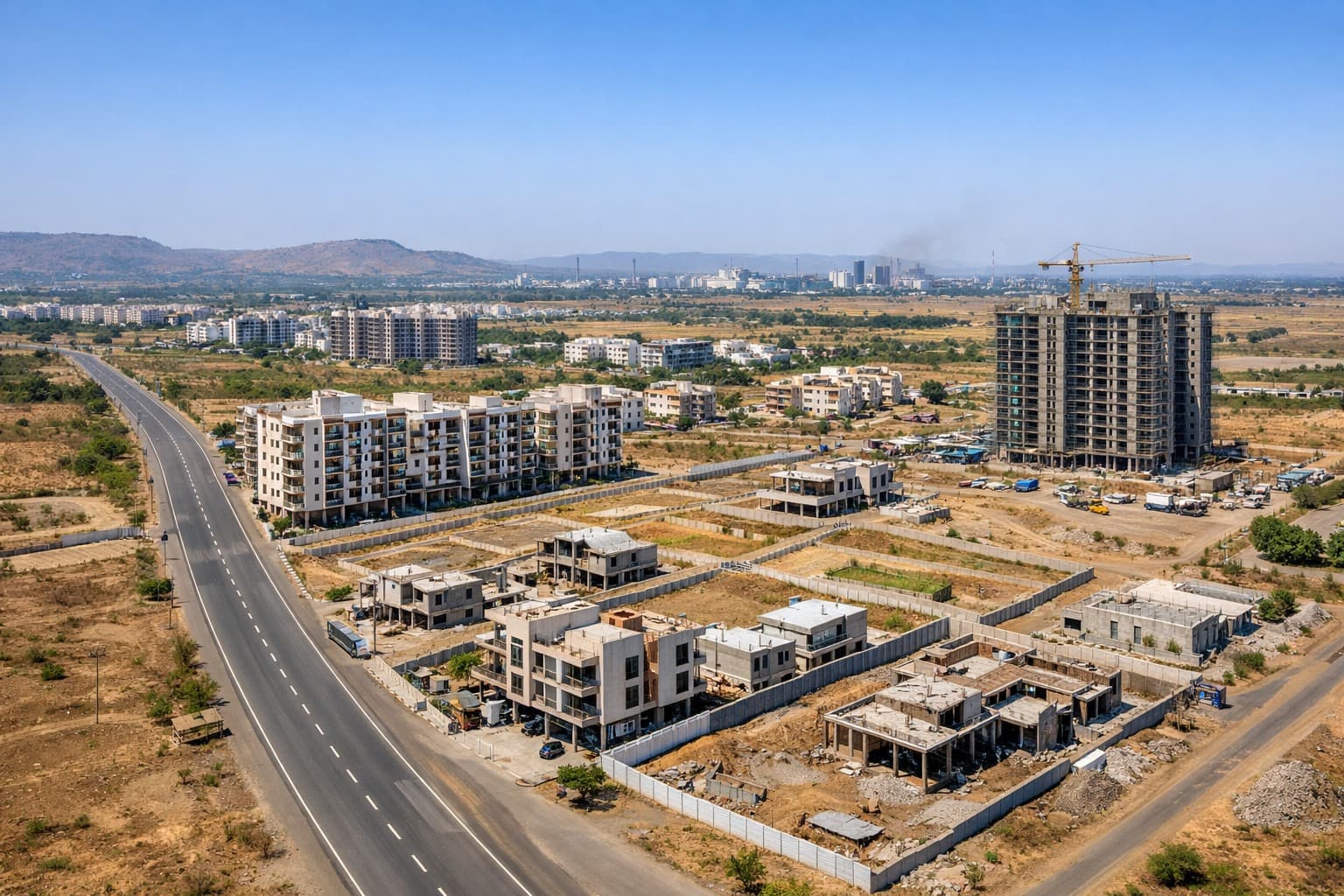
Then the management and professional workforce arrives. They want better quality housing, schools, hospitals, and retail. Developers respond by building organised residential projects. DMIC property prices India in nodes that have already reached this second stage, like Dholera in Gujarat and Greater Noida in Uttar Pradesh, confirm the pattern clearly. Maharashtra's nodes are still in the early phases of that cycle, which is precisely where long-horizon investors want to enter.
Pune's DMIC Connection: Dighi and Beyond
Pune's real estate market intersects with the Delhi Mumbai Industrial Corridor through the logistics and manufacturing activity the corridor generates along the Mumbai-Pune-Aurangabad industrial spine. Chakan, Talegaon, and the Pune-Nashik corridor manufacturing belt all sit within the corridor's broader economic influence zone even if they are not formal DMIC nodes. As freight movement on the Western Dedicated Freight Corridor scales up and AURIC's output grows, the logistics and warehousing demand in Pune's peripheral industrial areas will strengthen, supporting residential demand in the same corridors.
What Buyers Should Watch For
The honest caveat for DMIC-linked real estate in Maharashtra is timing. Industrial corridors of this ambition take longer to operationalise than initial government timelines suggest. Aurangabad's AURIC has been in various stages of development for over a decade. The land allotments and early production activity are genuinely encouraging signals, but buyers who entered very early are still waiting for the employment-scale that fully unlocks residential appreciation.
The right approach is to buy when infrastructure progress is visible and verifiable, not when the announcement is fresh but the ground is still empty.
Summary
The Delhi Mumbai Industrial Corridor is reshaping Maharashtra real estate across two primary nodes: Shendra-Bidkin near Aurangabad and the Dighi Port Industrial Area in Raigad. Both are moving from planning to execution, generating the employment and infrastructure activity that historically precedes significant property price appreciation in surrounding residential markets. For investors with a five to ten year horizon and the patience to wait for industrial activity to scale, DMIC Maharashtra corridor properties represent one of India's most infrastructure-backed long-term real estate plays currently available below peak cycle pricing.