Coworking vs Serviced Offices: Pros, Cons, and How to Choose in 2026
Introduction
The way Indian businesses rent office space has changed fundamentally over the past decade. Traditional long-term leases are no longer the default choice. Two alternatives have emerged as the mainstream: coworking spaces and serviced offices. They both offer flexibility and professionally managed facilities, and they both avoid the commitment of a direct lease. But they are built for different types of users, different company stages, and different working cultures. Understanding the real differences helps you make a decision that matches your business rather than just your budget.
What Is a Coworking Space
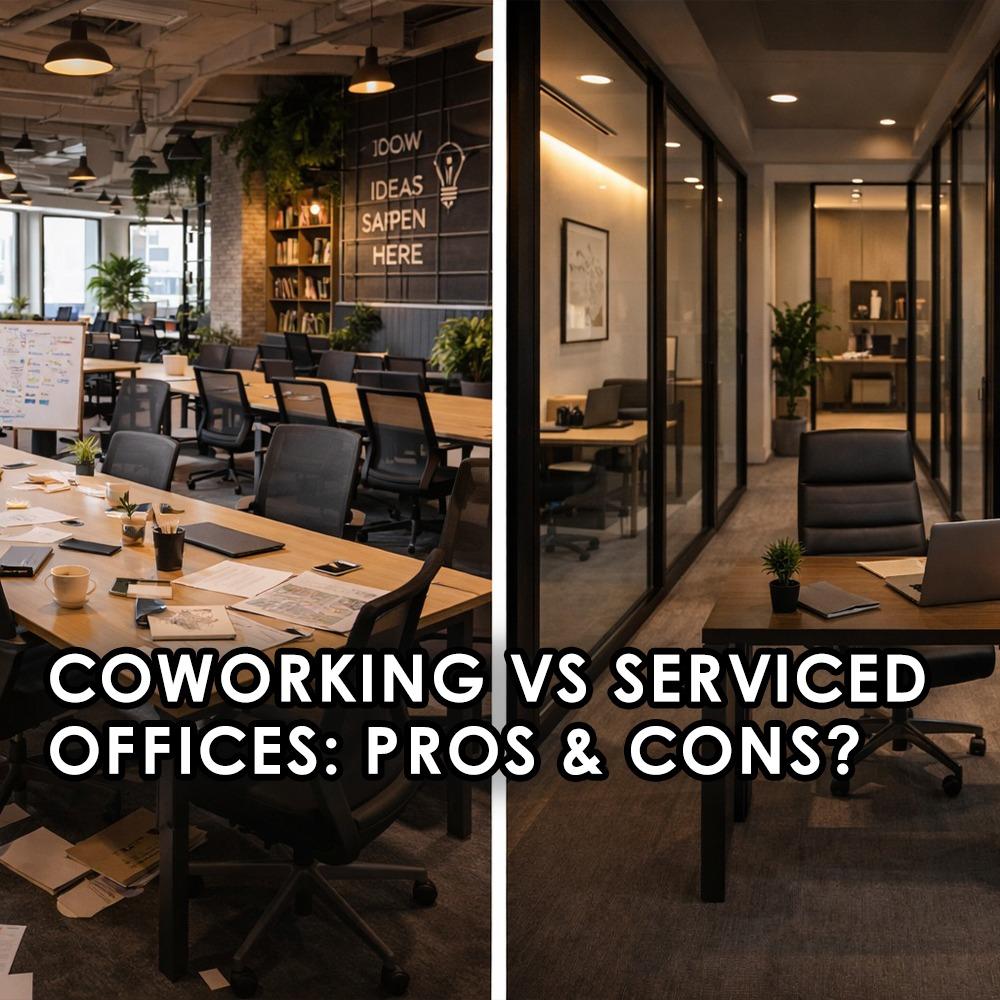
A coworking space is a shared work environment where individuals, freelancers, startups, and small teams rent desks or small offices within a larger, collectively used facility. The defining characteristic is the shared nature of the environment. Common areas, meeting rooms, kitchens, and event spaces are used by all members. A typical coworking membership gives you access to a hot desk or a fixed desk, basic amenities, internet, and community programming.
The cost is typically charged per seat per month. Operators like WeWork, 91Springboard, IndiQube, and Awfis have built large coworking networks across Indian cities, making the format accessible in virtually every major metro and many tier-two cities.
What Is a Serviced Office
A serviced office, also called a managed office, gives a company a private, dedicated space within a professionally managed building. The entire space is used exclusively by one company. Furniture, technology infrastructure, internet, security, reception, housekeeping, and facilities management are all provided and maintained by the operator.
Operators like Smartworks, EFC, and Regus offer serviced office campuses ranging from a few hundred square feet for a small team to tens of thousands of square feet for large enterprises. The client signs a lease or occupancy agreement for the dedicated space, but without the fit-out cost and management responsibility of a traditional direct lease.
The Case for Coworking
Coworking offers maximum flexibility. Month-to-month memberships mean a business can scale up or down very quickly without financial penalties. For a freelancer, an independent consultant, or a team of three to five people, a coworking desk is often the most cost-effective professional workspace available. The community aspect, access to networking events, and the energy of a shared environment can also be genuinely valuable for early-stage founders.
Coworking spaces also require minimal upfront commitment. You pay for what you use, you do not need to sign a long-term agreement, and you can exit with short notice if the business changes direction.
The Challenges of Coworking
Privacy is the most significant limitation of coworking. Open-plan shared environments make confidential calls, sensitive meetings, and focused deep work more difficult. For teams that handle client data, legal documents, or proprietary technology, the shared nature of the environment creates compliance and security concerns.
Noise and distraction are also real productivity factors in busier coworking locations. And as a company grows beyond ten to fifteen people, the per-seat cost of coworking often becomes comparable to or even higher than a serviced office, while delivering less privacy and control.
The Case for Serviced Offices
A serviced office gives a company its own branded space, its own culture, and its own operational environment. Teams can work without the noise and distraction of shared facilities. Client meetings happen in a professional, controlled setting. Sensitive work stays private. Large enterprises and GCCs use serviced offices precisely because the experience is consistent, scalable, and enterprise-grade.
Serviced offices also remove the operational burden of facilities management entirely. The operator handles everything from cleaning to internet reliability to security. For a company whose core business has nothing to do with real estate management, this is a meaningful operational simplification.
The Challenges of Serviced Offices
Serviced offices typically require a longer commitment than coworking memberships. Agreements are commonly signed for 12 months or more, with lock-in periods in many enterprise contracts running to three years. The cost is also higher than a coworking desk for small teams.
Which Should You Choose
For solo professionals, freelancers, and teams under ten people that need maximum flexibility and do not handle sensitive data, coworking is the practical choice. For teams of fifteen or more that need privacy, a consistent branded environment, and are ready for a one to three year commitment, a serviced office delivers better value over the contract period. For large enterprises expanding multi-city, managed office campuses from operators like Smartworks offer the additional dimension of consistency across locations.
Summary
Coworking and serviced offices both solve the problem of flexible office space in India, but they serve different needs. Coworking wins on flexibility, community, and low upfront commitment, making it ideal for small and early-stage businesses. Serviced offices win on privacy, scale, consistency, and enterprise suitability, making them the better choice for growing companies and large organisations expanding across Indian cities in 2026.