
Choosing Between Residential and Commercial Property in India
Summary
Choosing property in India involves weighing residential stability, modest returns, and lower entry costs against commercial's higher income potential and risks. Your capital, risk tolerance, and investment goals dictate whether a home or office unit best builds long-term wealth.

Introduction
Every serious property investor in India eventually arrives at the same fork in the road. One path leads to a flat in a gated society, the other to an office unit or a shop in a business district. Both are real estate. Both involve buying bricks. But the similarity ends roughly there.
Residential vs commercial property India is not a question with a universal answer. It depends entirely on how much capital you have, how much uncertainty you can absorb, and what you actually want from your investment ten years from now. Let us talk through both sides of this honestly.
What Residential Property Actually Delivers
A residential property investment in India is, at its core, a stability play. The demand side rarely dries up completely. Families will always need homes, working professionals will always need rentals, and cities will always keep growing. That baseline demand is what makes residential feel safe, especially for first-time investors.
The numbers are modest but consistent. Rental yield on apartments in Tier-1 cities typically lands between 2.5 and 4 percent annually. Tier-2 cities can stretch that slightly higher, sometimes toward 5 percent in high-demand corridors. Capital appreciation over eight to ten years in well-located markets has historically held between 6 and 9 percent compounded, though some pockets have done significantly better.
There is also the emotional dimension. A residential asset can be lived in if rental demand softens. It can be passed to family. It feels tangible in a way that office spaces simply do not. For risk-averse investors, that psychological comfort carries real weight.
Where Commercial Real Estate Changes the Equation
Commercial real estate operates on a fundamentally different logic. The headline attraction is income. Office spaces and retail properties in India's major business districts routinely deliver rental yield figures between 6 and 10 percent annually, nearly double what most residential property investments produce.
The lease structure explains much of this. A corporate tenant signs a three to nine year agreement, often with built-in annual rental escalations of 5 to 15 percent. They also typically absorb maintenance costs themselves. Compare that to a residential tenant who renews every eleven months and calls at midnight when the geyser fails. The income quality from commercial tenants is simply more structured.
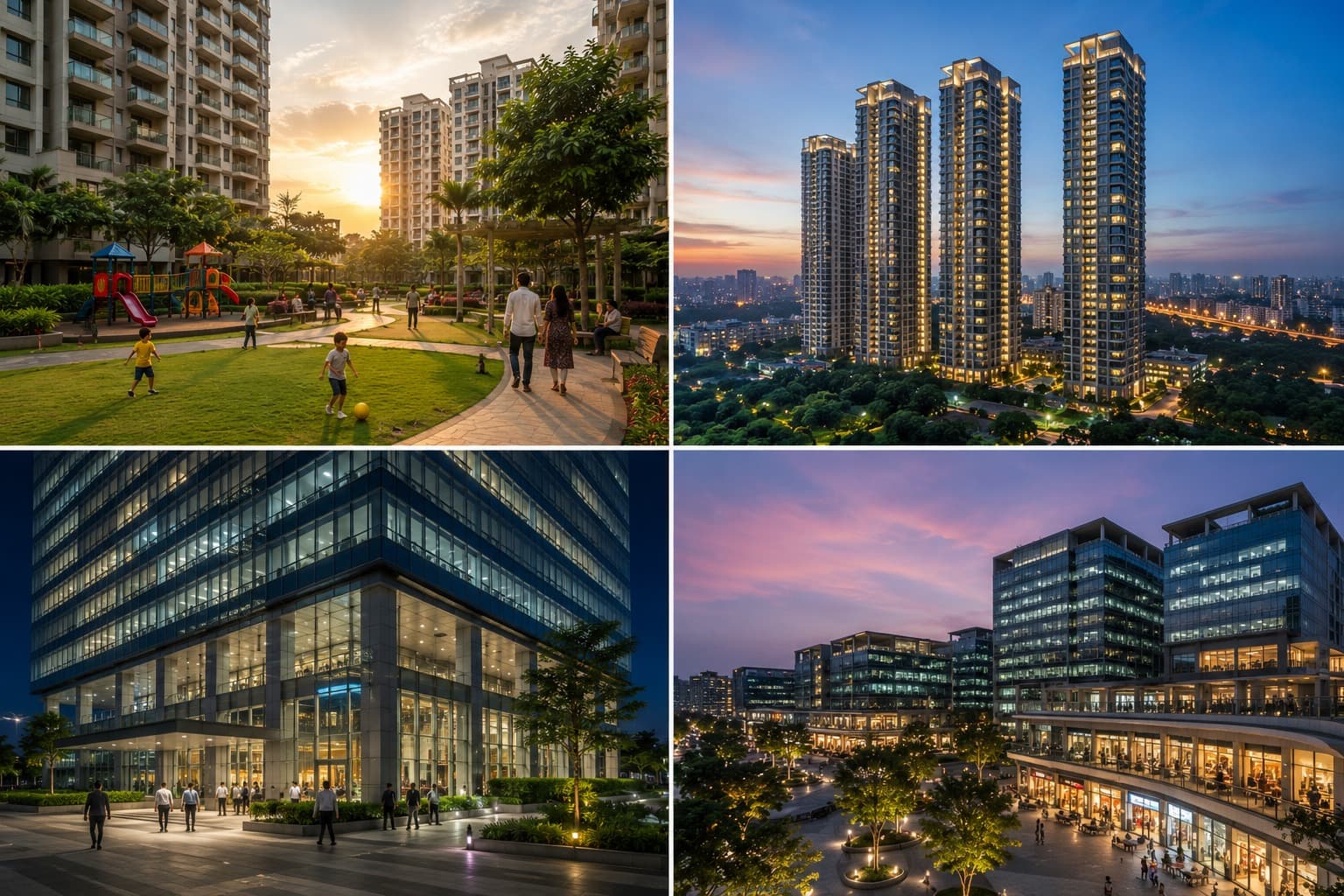
Commercial real estate returns India also benefit from the current GCC-driven demand cycle. Bengaluru, Hyderabad, and Pune have all seen Grade-A rental growth in the 8 to 10 percent range year-on-year recently. Investors who bought commercial space in these corridors five years ago are sitting on both strong appreciation and healthy rental income simultaneously.
The Risks Neither Side Should Ignore
Residential property carries vacancy risk that investors underestimate. A flat sitting empty for three months eats an entire quarter of annual income. Tenant disputes, maintenance demands, and rent recovery issues are common headaches that do not come with the asset brochure.
Commercial real estate carries a heavier risk when the economy wobbles. A corporate tenant who downsizes or relocates mid-lease can leave you with a large, specialised space that takes months to re-let. Entry costs are also substantially higher. A decent commercial unit in Mumbai's western suburbs costs considerably more than an equivalent residential flat, which restricts access to investors with serious capital.
Capital Requirements and Accessibility
This is often where the decision actually gets made. If your investable amount sits below Rs 80 lakh, residential property is the realistic path. Compact apartments in growing micro-markets remain accessible at this price point, particularly in Pune's outskirts, Hyderabad's peripheral corridors, or Chennai's southern belt.
Commercial real estate generally demands Rs 1 crore and above for even modest office units. REITs have partially bridged this gap, allowing investors to access commercial portfolios with relatively small amounts on the stock exchange. But owning actual commercial property outright requires substantially deeper pockets.

Which Builds Wealth Longer Term
Over a ten-year horizon, commercial real estate tends to generate superior absolute returns for investors who can manage the entry cost and the vacancy cycle. The combination of higher income and reasonable capital appreciation creates a stronger compounding effect.
But long-term wealth through residential property is entirely real and has worked for millions of Indian families. The appreciation story in cities like Bengaluru's Whitefield or Navi Mumbai's Kharghar over the last decade has been substantial. Consistent rental income, even at lower yields, compounds meaningfully over time when combined with solid location-driven capital growth.
Summary
The residential vs commercial assets for long-term wealth question has no single correct answer. Residential property offers steadier demand, lower entry points, and a more forgiving management experience but delivers modest rental yield between 2.5 and 5 percent. Commercial real estate returns India run between 6 and 10 percent with structured leases and stronger income quality, but require more capital and carry higher vacancy exposure. Match the asset class to your financial capacity, risk tolerance, and investment timeline. That matching process is where property investment India decisions either compound quietly into real wealth or create expensive regrets.