
Carpet vs Built-Up vs Super Built-Up Area — Real Difference Explained
Summary
Understanding the real difference between Carpet, Built-Up, and Super Built-Up Area is crucial for Indian homebuyers. This guide explains each term, highlighting how RERA mandates carpet area for transparency and prevents financial losses from inflated property sizes.

The Confusion Nobody Warns You About
Ask any first-time homebuyer in India what tripped them up the most during their property search and a good number of them will eventually mention the same thing: the numbers did not add up when they actually visited the flat. The brochure said 1,400 square feet. The apartment felt like something closer to 950.
That gap is not an accident. It is a product of three distinct area terms that have been used interchangeably in the Indian real estate market for decades, sometimes out of genuine confusion, and sometimes quite deliberately. Carpet area, built-up area, and super built-up area are not the same thing. They are not even close to the same thing. And understanding the difference between them could save you several lakhs on your next property purchase.
What Carpet Area Actually Means
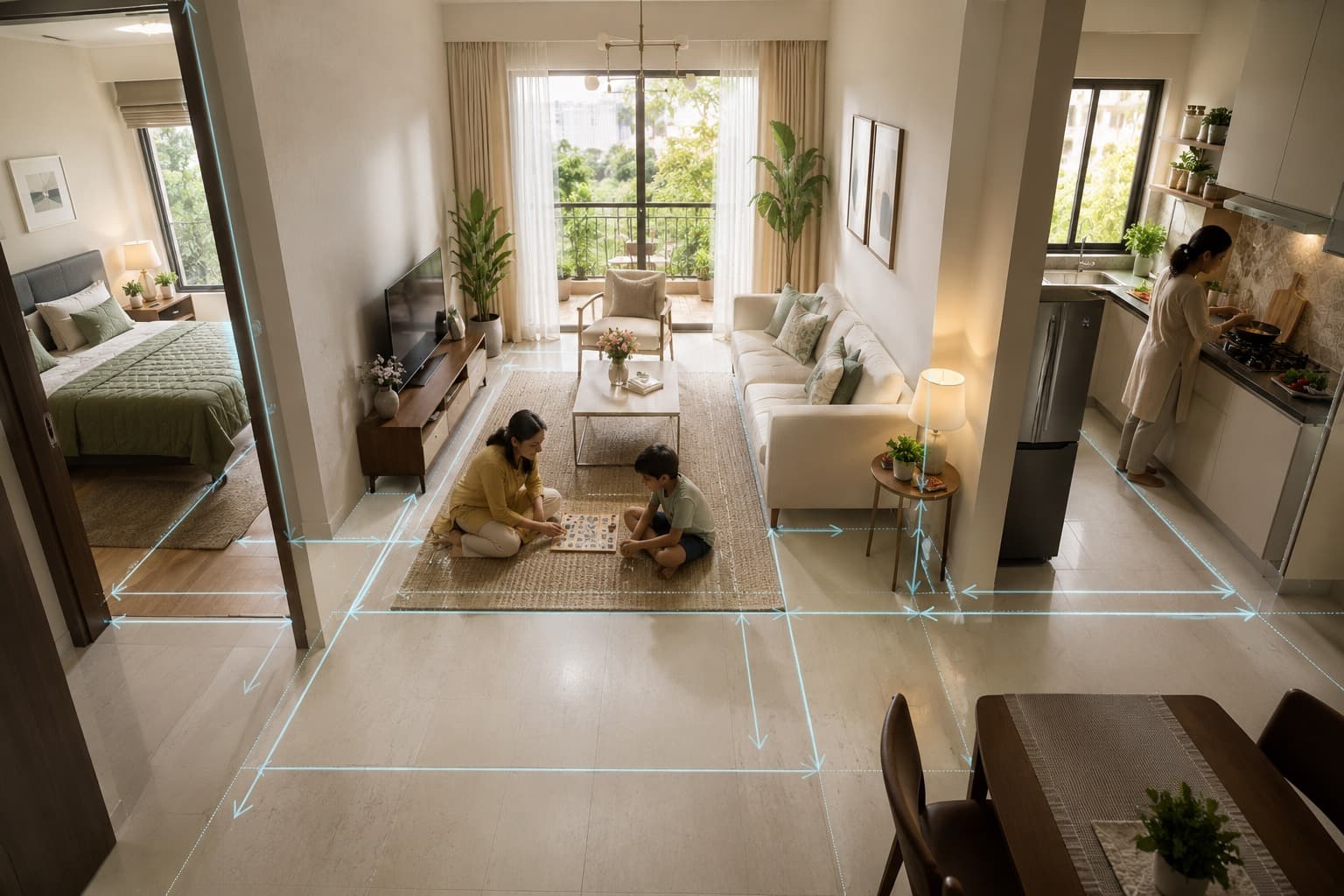
Imagine you are standing inside your new flat with a roll of carpet in hand and you want to cover the entire floor. Every room, every corridor inside the unit, even the walls that divide one room from another. But you stop at the front door. You do not go into the building lobby. You do not cover the staircase landing. You stop precisely where your private space ends.
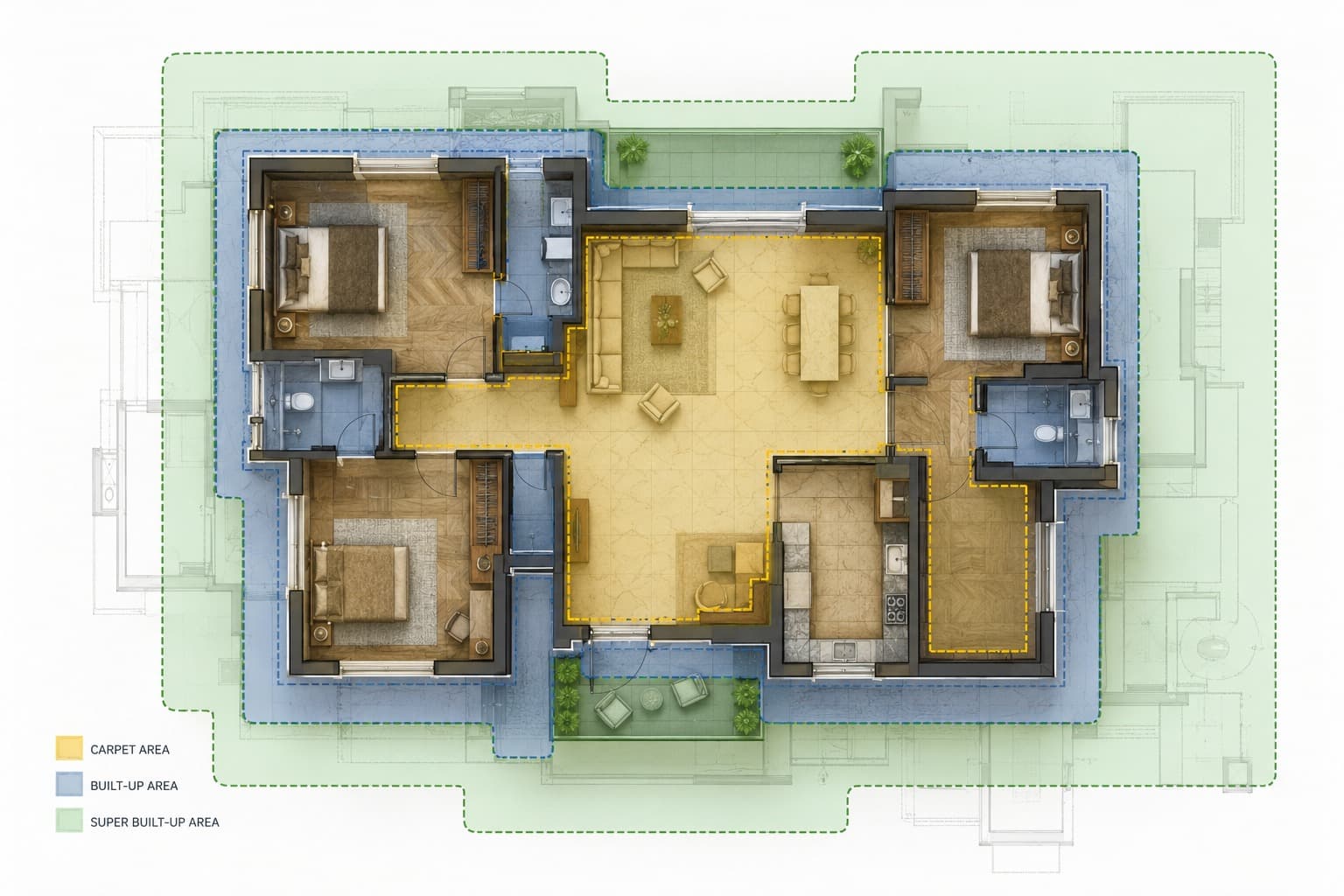
That floor area is your carpet area. It is the usable space that belongs entirely to you. It includes the floor beneath internal partition walls but does not count external walls, service shafts, open terraces, or shared balconies. This is the number that tells you how much room your furniture will actually occupy, how comfortably your family will live, and whether your children have space to run around.
Since RERA came into force in 2017, every registered developer in India is legally required to advertise and sell properties on the basis of RERA carpet area. Builders cannot market a flat using any other area metric as the primary pricing figure. This single rule changed the entire conversation around flat area calculation in India.
Built-Up Area: One Step Bigger
Now expand your thinking just slightly. Take the carpet area and add the thickness of the outer walls, the dry balcony attached to your unit, and any flower bed or utility area that forms part of your individual flat but is not strictly indoor floor space. That combined measurement is your built-up area.
In practical terms, the built-up area of a flat is typically 10 to 20 percent more than its carpet area. So if a flat has 800 square feet of carpet area, its built-up area might land somewhere between 880 and 960 square feet. The additional space accounts for physical construction material, not liveable room. You own those walls. You are just not living inside them.
Super Built-Up Area and the Loading Factor
This is where the real confusion has historically lived, and where buyers have traditionally lost the most money without realising it. Super built-up area takes your built-up area and adds on a proportionate share of all the common spaces in the entire building complex. The lift shaft, the stairwells, the lobby at each floor, the entrance foyer, the security cabin, the generator room, and in many large projects, even the clubhouse and parking areas.
The percentage by which super built-up area exceeds carpet area is called the loading factor in real estate. In older projects or large gated communities, this loading factor commonly runs between 25 and 40 percent. That means if a developer quotes you a super built-up area of 1,200 square feet with a 30 percent loading factor, your actual usable carpet area works out to roughly 923 square feet. You are paying for 1,200 but living in 923.
Before 2017, many builders routinely quoted price per square foot based on super built-up area without making this clear. A rate of Rs 4,500 per square foot sounded reasonable until you worked backward and realised the effective rate on actual usable space was closer to Rs 5,800 or more.
Why This Still Matters Even After RERA
You might assume that RERA has put all this behind us. It has improved things dramatically. But it has not eliminated the issue entirely. Resale properties in older buildings are still often discussed in terms of built-up or super built-up area. Developers of plotted developments and commercial projects operate under different disclosure norms. And some builders continue to display super built-up area prominently in marketing material while mentioning carpet area only in the fine print of the agreement.
How super built-up area affects actual usable space in flats is something every buyer must personally calculate before signing anything. Ask the developer directly. Request the floor plan. Verify against the RERA registration on your state portal. These steps take twenty minutes and can prevent years of regret.
The Rule of Thumb Worth Memorising
For quick mental arithmetic, a widely used approximation in Indian real estate is that carpet area works out to roughly 70 percent of built-up area, and built-up area is roughly 70 percent of super built-up area. These ratios vary by project, but they serve as a reasonable sanity check when a salesperson quotes you numbers over the phone.
Always bring every conversation back to one figure: what is the RERA carpet area, and what am I paying per square foot of that carpet area. Everything else is secondary.
How to Protect Yourself as a Buyer
The most effective thing you can do is cross-reference the carpet area mentioned in the developer's brochure against the RERA portal entry for that specific project. Every RERA-registered project must disclose carpet area as part of its public filing.
If the numbers differ, that is a red flag. If the developer cannot or will not give you the carpet area upfront, walk away. In a post-RERA market, there is no acceptable reason for a builder to be vague about how to calculate carpet area of a flat in India.
Summary
Understanding carpet vs built-up vs super built-up area is the single most important numerical skill a homebuyer in India can develop. RERA carpet area is the only honest measure of the space you will actually live in, and why RERA made carpet area mandatory for property buying is precisely because the loading factor in real estate was silently inflating prices for decades. Before committing to any property, always confirm the carpet area first, calculate the effective cost per square foot on that basis, and verify everything against the RERA portal. What you see in a brochure and what you live in are two very different things.