
Carpet Area in Duplex vs Regular Flats: What Buyers Need to Know
Summary
Don't judge flats by advertised carpet area alone! Duplexes lose 70-120 sq ft to internal staircases, offering less usable space than regular flats. Understand true area efficiency and lifestyle suitability before buying.

Introduction
Two flats sit side by side in the same tower. Both are advertised at 1,200 square feet. One is a regular apartment. The other is a duplex spread across two levels. A buyer comparing them purely on size is making a mistake. Carpet area duplex units and standard floor apartments behave very differently when it comes to actual usable space, daily convenience, and long-term practicality. The number on the brochure does not tell you the full story.
What Carpet Area Actually Means
Before comparing, the definition needs to be clear. Flat carpet area India under RERA is the net usable floor space inside an apartment, measured wall to wall across all rooms including internal partition walls. It excludes external walls, exclusive balconies, terraces, and any common building infrastructure. This is the space where you actually place furniture, move around, and live. Both duplex and regular flats are required to disclose this number under RERA. The difference is in how that space is configured and what portion of it serves you productively every single day.
The Staircase Problem in Duplex Units
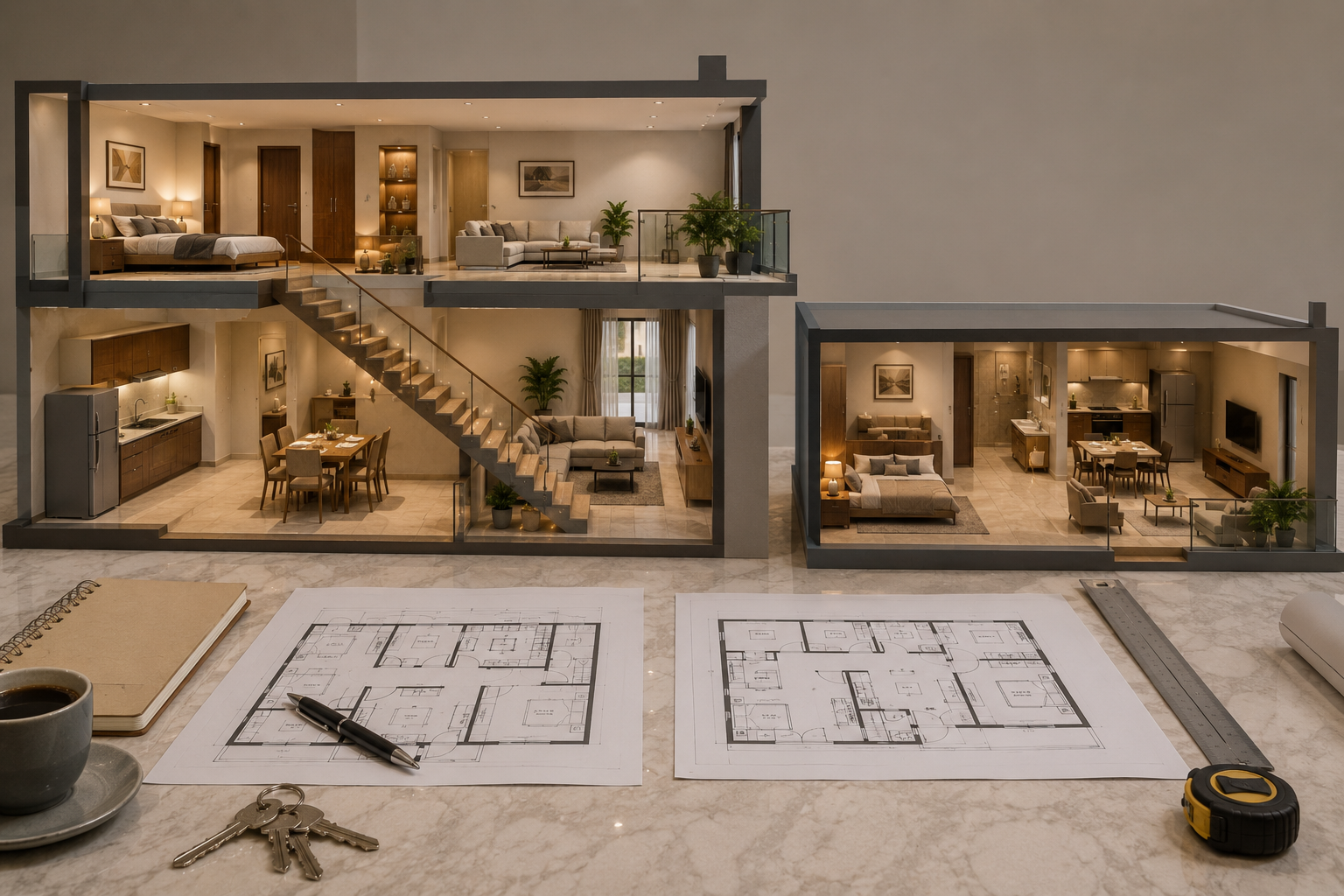
Here is where duplex flat area efficiency India diverges sharply from standard apartments. A duplex unit contains an internal private staircase connecting the two levels. That staircase and its immediate landing area typically consumes between 70 and 120 square feet of carpet area depending on its design and the floor height involved. In a 1,200 square foot duplex, losing even 80 square feet to stairs and landings means your actual furniture-bearing, walking-around space is closer to 1,120 square feet. In a same-sized regular flat, all 1,200 square feet work for you from day one. That gap matters more in compact urban apartments than in large villa configurations where the total area absorbs the staircase comfortably.
How Space Gets Distributed Across Two Floors
In a typical duplex home India layout, the ground level carries the living room, dining area, and kitchen. The upper level holds the bedrooms. This vertical separation is the duplex's defining characteristic and its primary lifestyle appeal. But it also means that every trip between a bedroom and the kitchen involves climbing stairs. For a young couple or a nuclear family, this is perfectly workable. For a household with elderly members, toddlers who need supervision across floors, or anyone with mobility concerns, the daily stair usage becomes a genuine friction point. Regular flats eliminate this entirely. All spaces sit on one plane, and movement within the home is effortless.
Area Efficiency: The Numbers Tell a Nuanced Story
How carpet area works differently in duplex vs regular flats in India becomes clearest when you compare same-sized units in the same project. A standard 1,200 square foot apartment typically delivers close to 95 to 98 percent of its RERA carpet area as directly usable living space. In a duplex of identical carpet area, the figure drops to around 88 to 93 percent once you account for the staircase, landing zones, and the structural wall separating the two levels. That difference of 5 to 10 percent in effective usability translates to 60 to 120 square feet in practical terms. In a Bengaluru or Mumbai apartment where every square foot costs Rs 8,000 to Rs 15,000, that is a meaningful gap. Buyers should always calculate the effective cost per truly usable square foot rather than the headline carpet area cost.

Where Duplexes Win and Where They Do Not
Duplex vs single floor apartment carpet area comparisons should not end with a verdict against duplexes. They offer genuine advantages that justify the trade-off for the right buyer. Internal privacy is the strongest argument. When the living zone and sleeping zone occupy completely separate floors, guests staying downstairs do not disturb anyone sleeping upstairs. Professionals working from home benefit from a physical separation between the work level and the rest zone. In Tier 1 cities, duplexes serve as an aspirational mid-point between a standard apartment and a villa. In Tier 2 cities, duplex villas and row houses offer growing families the space separation that joint living often demands. The format works best when the total carpet area is large enough, typically above 1,800 square feet, to absorb the staircase cost without the remaining space feeling compromised. Below that threshold, particularly in compact urban apartments under 1,000 square feet, a duplex layout leaves very little room for furniture arrangement on either floor after the staircase is accounted for.
What Buyers Should Verify Before Committing
Staircase impact on carpet area in duplex flats India is rarely disclosed in marketing material. Ask the developer explicitly for the staircase area and subtract it mentally from the carpet area before comparing against regular units. Verify whether the RERA registration shows the staircase as part of the carpet area or excluded from it. Some developers fold it in, others do not. Check the ceiling height on both floors. Low ceilings on the upper duplex level are a common cost-cutting measure that makes bedrooms feel cramped despite adequate floor area. Walk through both levels during the site visit and physically test the staircase width, landing space, and natural light availability on each floor.
Summary
Carpet area efficiency comparison duplex and standard apartments India consistently shows that regular flats deliver more usable space per square foot of carpet area than duplex units at the same size. Why duplex homes have less usable carpet area than advertised comes down to the staircase occupying 70 to 120 square feet that cannot serve any other function. Which has better carpet area utilisation duplex or regular flat India depends on total size: large duplexes above 1,800 square feet absorb the staircase cost comfortably, while compact urban duplexes below 1,000 square feet sacrifice a disproportionate share of livable space. Match the format to your family size, life stage, and daily movement patterns before the carpet area number makes the decision for you.