
Budgeting Mistakes Homebuyers Must Avoid
Summary
First-time Indian homebuyers often underestimate the true cost of property. This guide exposes common budgeting mistakes, from hidden charges like stamp duty and interior costs to managing EMIs, floating interest rates, and the critical need for an emergency fund, ensuring a less stressful ownership journey.

Introduction
Buying a home is the most expensive financial decision most Indian families will ever make. You would expect people to approach it with a tight, well-researched budget. Most do not. And the ones who do often discover they have only planned for half the actual cost.
The mistakes first-time homebuyers make are rarely dramatic. They creep in quietly, one missed cost at a time, until the buyer is stretched well beyond comfort in their very first year of ownership.
The Sticker Price Is Only the Starting Point
The most common budgeting mistake is treating the developer's advertised price as the total budget. It is nowhere close.
On top of the base price, buyers across most Indian states need to account for stamp duty and registration charges, which together typically add 5 to 11 percent depending on the state. In Maharashtra, for instance, that combination adds 7 percent to the purchase price. On a one-crore home, that is seven lakh rupees in government charges alone, payable before you even receive the keys.
Add GST for under-construction properties, legal and documentation fees, and registration appointment costs. Most buyers underestimate the total acquisition cost by 10 to 15 percent before they have moved in.
The EMI That Looks Fine on Paper
Home loan calculators are deceptively reassuring. You enter your income, the loan amount, and the current interest rate, and the monthly EMI looks entirely manageable. The problem is that EMIs do not exist in isolation.
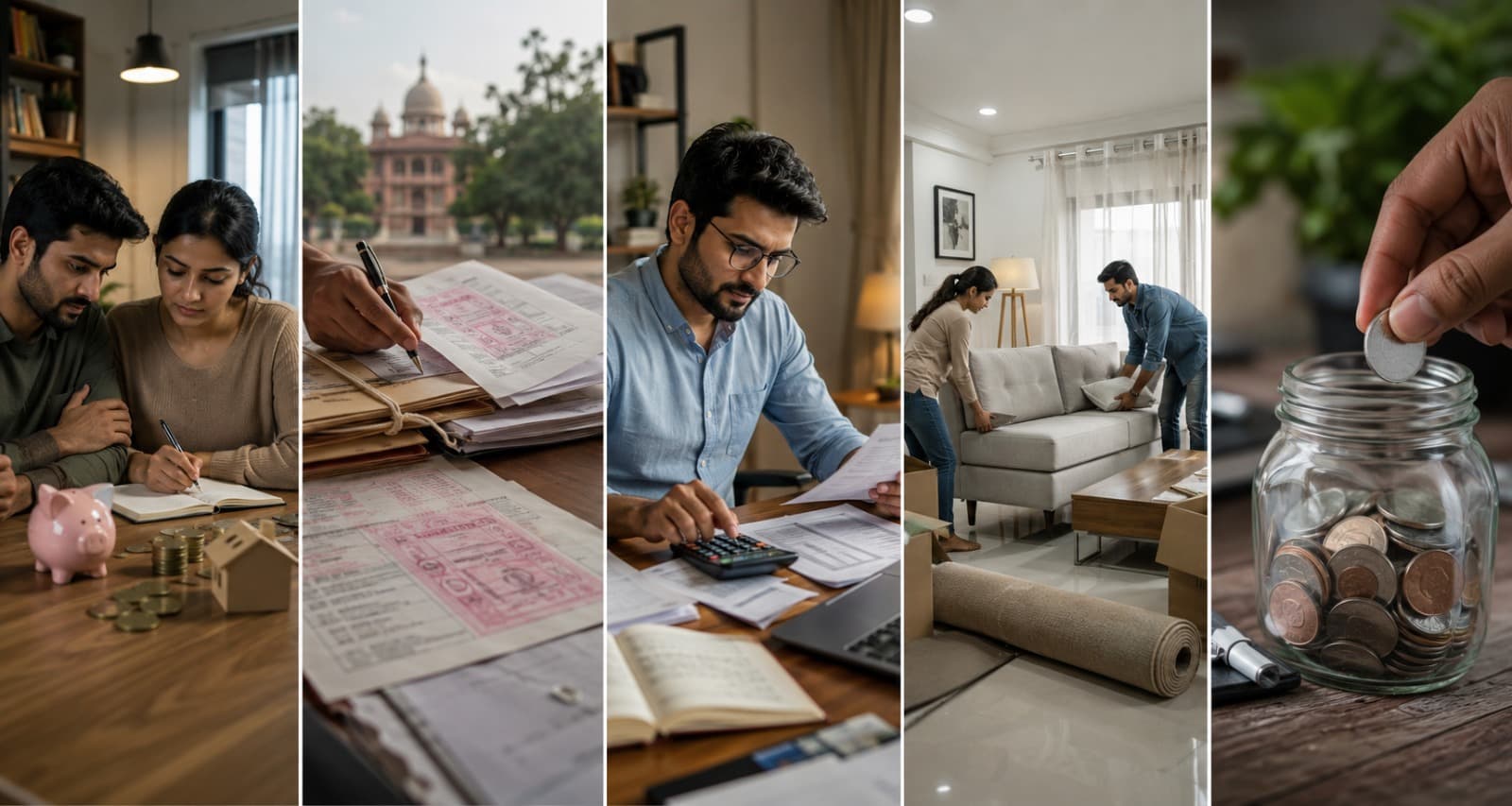
Your monthly expenses do not pause because you have bought a home. Groceries, school fees, utilities, petrol, and insurance continue exactly as before. Many buyers discover their post-EMI monthly surplus is far thinner than they expected, leaving almost no room for any unplanned expense.
Most financial planners suggest keeping your total EMI outflow, including all existing loans, below 40 percent of monthly take-home salary. Most first-time buyers push that figure above 50 percent without realising it until they are already under pressure.
The Interior Budget That Gets Ignored
Here is a cost that shocks almost every new homebuyer. Moving into a bare flat, especially in new construction, costs far more than people expect. Modular kitchen units, wardrobes, bathroom fittings, flooring upgrades, lighting, curtains, and basic furniture can together run anywhere from five to fifteen lakh rupees depending on home size and finish quality.
Buyers who exhaust everything on the down payment and stamp duty often find themselves living in an incompletely furnished home for the first year or two. Allocating a separate interior fund before signing the sale agreement saves a significant amount of financial and emotional stress later.
Maintenance Charges and Society Fees
This one genuinely surprises people. Premium residential projects in Mumbai, Pune, Bengaluru, and Hyderabad routinely carry monthly maintenance charges of ₹5,000 to ₹20,000 or more, depending on the facilities offered. A project with a clubhouse, pool, gymnasium, and 24-hour security generates real running costs that residents carry monthly.
These charges are not temporary. They are a permanent commitment for as long as you own the property. Buyers who do not account for them find the amount quietly eating into their monthly budget month after month, year after year.
Floating Interest Rate Risk
Most home loans in India today carry floating interest rates, meaning the EMI can rise whenever the Reserve Bank of India increases its benchmark lending rate. Between 2022 and 2023, home loan rates in India rose by nearly 2.5 percentage points in under eighteen months. Buyers who had stretched their budgets at lower rates found their EMIs jumping by several thousand rupees a month.

Planning for a buffer of at least 1 to 1.5 percent above your current rate when calculating EMI affordability is simple, sensible protection against a risk that has already materialised once in recent memory.
The Emergency Fund That Disappears
The most dangerous version of this mistake is draining every rupee of savings into the down payment and arriving at ownership with nothing left. No emergency fund. No liquid backup.
Life does not accommodate timing. A job change, a medical emergency, a car breakdown, or a family crisis can all land in the same year you buy a home. Without a financial cushion, even one unexpected expense can create serious cash flow distress.
Most advisors recommend keeping at least three to six months of household expenses in liquid savings even after completing the home purchase. That buffer is not optional. It is the difference between manageable homeownership and a genuinely stressful one.
Summary
Buying a home in India involves far more financial planning than most first-time homebuyers expect. From stamp duty and GST to interior costs and maintenance charges, the real cost of homeownership extends well beyond the monthly EMI. Avoiding these budgeting mistakes requires honest planning, conservative affordability assumptions, and the discipline to keep a financial cushion intact even when the urge to spend everything on the new home feels entirely natural.