
Adverse Possession: How You Could Lose Your Property to a Squatter in India
Summary
In India, adverse possession allows a squatter to claim ownership after 12 years of continuous, open, and hostile occupation. Protect your property through regular inspections, prompt legal action against encroachments, and formalizing property usage.

Adverse Possession: The Property Law That Can Hand Your Land to a Stranger If You Are Not Careful
Introduction
Most property owners in India know about the risk of fraud, forged documents, and builder defaults. Far fewer know about a legal doctrine that can quietly transfer ownership of their land or flat to someone else without a single fraudulent document changing hands. Adverse possession India is a principle embedded in the Limitation Act of 1963 that allows a person who has been occupying someone else's property openly, continuously, and without permission for twelve years to claim legal ownership of it through a court. It sounds extreme. It is real. And it has been used successfully in Indian courts often enough that any property owner with an unoccupied plot, an inherited flat sitting vacant, or a portion of land encroached upon by a neighbour should understand exactly how this law works.
The Basic Legal Framework
The adverse possession law in India derives from Articles 64 and 65 of the Limitation Act, 1963. The principle is that if a landowner does not take legal action to reclaim their property within the prescribed limitation period, their right to sue extinguishes. For private property, that period is twelve years. For government-owned land, it is thirty years.
The logic behind the doctrine is not to reward squatters. It is to ensure that property disputes are resolved within a reasonable timeframe and that land does not sit in legal limbo indefinitely because an owner failed to assert their rights. Courts have consistently held that a property owner who sleeps on their rights for twelve years forfeits the legal mechanism to enforce them.
The Four Conditions That Must Be Satisfied
For an adverse possession claim to succeed, the person claiming ownership must prove four things simultaneously. The possession must be actual, meaning the person physically occupies and uses the land. It must be open and notorious, meaning the occupation is visible and not concealed. It must be hostile, meaning it is without the owner's permission. And it must be continuous for the full twelve-year period without significant interruption.

All four conditions must be proven together. A squatter who has the owner's verbal permission to stay loses the hostile element. Someone who vacates for six months in the middle of the twelve years resets the clock. Courts examine these conditions rigorously and many adverse possession claims fail on one of the four criteria.
How Property Owners End Up Losing Land They Did Not Know Was at Risk
The most common scenario is an inherited property that the legal heir never visits or manages. An ancestral plot in a hometown. A flat in a city the family left decades ago. A piece of agricultural land that nobody farms. Someone moves in, uses the property openly, and twelve years pass without the legal owner filing a suit for recovery.
Property encroachment India that gradually expands is another route. A neighbour who builds a boundary wall two feet into your plot and leaves it there for over a decade has created an adverse possession situation on that two-foot strip. Small encroachments ignored for years compound into legitimate legal claims over time.
Recent Supreme Court Position: The State of Haryana Clarity
Indian courts have not been uniformly sympathetic to adverse possession claims. The Supreme Court has expressed discomfort with the doctrine in several judgements, observing that rewarding a trespasser with ownership at the expense of a legitimate owner raises serious constitutional questions under the right to property.
In the landmark judgement of Hemaji Waghaji Jat vs Bhikhabhai Khengarbhai Harijan, the Supreme Court strongly criticised the doctrine and called on Parliament to reconsider it. The court held that adverse possession, while legally valid, should not be used as an instrument to defeat the rights of a vigilant property owner. More recently, courts have insisted on strict proof of all four conditions, making successful claims harder to establish than they once were.
What Property Owners Must Do to Protect Themselves
The most effective protection against adverse possession is periodic physical inspection of all owned properties combined with documentation of that inspection. Visit unoccupied land or flats at regular intervals. Photograph the boundary, the structure, and any access points. Keep dated records.
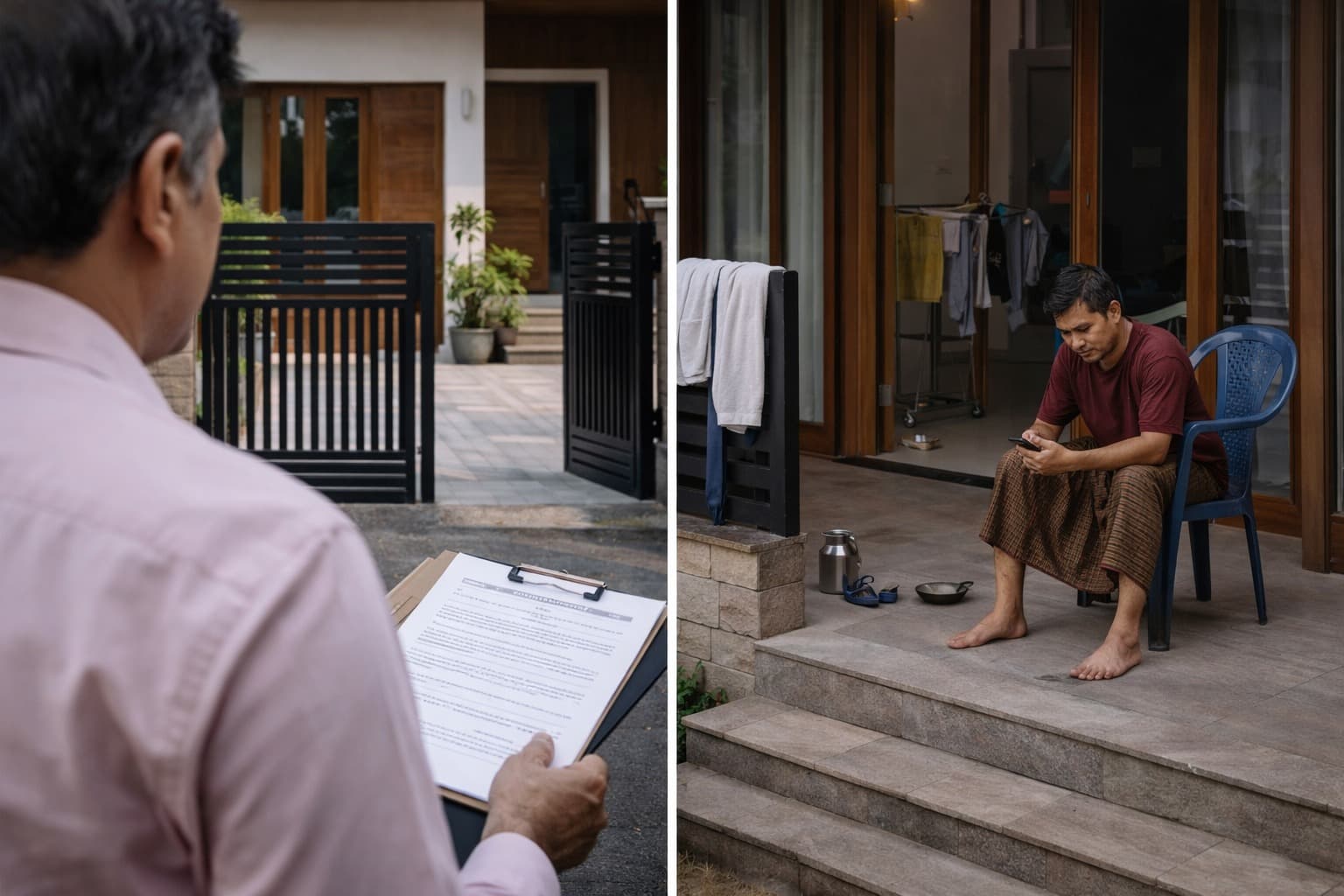
If any encroachment or unauthorised occupation is discovered, file a complaint with the local police and issue a legal notice through a lawyer immediately. The clock on the twelve-year period is interrupted the moment legal proceedings are initiated. Waiting, hoping the situation resolves itself, or assuming the person will eventually leave voluntarily are the responses that lead to adverse possession claims reaching court.
Preventive Measures That Actually Work
Lease your vacant property rather than leaving it empty. A formal lease agreement with rent paid creates a permissive occupation that eliminates the hostile element required for adverse possession. Even a token rental arrangement with documentation removes the squatter's ability to claim the occupation was against the owner's wishes.
Erect clear boundary markers and fencing. Commission a survey to establish precise boundaries and keep the survey records with your title documents. For rural land, engage a local caretaker with a documented service agreement who can report any encroachment immediately.
Summary
Adverse possession in India allows a person occupying another's property openly, continuously, and hostilely for twelve years to claim ownership through court. The Limitation Act 1963 provides the legal basis. Property owners with vacant plots, inherited land, or unmonitored flats are most vulnerable. Protection requires periodic physical inspection, immediate legal action on discovery of encroachment, and converting vacant possession into formal licensed or leased arrangements. Courts have been applying stricter scrutiny to these claims in recent years but the risk remains real for owners who do not actively assert their rights.
Video will be embedded from: https://www.youtube.com/watch?v=nEgHh2YL-cY