
Your Complete Investment Guide to High-End Real Estate in Delhi
Summary
Delhi's luxury real estate is a top wealth store for HNIs/NRIs, boasting appreciation from limited supply. This guide details prime zones like Lutyens Delhi and South Delhi for strategic, long-term investment.

Introduction
There is a certain kind of buyer who looks at Delhi's luxury property market and sees something most investors in Gurgaon or Noida do not quite understand. It is not just about square footage or club memberships. It is about permanence. Delhi luxury real estate, particularly in the older southern and central pockets of the city, operates by a different set of rules entirely. Supply is fixed. Demand comes from people who are not checking EMI affordability calculators. And prices tend to move in one direction over any meaningful time horizon.
If you are an HNI, an NRI, or a business family thinking seriously about parking wealth in premium property Delhi, this guide is built for you.
Delhi's Standing in the Global Luxury Market
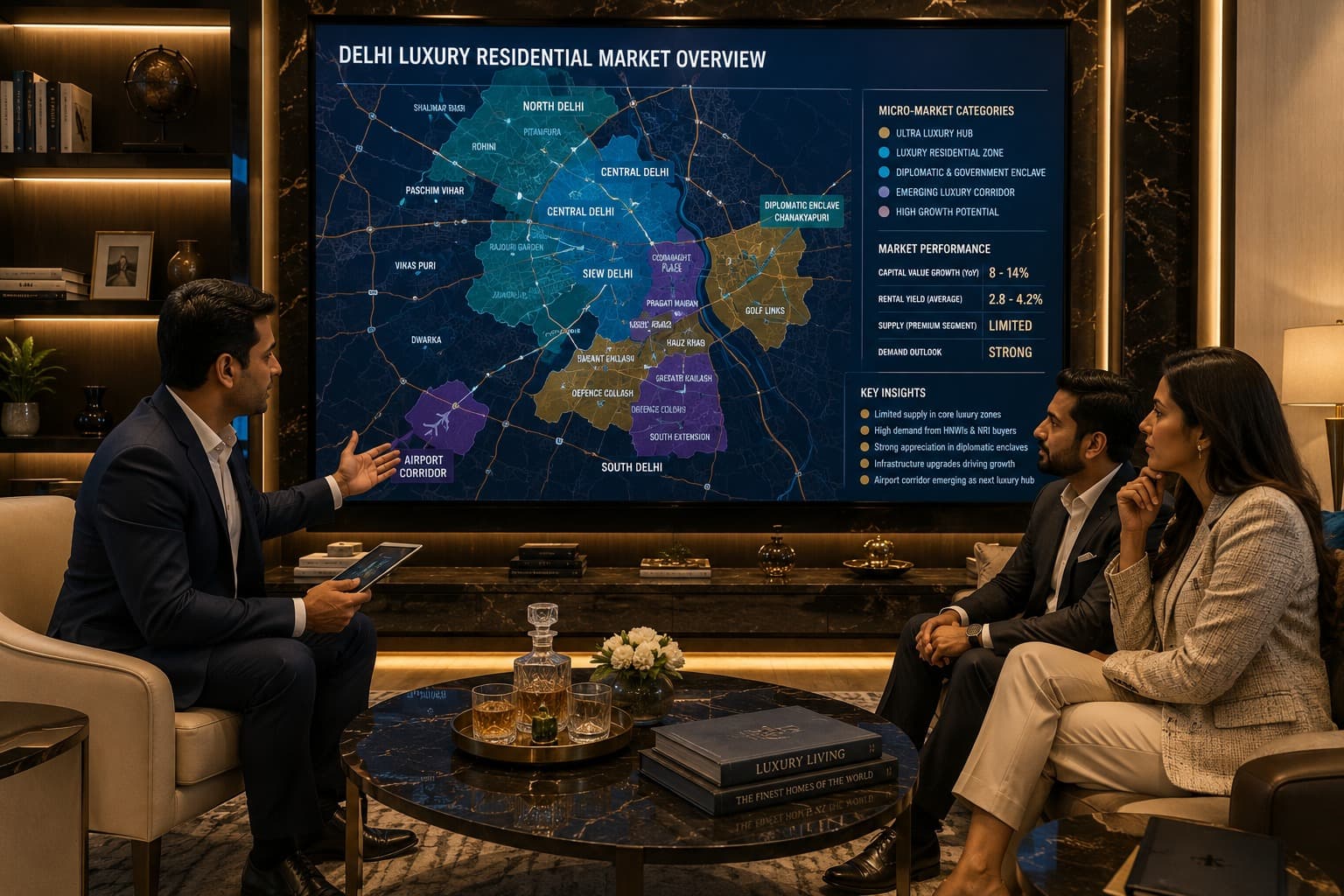
Delhi is no longer a secondary player in the global premium housing conversation. The city climbed from 37th to 18th position in the Prime International Residential Index between 2023 and 2024, on the back of a nearly 7 percent year-on-year increase in luxury homes South Delhi and central pockets. That is a significant jump for any city, let alone one that already had some of the most expensive addresses in Asia.
NRI investment in high-end real estate Delhi has been a key driver behind this. Buyers from the United States, the United Kingdom, and the Gulf are increasingly treating Delhi property as a legacy holding rather than a speculative trade. The numbers back this up. NRI investments into India's premium residential market were projected to hit around 16 billion dollars in 2025 alone.
Lutyens Delhi: The Asset Class of Last Resort
You cannot write about Delhi investment at the premium end without starting here. The Lutyens Bungalow Zone, or LBZ as insiders call it, is essentially a closed market. The colonial-era grid of wide roads, government-allocated bungalows, and expansive land parcels was designed decades ago and has not meaningfully expanded since.
What that scarcity produces is an asset that barely responds to economic cycles. Recent transactions tell the story plainly. In June 2025, a bungalow in Golf Links changed hands for Rs 100 crore. A Mittal-linked firm acquired a 3,540-square-yard property on APJ Abdul Kalam Road for Rs 310 crore in the same period. ChrysCapital's Sanjay Kukreja paid Rs 155 crore for a Golf Links address. These are not outliers. They are the going rate.
Lutyens Delhi bungalow price per square foot in areas like Golf Links and Prithviraj Road runs between Rs 1 lakh and Rs 1.5 lakh per square foot. Many transactions here never appear on portals at all. They are settled through broker networks, passed between industrialists and business families who already know each other.
South Delhi: The Accessible Luxury Tier
For buyers who want serious luxury real estate appreciation Delhi without the near-impossible barrier of entry that Lutyens Delhi represents, South Delhi's established colonies offer a more navigable path.
Greater Kailash, split into GK-I and GK-II, is where the upper-middle and wealthy class actually transacts. Builder floors here are active, listings are real, and sales happen across the year rather than once a decade. Property rates in GK sit between Rs 25,000 and Rs 50,000 per square foot depending on the configuration and floor. Annual appreciation has held in the 8 to 12 percent range, and rental demand from corporates, expats, and working professionals keeps yields reasonably healthy.
Vasant Vihar attracts a different crowd entirely. Diplomats, global executives, and business families with international exposure have long favoured this locality for its wide streets, proximity to the airport, and the kind of quiet that money buys in a city of twenty million people. Land banking activity in Vasant Vihar has picked up sharply over the last couple of years. When family offices are buying land without an immediate construction plan, it signals that they expect the locality to hold and grow value across generations.
Defence Colony, Jor Bagh, Panchsheel Park, and Hauz Khas round out the South Delhi luxury belt. Each has its own personality and price point. But collectively, they represent a market where land supply is finite, buyer quality is high, and demand rarely dries up completely.
What Drives These Prices
Delhi luxury real estate is not driven by the same variables that move mid-segment markets. Infrastructure announcements matter less here than they do in Noida or even Gurugram. What matters in South Delhi property is the social capital embedded in an address, the quality of daily life in the neighbourhood, and the long-term stability of the city's political and commercial importance.
Delhi will always be the seat of India's government. That concentration of power means a permanent population of senior bureaucrats, politicians, industrialists, and diplomatic staff who need premium housing. And because that demand is structural rather than cyclical, the market does not collapse when interest rates rise or when the broader economy slows.
How to Approach This Market as an Investor
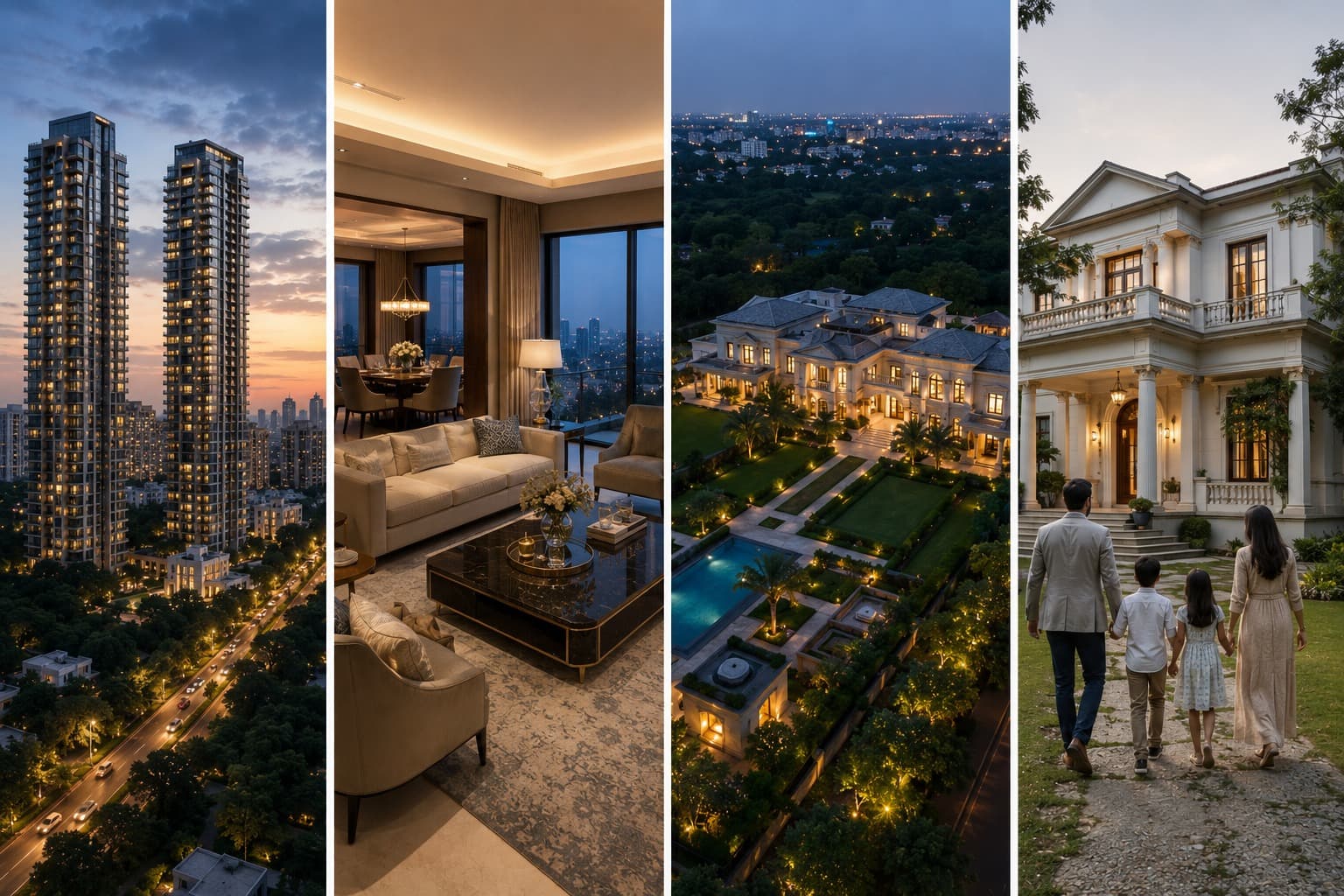
First, clarify your purpose. Luxury homes South Delhi serve either as long-term wealth stores or as rental income assets. They rarely function as short-cycle flips. If you are chasing quick returns, this is the wrong playground.
Second, understand the documentation complexity. Properties in areas like Lutyens Delhi come with heritage regulations, renovation restrictions, and legal histories that require thorough due diligence. Engaging a legal team that specifically understands LBZ norms is not optional.
Third, consider the newer premium options. Emerging luxury projects in Delhi's better-connected residential zones, including parts of Dwarka and the extended south belt, are offering RERA-registered luxury apartments in the Rs 2 crore to Rs 10 crore range. These provide the benefits of modern construction standards, defined possession timelines, and stronger regulatory protection.
The NRI Angle
For HNI property investment Delhi NCR, the case is straightforward. India's rupee pricing means that dollar or pound-denominated buyers are getting a relative discount compared to ten years ago. Rental management has become easier through professional facility management companies. And RERA has added a layer of transparency that makes buying from abroad far less risky than it once was.
Summary
Delhi luxury real estate remains one of India's most dependable wealth stores, combining limited supply with enduring demand from business families, diplomats, and NRIs. Lutyens Delhi commands Rs 1 to 1.5 lakh per square foot for bungalows that almost never come to market twice. South Delhi property in localities like Greater Kailash, Vasant Vihar, and Defence Colony delivers 8 to 12 percent annual appreciation with active rental markets. For serious investors, the investment guide to high-end real estate Delhi is simple: enter early, hold long, and let the city's irreplaceable position do the work.