
Virar West vs East: Who Is Winning the Price Race in 2025?
Summary
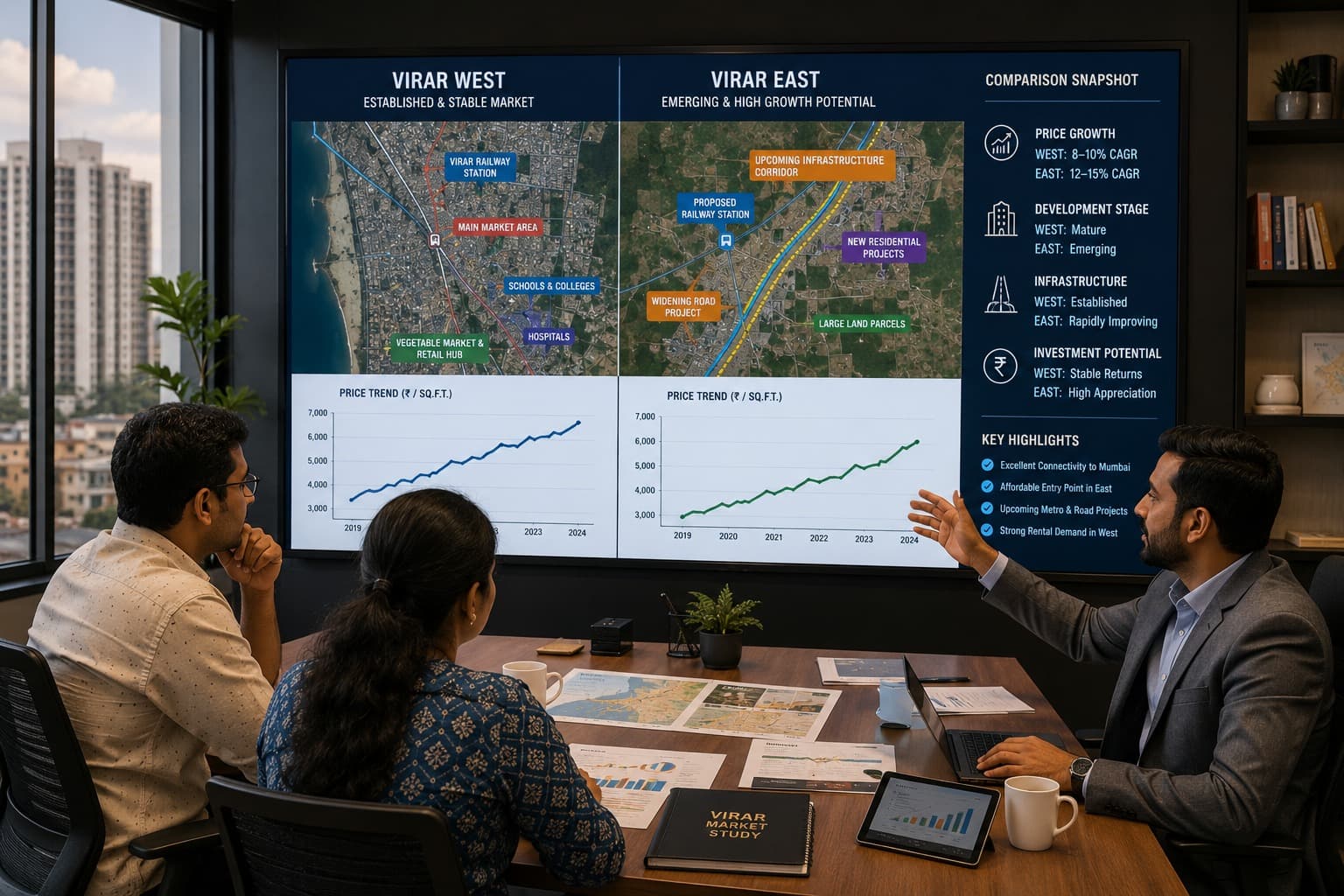
Virar West commands a premium at Rs 5,500-9,000/sq ft due to established amenities and railway access, ideal for end-users. Virar East, priced lower at Rs 4,500-7,000/sq ft, presents a strong investment opportunity with significant upside from upcoming Metro Line 13 and multimodal corridor development.

Introduction
Most people who look north of Borivali for property end up in a familiar dilemma. Virar is clearly the right call. The suburb has shed its old image as a sleepy weekend retreat and turned into one of the most active residential markets in the entire Mumbai Metropolitan Region. But once you decide on Virar, the next question hits immediately: West or East?
They share a railway station. They share the same postal identity. And yet the two micro-markets have been moving at different speeds, attracting different buyer profiles, and offering very different entry points. This is not a small distinction. For someone putting in forty or fifty lakhs of savings, picking the wrong side of the tracks can mean the difference between good returns and great ones.
The Numbers First
Let us start with what the market is actually saying right now. Virar West property prices currently sit in the range of roughly Rs 5,500 to Rs 9,000 per square foot depending on the project, the floor, and how close you are to the station. The average transaction rate hovers around Rs 9,000 to Rs 10,000 per square foot for registered deals, with the five-year price movement clocking in at over 20 percent.
Virar East real estate tells a slightly different story. Average rates there sit lower, typically between Rs 4,500 and Rs 7,000 per square foot, with newer project listings pushing closer to Rs 6,800 in 2025. The gap between the two sides has narrowed compared to three years ago, which itself is an important signal worth paying attention to.
Why West Commands a Premium
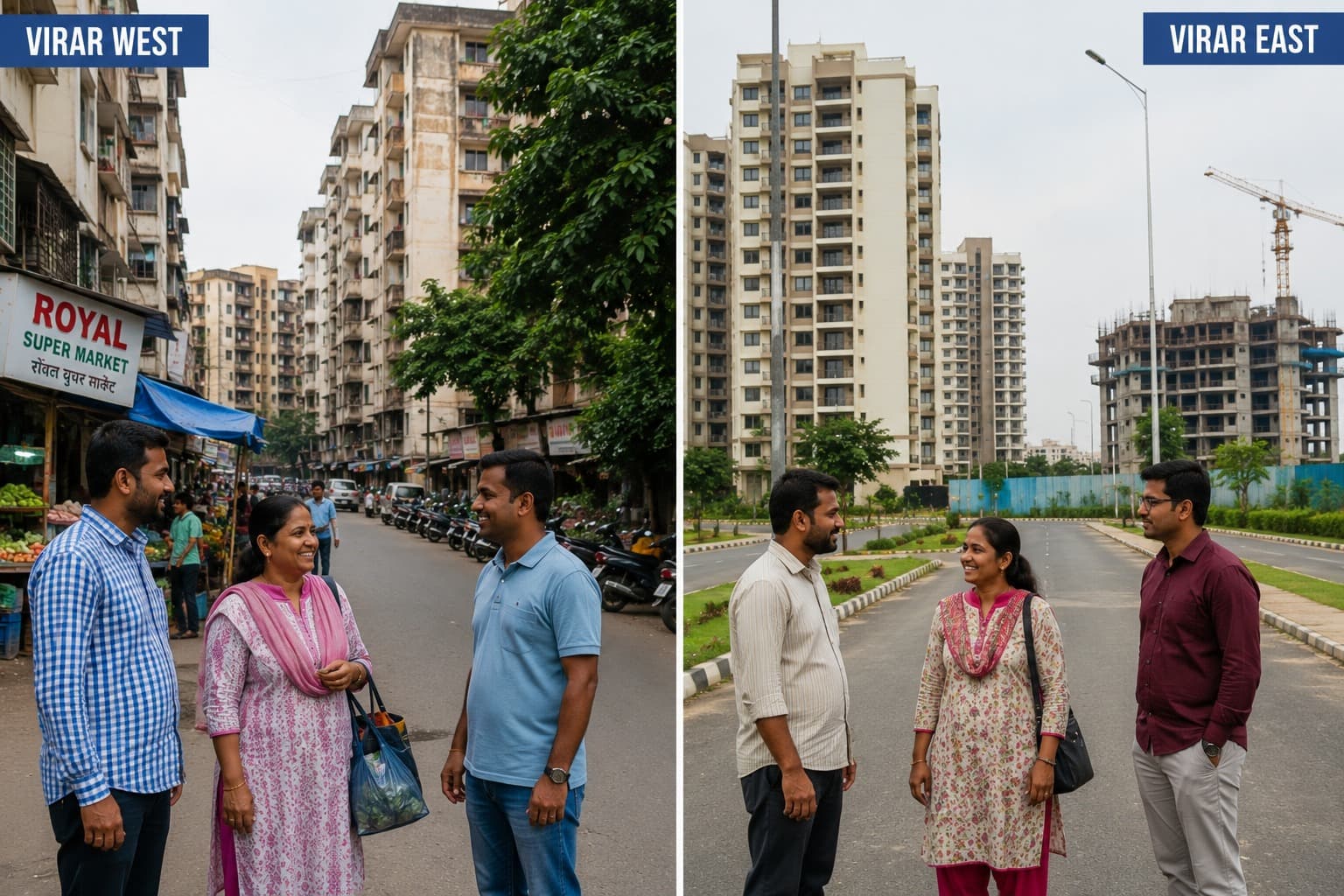
The premium in Virar West is not accidental. It has been built up over years of better amenities, more developer activity, and cleaner civic infrastructure overall. Big names like Rustomjee, Shapoorji Pallonji Group, and Runwal Group have established significant residential projects here, which naturally pulled in buyers who wanted quality delivery and branded assurance.
Then there is the railway station factor. Virar West sits on the same side as the railway terminus, which means the walk or auto-rickshaw ride to catch a fast train to Andheri or Churchgate takes considerably less time. For a working professional whose entire weekday is built around that commute, this convenience is worth paying more per square foot. It always has been.
The East Side Opportunity
Here is where things get genuinely interesting. Virar East investment has historically been the choice of the cautious budget buyer. It was cheaper, less polished, and slightly disconnected from the premium township clusters that gave West its shine. But that calculus is shifting.
The upcoming Metro Line 13, often called the Purple Line, is a 23-kilometre elevated corridor connecting Mira Road all the way to Virar. The route passes through stations that are expected to serve Virar East quite directly. Infrastructure at this scale does not just improve travel times. It reassigns value entirely. Land and apartments near proposed metro stations in this belt are already showing early appreciation, and market forecasts suggest localities in East could see 25 to 30 percent value growth by 2030 as metro operations inch closer to partial commencement.
The Virar-Alibaug Multimodal Corridor is another project that positions East specifically well, given its proximity to highway nodes on that side.
Rental Yields and Who Is Buying
Virar West vs East also plays out differently when you look at rental demand. West tends to attract long-term end-users and families who want established schools, hospitals, and shopping nearby. The rental yields are steady but not aggressive, typically in the 3 to 3.5 percent range annually.
East, on the other hand, is beginning to attract investor interest from people who are betting on the infrastructure story. Rental yields there are nudging toward 3.5 to 4 percent, partly because tenants working in logistics zones, industrial belts, and even extended Mumbai suburbs find East a convenient and affordable base. NRIs looking for entry-level investment in the Mumbai property market have also started circling Virar East, drawn by ticket sizes that remain under 50 lakhs for a decent 1 BHK.
Who Should Go Where
If you are an end-user who needs to commute into central Mumbai daily and wants a completed, well-serviced township with established schools and hospitals, Virar West is the stronger choice. You will pay more, but the infrastructure is ready and the lifestyle quality is already there.
If you are an investor with a five to seven year horizon and can handle a slightly longer gestation period, Virar East investment makes a compelling case today. You enter at a lower price point, benefit from the metro construction story as it unfolds, and exit into a market that will likely look very different by 2030.
The Developer Angle
One often overlooked indicator of where a market is heading is developer appetite. Virar East in 2025 has over 56 under-construction projects from various developers, with a significant share focused on 1 and 2 BHK gated communities. Lodha has announced Springwoods in East, targeting smart-home layouts and EV-ready infrastructure. When a brand of that size picks a side, it tends to pull mid-size developers and buyers in the same direction.
West still has more premium supply and established names, but the pipeline of new launches is actually denser in East right now. That volume of new supply usually compresses yields slightly in the short term but drives up capital values as the surrounding infrastructure matures.
The Big Picture
Virar real estate as a whole is in a strong cycle. The suburb offers homes at prices that are 40 to 60 percent cheaper than equivalent spaces in Andheri or Malad. That gap is the fundamental engine of demand. And as long as central Mumbai remains expensive, buyers will keep looking north.
The question of East versus West is really a question of timing and purpose. West is a safer bet for someone who needs to live there now. East is the smarter bet for someone willing to wait for infrastructure to do its work.
Summary
Virar West and Virar East represent two distinct phases of the same growth story. West has the established premium at roughly Rs 9,000 per square foot with steady appreciation, while Virar East real estate offers entry points around Rs 4,500 to Rs 7,000 per square foot with a sharper upside tied to Metro Line 13 and multimodal corridor development. For end-users, Virar West property delivers lifestyle readiness today. For investors focused on the best area to invest in Virar, East's pre-metro pricing and evolving infrastructure make it one of the more exciting bets in the extended Mumbai market right now.