
New Nagpur's Land Bill May Cross Rs 4,000 Crore: IBFC Project's Impact on the City and Real Estate
Summary
New Nagpur's IBFC project faces rising land acquisition costs, potentially exceeding Rs 4,000 crore due to increased land values. Despite this, the project is progressing with surveys and funding secured, impacting Nagpur's real estate market.

Introduction
Nagpur has long sat at India's geographical centre without fully capitalising on that advantage. That may be about to change. The Maharashtra government's New Nagpur project, officially conceived as an International Business and Finance Centre, is the most ambitious urban development initiative the city has seen in decades. And right now, the project's most immediate challenge is also its most consequential: land acquisition. Costs on the ground have moved faster than official estimates, with the total NMRDA land acquisition bill for the project now at risk of crossing Rs 4,000 crore.
What the New Nagpur Project Actually Is
The Maharashtra Cabinet gave its approval for the Nagpur IBFC project on 3 September 2025. Under the plan, the Nagpur Metropolitan Region Development Authority, commonly known as NMRDA, will develop 1,710 acres of land in Godhani and Ladgaon villages of Hingna taluka on the outskirts of Nagpur. The first phase will cover 1,000 acres, with the remaining 710 acres reserved for future expansion.
The vision is a city within a city. The New Nagpur smart city is being designed as Central India's gateway for knowledge industries, global financial services, IT companies, MSMEs, and startups. It is not another industrial estate. It is intended to function like a self-contained business district, complete with underground utility tunnels carrying power, water, gas, and telecom lines, a district cooling system, automated waste collection, IT parks, MSME zones, residential areas, and a large central park with an artificial lake.
The Funding Structure
Two key MoUs were signed in September 2025, bringing NBCC and HUDCO formally into the picture. NBCC has been appointed as the project management and consultancy agency, while HUDCO committed to providing Rs 11,300 crore in total funding. Of this, Rs 6,500 crore is earmarked for the New Nagpur IBFC, covering land acquisition and infrastructure development. A separate Rs 4,800 crore will go toward land acquisition for the 148-kilometre Nagpur Outer Ring Road, a parallel infrastructure project that will significantly improve connectivity to the new city.
Within the Rs 6,500 crore IBFC budget, the official allocation for land acquisition alone was set at Rs 3,000 crore. The Maharashtra government approved a state guarantee for this loan from HUDCO in November 2025, giving NMRDA the financial backing to begin the acquisition process formally.
Why the Acquisition Cost May Cross Rs 4,000 Crore
Here is where the on-ground reality diverges from the official plan. The moment the New Nagpur project was announced, land values in the surrounding villages shot up dramatically. In Godhani and Ladgaon, the primary acquisition zones, prices reportedly climbed to approximately Rs 2 crore per acre within just three months of the announcement. Gumgaon, a nearby village in the same cluster, saw prices jump from around Rs 50 lakh to over Rs 1.2 crore per acre in the same period. Premium plots closest to the proposed development zones have been quoted at up to Rs 2.5 crore per acre.
Villages like Kotewada and Sumthana, positioned near the Samruddhi Expressway corridor, have commanded even higher rates of up to Rs 3.5 crore per acre. When you apply these market rates to the total land area of roughly 692 hectares, the arithmetic pushes the real acquisition cost well beyond the Rs 3,000 crore originally budgeted. The Rs 4,000 crore threshold becomes realistic, if not conservative.
On-Ground Progress
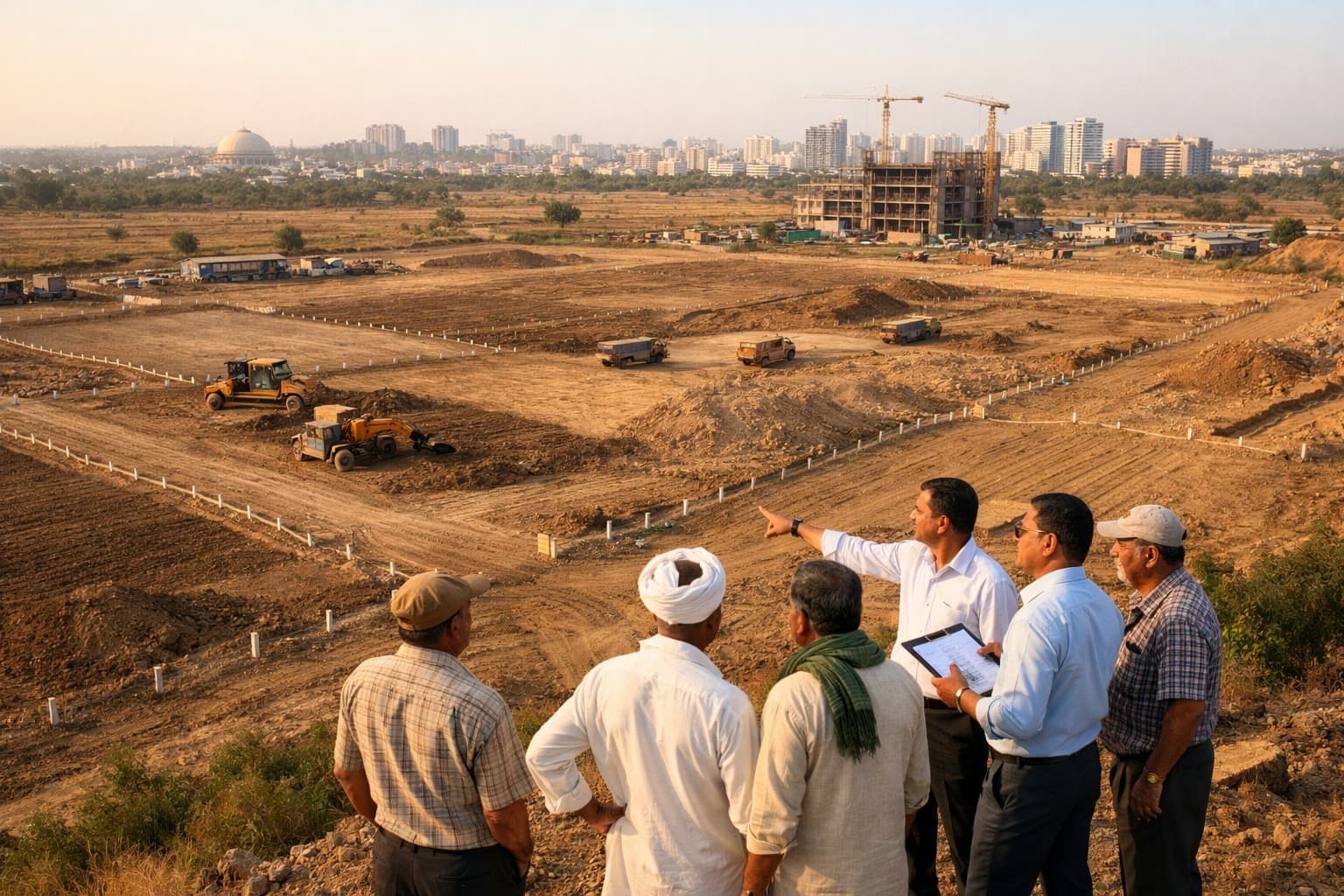
Despite the cost pressures, the project has been gaining practical momentum. NMRDA initiated Joint Measurement Record surveys across Godhani and Ladgaon in late 2025, with teams of revenue officials, NMRDA engineers, and landowners working together to verify boundaries and reconcile land records. By the time these surveys were underway, consent letters covering nearly 1,480 acres had already been submitted by farmers, with the remaining landholders also expressing their willingness to participate.
The JMR process is critical. It reduces the risk of disputes by involving landowners directly in the documentation exercise, something that larger infrastructure projects across India have often neglected with costly results. NMRDA has positioned transparency as a deliberate strategy here.
What This Means for Nagpur Real Estate
The Nagpur real estate market has been watching the New Nagpur IBFC project closely, and the response has already been visible. Land prices in the acquisition zone and its periphery have appreciated sharply. Areas adjacent to the project site, traditionally low-value agricultural belts, have attracted speculative buying from investors anticipating long-term urbanisation.

For residential buyers in Nagpur more broadly, the project signals sustained demand ahead. Over 5 lakh jobs are expected to be generated once the IBFC is operational. That level of employment creation would lift housing demand across multiple price segments in the city, from affordable housing in eastern corridors to premium gated communities near the western and Hingna belt.
The Risk That Cannot Be Ignored
Land acquisition in India remains one of the most dependable sources of project delay. The New Nagpur project is aware of this. Officials have moved relatively quickly to begin surveys and collect consent letters. But consent letters and completed acquisition are not the same thing. Compensation disputes, procedural timelines under the Land Acquisition Act, and the difficulty of acquiring the last holdouts can stretch schedules considerably.
If acquisition stalls, investor confidence in the project could waver, particularly for global businesses being courted to anchor the IBFC.
Summary
The New Nagpur IBFC land acquisition cost is on course to exceed Rs 4,000 crore, driven by a sharp rise in land values across Godhani, Ladgaon, and surrounding villages following the project announcement. The Rs 6,500 crore HUDCO funding for New Nagpur covers both acquisition and infrastructure, but the original Rs 3,000 crore land budget looks stretched given current market rates of Rs 2 to 3.5 crore per acre. With NMRDA, NBCC, and HUDCO formally aligned and surveys underway, the New Nagpur smart city project has cleared its early planning hurdles. Whether it can clear its land hurdles on time will determine how quickly Nagpur's ambitions translate into reality.
Video will be embedded from: https://www.youtube.com/watch?v=5vDwb5gMvJs