
Mumbai's Housing Stock Is About to Get the Most Ambitious Rebuild in Its History
Summary
Mumbai's MHADA is undertaking its most ambitious housing rebuild: a Rs 4 lakh crore, 925-acre redevelopment across 12 layouts. A new C&D model, involving major developers like Adani and Reliance, will rehabilitate over 75,000 families, vastly improving living spaces.

The Scale Is Hard to Wrap Your Head Around
Somewhere in the gap between a headline number and what it actually means on the ground, most readers lose the thread. So let us try to make this tangible. MHADA Mumbai is sitting on a redevelopment pipeline touching roughly 925 acres spread across twelve distinct layouts in the city. The combined investment required to rebuild all of it is being estimated at around Rs 4 lakh crore. That is four hundred thousand crore rupees flowing into Mumbai's ageing housing stock over the next decade.
India has rarely seen a single housing authority mobilise this kind of capital for one city at one time. And MHADA's 925-acre Mumbai redevelopment pipeline is only just getting started.
Why This Moment Is Different From Previous Attempts
Mumbai redevelopment has been discussed, promised, and partially attempted for decades. What makes 2026 different is a structural shift in how MHADA is approaching the problem. The old model required individual housing societies to find their own developers, negotiate their own terms, and push their own approvals. Most projects died in that process, strangled by misaligned incentives and financial unviability.
The newer MHADA C&D model changes the logic entirely. MHADA identifies large land clusters, appoints private developers with adequate financial capacity, and retains ownership of the land throughout. The developer earns from the saleable component. Residents get significantly larger homes. MHADA collects a housing inventory it can offer through its affordable lottery. All three parties get something. That alignment is why projects are actually moving now.
The Twelve Layouts and What Each Represents
The largest single cluster is Gorai at around 256 acres, estimated to require Rs 79,111 crore and rehabilitate over 26,000 families. Charkop in Kandivali runs close at 250 acres, with an investment estimate of Rs 87,307 crore and over 20,000 families in the rehabilitation count. Both are awaiting state cabinet clearance.
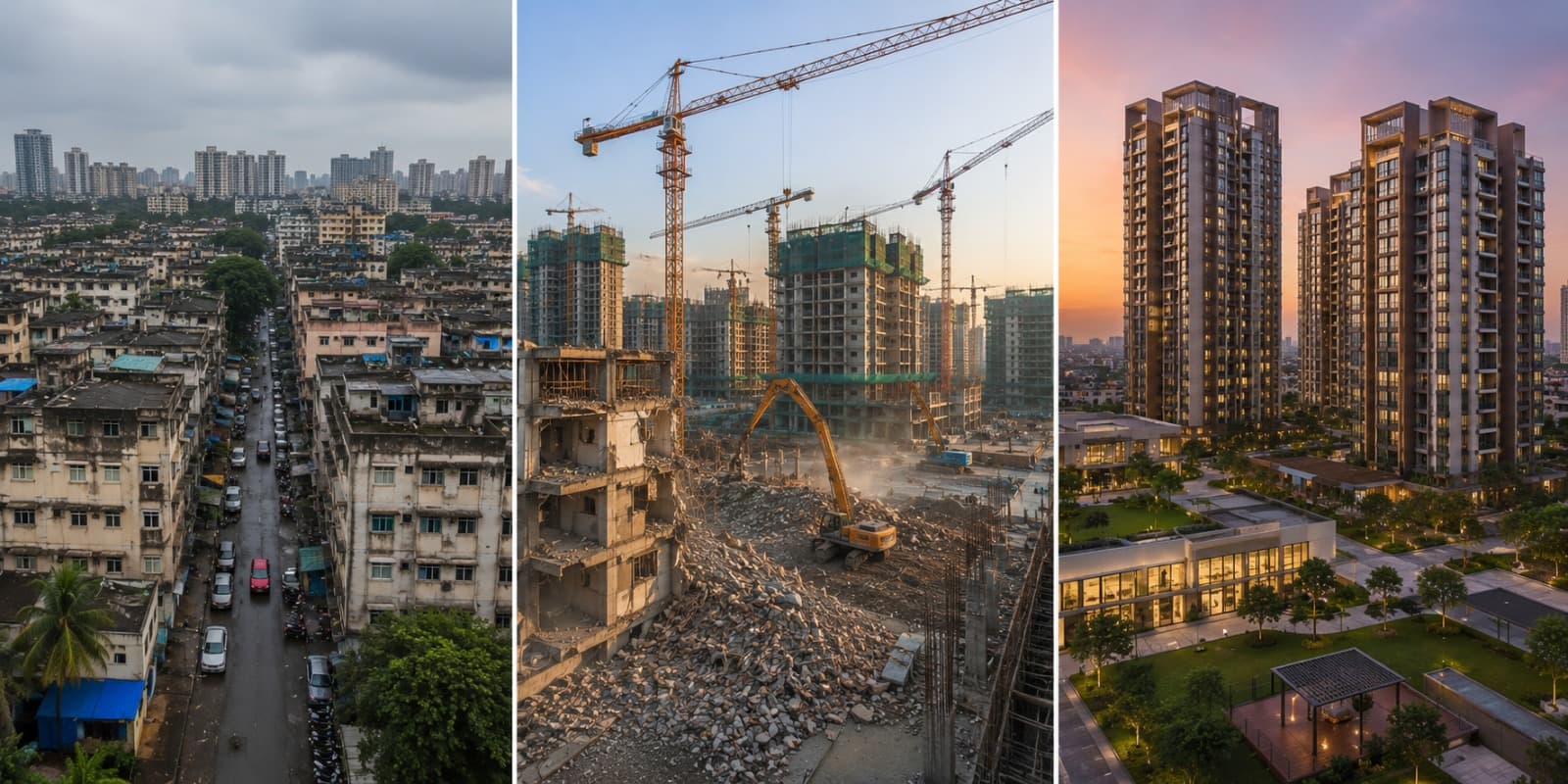
Motilal Nagar at 143 acres in Goregaon West has already passed that stage. Adani Realty won the tender for this project, which is expected to involve up to Rs 1 lakh crore in total outlay and eventually house close to 35,000 families on land that currently accommodates a fraction of that number. Eligible original tenants will receive redeveloped homes of 1,600 square feet, which is a dramatic upgrade from the roughly 230 square feet most of them occupy today.
Other layouts in the pipeline include Bandra Reclamation at 98 acres, Adarsh Nagar in Worli, Abhyudaya Nagar at 33 acres in Kalachowki, SVP Nagar in Andheri West, and several smaller clusters. Tenders have been awarded for seven of the twelve projects already, with the remaining two waiting on state-level approvals.
The Adani-Ambani Dimension
This programme has drawn the attention of India's biggest private sector names. Beyond Motilal Nagar, a consortium involving Reliance Industries through its 4IR Realty arm has won the bid for the 101-acre Juhu Galli cluster in Andheri West, covering rehabilitation for over 28,000 families. Adani and Reliance also placed competing bids for the SVP Nagar cluster separately.
The entry of groups of this scale into Mumbai housing redevelopment changes the execution risk profile considerably. These are not small builders hoping to flip a single tower. They are organisations with infrastructure execution experience across sectors, and that changes what is possible on large, complex parcels.
MHADA's Own Financial Transformation
One number that does not get enough attention: MHADA's own treasury has grown from roughly Rs 150 crore in mid-2023 to over Rs 5,000 crore by early 2026. That growth came largely from premiums collected from private developers participating in these programmes. A housing authority that was once cash-thin is now entering deals from a position of genuine financial strength.
This matters because it changes how MHADA negotiates. A landlord who needs the deal will accept worse terms than one who does not.
What 75,000 Families Actually Means
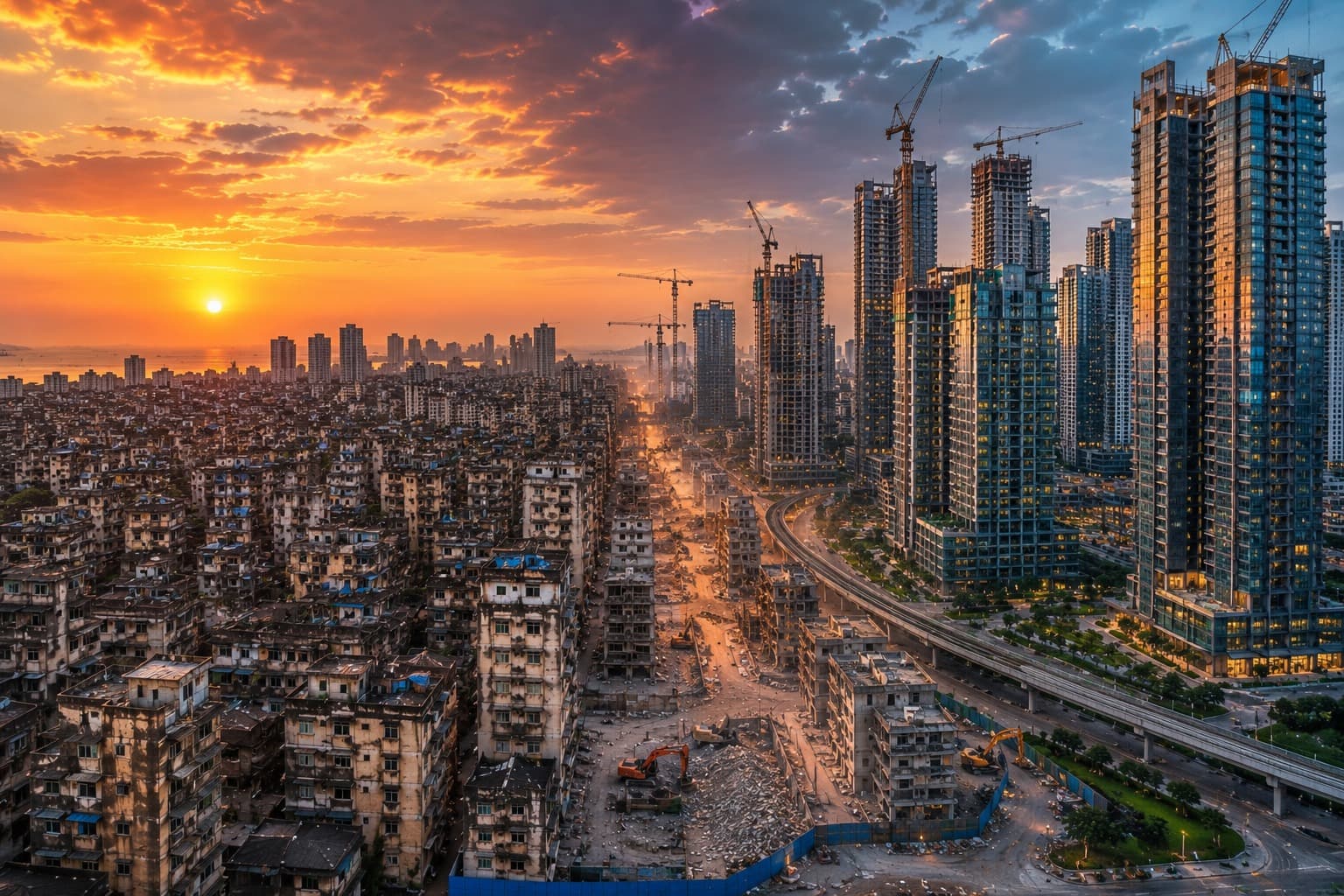
Across all twelve layouts, MHADA aims to rehabilitate over 75,000 households within five to seven years. These are families currently living in structures that, in many cases, have been standing for forty to sixty years. The buildings are tired, the infrastructure is strained, and the living space is genuinely inadequate.
The MHADA C&D model Mumbai is not replacing these communities. It is keeping them on the same land while tripling or quadrupling the usable living area. That is the part of this story that gets lost when the conversation focuses purely on the investment numbers.
Summary
MHADA's 925-acre Mumbai redevelopment pipeline worth Rs 4 lakh crore is reshaping the city block by block. Spanning twelve layouts from Motilal Nagar to Charkop and Gorai, the MHADA C&D model is drawing investments from groups like Adani and Reliance while targeting rehabilitation of over 75,000 families in five to seven years. With its own corpus crossing Rs 5,000 crore and tenders already awarded for seven clusters, MHADA Mumbai is executing the most consequential Mumbai urban renewal programme the city has seen in its modern history.
Video will be embedded from: https://www.youtube.com/watch?v=c7rVnuaPUvQ