Introduction
India’s commercial real estate sector has entered a phase of strong resurgence, led by remarkable growth in the office space India segment. The country’s total office space absorption in India 2025 surged by 34%, reaching nearly 42 million square feet across major cities. This growth reflects a significant rise in corporate confidence, business expansion, and renewed office leasing activity report India after a period of global economic uncertainty. Among the cities, Bengaluru real estate emerged as the clear leader, recording the highest office take-up of 9.95 million square feet. The expansion of the technology, financial services, and flexible workspace sectors has been central to this revival. This blog explores the key office market trends shaping the real estate news India landscape today.
The Big Picture: A Record-Breaking Year for Office Space India
The Indian office market in 2025 stands stronger than ever, signaling a vibrant recovery and consistent business optimism. According to recent reports, India’s office space absorption rises 34% to 42 million sq ft in 2025, marking a new benchmark and surpassing pre-pandemic levels. This remarkable performance reaffirms India’s position as one of the top cities for office space demand globally.
This increase highlights the confidence of both domestic and international companies in India’s economic stability, infrastructure, and skilled workforce. The resurgence of large-scale leasing transactions, expansions by technology giants, and the steady growth of global capability centers have made India a preferred destination for commercial real estate investors and occupiers worldwide.
Commercial Real Estate Momentum and Market Health
The surge in office space India absorption is a positive signal for the broader commercial real estate ecosystem. It reflects rising employment opportunities, improving business sentiment, and the continuing formalization of workspace demand. Developers, landlords, and investors have benefited from better occupancy rates, while tenants have gained access to an evolving supply of Grade A office infrastructure.
Average office rentals have also seen upward movement, growing from around ₹85 per sq ft to approximately ₹90 per sq ft year-on-year. This steady increase underlines the growing appetite for quality office spaces and the shift towards flexible yet premium work environments. India’s commercial property trends now align more closely with global standards, offering sustainable and technologically equipped office spaces that support hybrid working models.
Bengaluru Real Estate Leads India’s Office Market Growth
Bengaluru real estate continues to be the undisputed leader in India’s office market, accounting for 9.95 million square feet of total absorption in 2025. This performance highlights the city’s continued dominance as the country’s technology and innovation capital. The city’s strong talent base, advanced infrastructure, and large presence of IT, fintech, and startup ecosystems have created an ideal environment for business expansion.
Several global technology and consulting firms have expanded their footprint in Bengaluru this year, supported by the growing role of Global Capability Centres (GCCs). Moreover, the city’s availability of high-quality Grade A spaces, coupled with its strong connectivity and well-developed micro-markets, has made it the top destination for corporate occupiers.
Bengaluru leads India’s commercial real estate with 9.95 mn sq ft office take-up, reaffirming its position as the benchmark for India’s office market trends and a model for urban commercial development.
Key Demand Drivers for Office Space Absorption in India 2025
Several factors are driving office space absorption in India 2025:
Technology and IT/ITeS Sector: This segment remains the largest contributor, accounting for about 27% of total leasing activity.
Global Capability Centres (GCCs): Multinational corporations continue to set up and expand their offshore operations in India due to cost efficiency and talent quality.
Flexible Workspaces: The rise of coworking operators has been remarkable, representing about 23% of the total leasing volume.
BFSI and Consulting Sectors: Financial institutions and consulting firms are actively leasing new spaces as they resume full-scale office operations.
Focus on Quality and Sustainability: Tenants now prefer modern, green, and technology-enabled workspaces that enhance productivity.
Together, these drivers explain why Bengaluru office market growth and India’s overall commercial real estate expansion remain strong and consistent.
Supply and Vacancy Trends: Balancing Demand and Availability
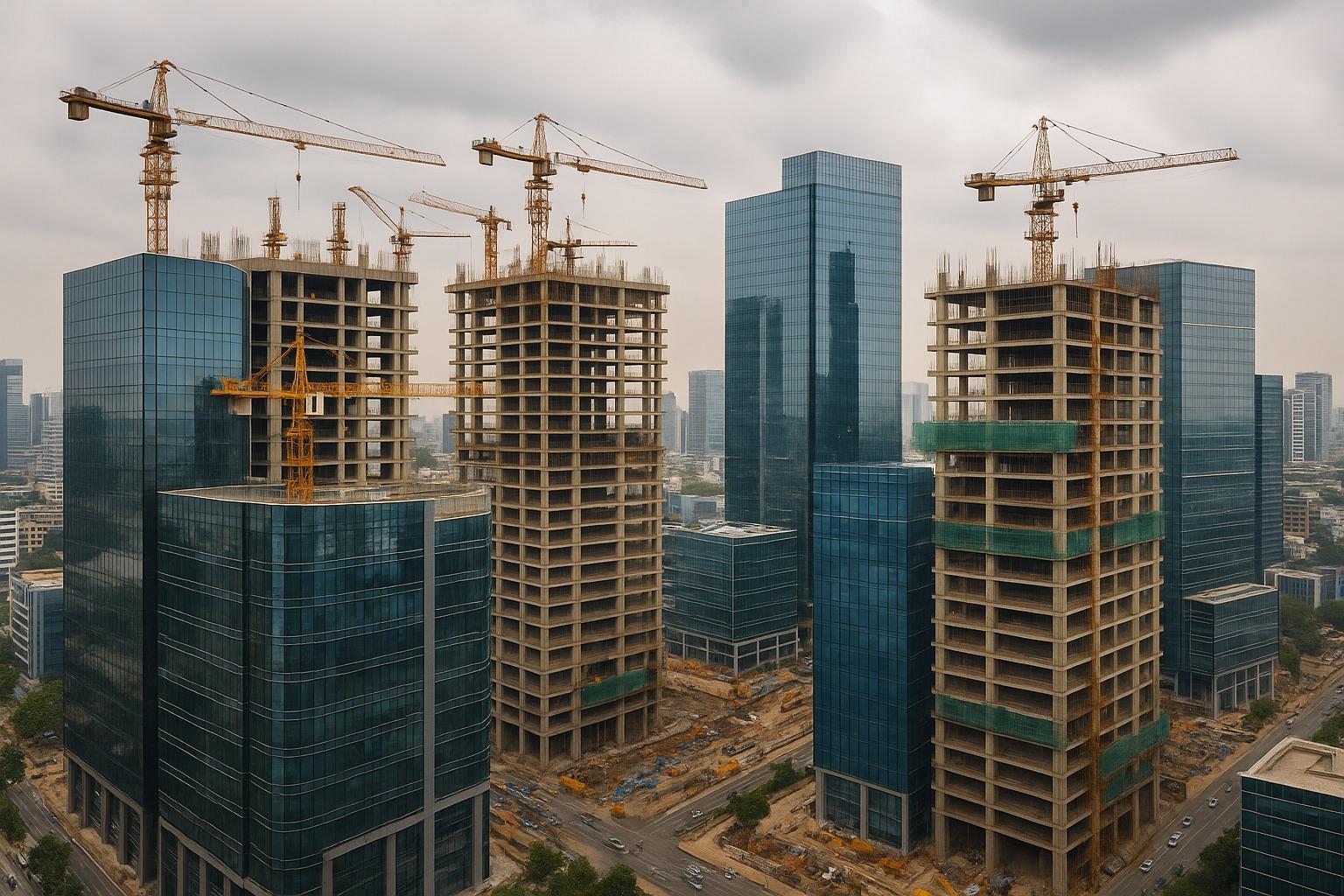
While demand has been growing rapidly, developers have been equally proactive in adding new supply. The top seven cities recorded new office completions of about 39 million square feet in the first nine months of 2025, a 15% increase compared to last year.
Vacancy levels have also improved, reflecting a balanced market.
Chennai: Lowest vacancy rate at around 8.9%.
Bengaluru: Healthy vacancy rate of 15.8%.
Delhi-NCR: Around 17.6%.The overall national average stood at 16.2%, showing stability and sustainable growth in India commercial property trends.
The balanced demand-supply equation ensures that leasing activity remains strong while maintaining reasonable rental growth.
City-Wise Breakdown: Diverse Growth Stories Across India
While Bengaluru real estate leads, other Indian cities also contribute significantly to office leasing activity report India:
Delhi-NCR: Logged around 8.2 million sq ft absorption, driven by demand in Gurgaon and Noida.
Mumbai Metropolitan Region: Recorded about 6.6 million sq ft of leasing activity, highlighting resilience in India’s financial capital.
Pune: Registered a 168% rise in new office supply, demonstrating strong growth potential.
Hyderabad and Chennai: Continued to perform strongly, supported by IT and BFSI sectors.
Kolkata: Showed moderate leasing activity but higher vacancy, indicating potential for future absorption.
This city-wise variation shows that while some cities dominate demand, others are rapidly improving infrastructure and supply to attract corporate occupiers.
Office Market Trends Shaping the Future
The office market trends in India reveal a clear transformation toward quality and flexibility.
Larger Leases: Many corporates are signing leases exceeding 100,000 sq ft, showing confidence in expansion.
Hybrid Work Models: Companies are adapting to hybrid operations, increasing the demand for flexible workspaces.
Sustainable Buildings: Tenants now prefer energy-efficient and wellness-certified spaces.
Technology Integration: Smart offices with digital systems and sustainable energy designs are now industry standards.
These trends reinforce India’s evolution from being a cost-effective workspace hub to a strategic global office destination.
Implications for Developers, Investors, and Occupiers
The strong rise in office space India absorption impacts every stakeholder in the commercial real estate sector:
Developers: Must focus on building premium, sustainable, and flexible Grade A offices.
Occupiers: Should take advantage of the current phase to secure leases in high-demand zones.
Investors: The consistent rental growth and healthy demand make India one of the best destinations for commercial real estate investments.
Policymakers: Need to strengthen infrastructure and connectivity to support upcoming business districts.
The resilience of India commercial property trends offers a clear roadmap for sustained urban and economic development.
The Road Ahead: Sustained Growth and Global Appeal
The outlook for office leasing momentum across major Indian cities 2025 remains highly positive. Demand from technology firms, startups, and multinational corporations is set to remain robust. Rental rates are likely to continue rising moderately, while vacancy levels may decline further in prime locations.
Cities such as Bengaluru, Pune, Hyderabad, and Chennai will continue to dominate, while Delhi-NCR and Mumbai strengthen their appeal as global business hubs. The focus on sustainability, digitization, and employee well-being will shape the next generation of offices.
India’s real estate news India sector, particularly the commercial real estate space, stands poised for continued success as it aligns with international standards and investor expectations.
Summary
India’s office space absorption rises 34% to 42 million sq. ft in 2025, led by Bengaluru real estate with 9.95 million sq. ft. Strong demand from IT, GCCs, and flexible workspace operators fuelled this surge. Rental rates increased steadily, while vacancy stabilized across top cities for office space demand. With healthy office market trends and sustained office leasing activity report India, the commercial real estate sector shows long-term promise. Bengaluru leads India’s commercial real estate journey, marking a new milestone in India commercial property trends and nationwide business expansion.