
India's Manufacturing Boom: How Property Developers Are Building Industrial Townships
Summary
India's manufacturing boom, fueled by PLI schemes and infrastructure development, is spurring private industrial townships. Property developers are seizing opportunities to build integrated industrial parks and meet the rising residential demand from the manufacturing workforce.

Introduction
Something interesting is happening at the edges of India's tier 2 cities. Where agricultural land and scrubby highway margins sat quietly for years, cranes are rising, roads are being laid, and security gates are going up around parcels that until recently had no obvious commercial purpose. Industrial townships India are no longer a government planning concept. They are active real estate products being developed by private property companies that smell opportunity in the manufacturing wave sweeping through the country's economic policy landscape. The convergence of PLI incentives, China-plus-one supply chain logic, and dedicated freight corridor connectivity has created a demand for organised industrial land that the market is only beginning to understand how to serve.
What Changed to Make This Happen
India has had industrial estates since the 1960s. MIDC in Maharashtra, GIDC in Gujarat, KIADB in Karnataka. These government-run clusters delivered land and basic utilities to manufacturers for decades. They still function and they still matter. But they were never designed for the scale, the speed, or the quality standards that global manufacturers arriving through PLI programmes demand today.
A semiconductor component supplier or an electronics manufacturer evaluating India as a production base looks for plug-and-play infrastructure. Power with redundancy built in. Roads wide enough for forty-tonne trucks. Worker housing within a fifteen-minute commute. A food court, a bank branch, a medical centre. Government industrial estates built in 1975 were not designed around these requirements. Private industrial townships India are, and that gap is exactly where developers have moved.
The PLI Catalyst and What It Created
The Production Linked Incentive scheme across fourteen sectors has pulled global and Indian manufacturers toward capital commitment decisions that require industrial land at scale and on timeline. Electronics, pharmaceuticals, textiles, food processing, specialty chemicals, and defence components are all sectors where PLI beneficiaries need operational sites that can be developed and handed over in eighteen to twenty-four months.
PLI scheme real estate demand has therefore been qualitatively different from earlier waves of industrial growth. These are not companies looking for a plot and a shed. They want finished, compliant, connected facilities in managed parks where the developer handles regulatory approvals, infrastructure maintenance, and workforce support services. Developers who understand this have built products that government estates simply cannot replicate at comparable speed.
Which Developers Are Actually Building
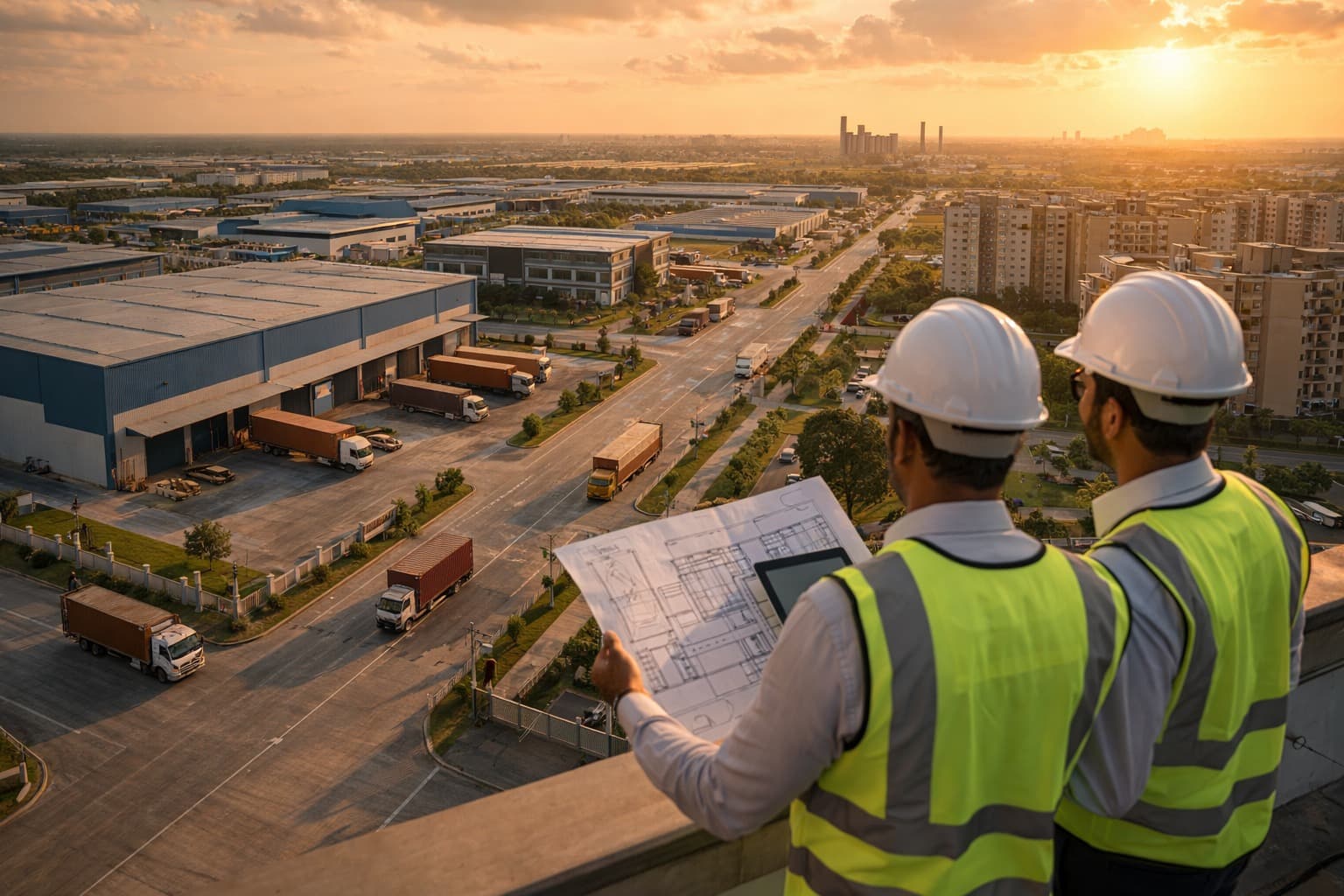
The names entering this space are a mix of established industrial park specialists and residential developers making a deliberate pivot. IndoSpace has been India's largest private industrial and logistics real estate platform for several years, developing Grade A parks across Pune, NCR, Chennai, Bengaluru, and Rajasthan. ESR India, Welspun One, and Embassy Industrial Parks have been competing actively in the same space.
What is newer is the entry of developers with primary residential backgrounds. Hiranandani Communities launched its data centre and industrial park strategy through Hiranandani Fortune City Panvel. Brigade Group announced its first industrial real estate entry at Devanahalli in Bengaluru. These residential-to-industrial pivots reflect a recognition that Make in India property demand is too large and too durable to leave entirely to specialist industrial operators.
Where the Townships Are Emerging
The geography of industrial township development follows the infrastructure map rather than population density. The Delhi-Mumbai Industrial Corridor nodes, Shendra-Bidkin near Aurangabad, Dholera in Gujarat, and the integrated manufacturing cluster at Tumkur near Bengaluru are all receiving organised private investment. The Chennai-Bengaluru Industrial Corridor and the Amritsar-Kolkata Freight Corridor are generating their own ring of industrial township activity.
Pune's Chakan, Rajgarh Road, and Khed Rajgurunagar belt continue to attract automotive and component manufacturer demand. Hosur in Tamil Nadu has become India's electric vehicle manufacturing concentration point. Sanand in Gujarat has the FAME scheme-linked EV cluster. Each of these locations is generating residential demand in a ten to fifteen kilometre ring around the primary industrial zones, which is where developers with residential expertise have a natural advantage.
The Residential Demand That Follows Manufacturing
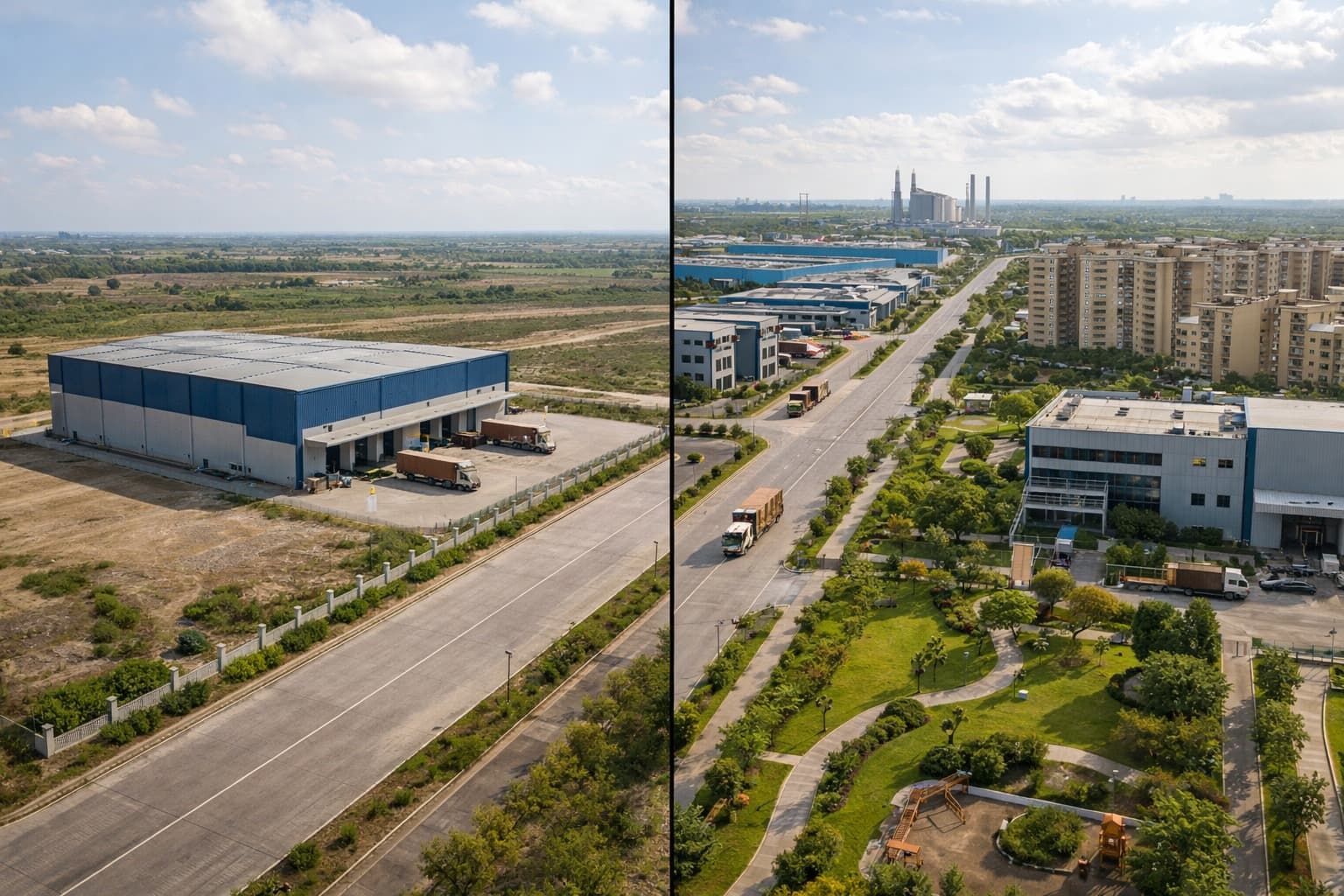
This is the part of the industrial township story that property buyers and residential investors should pay close attention to. Every large manufacturing facility that becomes operational creates a workforce of several hundred to several thousand people who need homes. The immediate workforce is largely absorbed by affordable housing in the nearest town. The management and technical workforce, drawing salaries between Rs 40,000 and Rs 2 lakh per month, needs mid-segment housing that most industrial towns historically do not have.
Manufacturing real estate India therefore creates two simultaneous property opportunities: the industrial asset itself, which requires large capital and specialist management, and the residential and commercial development that serves the industrial workforce, which is exactly the product residential developers already know how to build and sell.
Summary
India's manufacturing push through PLI incentives, Make in India policy, and dedicated freight corridor connectivity is driving property developers to build industrial townships that private operators and government estates alike were previously unable to supply at the required quality and speed. Specialist industrial park developers and residential developers entering the space are meeting demand from global manufacturers needing plug-and-play facilities across Pune, NCR, Chennai, Hosur, and DMIC corridor nodes. The residential real estate demand that industrial employment generates in surrounding areas creates a second opportunity layer that developers with housing expertise are well positioned to capture in 2026 and beyond.
Video will be embedded from: https://www.youtube.com/watch?v=Zk3XGZ8yVxE