
CIDCO's ₹16,250 Crore FY27 Plan: Transforming Navi Mumbai
Summary
CIDCO's ₹16,250 crore FY27 plan focuses on transforming Navi Mumbai around its new international airport. The plan includes metro connectivity, economic zones, housing, and infrastructure, signaling major growth potential for Navi Mumbai property.

Introduction
Navi Mumbai has spent decades as a planned city that never quite fulfilled the ambitious vision on which it was built. That may be changing. The City and Industrial Development Corporation has announced a budget of Rs 16,250 crore for FY 2026-27, the largest outlay in its history, centred almost entirely on capitalising on the newly operational Navi Mumbai International Airport. The plan covers metro connectivity, specialised economic zones, a massive housing rollout, and infrastructure projects that together represent a genuine city-building exercise rather than incremental improvement. For real estate investors and homebuyers, understanding what CIDCO is doing and where it is investing is essential context for any decision involving Navi Mumbai property.
The Numbers Behind the Budget
CIDCO projects receipts of Rs 16,250 crore against estimated expenditure of Rs 16,150 crore for FY27, leaving an anticipated surplus of Rs 100 crore. This is a sharp jump from the revised FY26 figures where receipts stood at Rs 9,774 crore and expenditure at Rs 9,770 crore. The increase reflects both the scale of planned development and the corporation's improved financial position following the NMIA launch. Vijay Singhal, Vice Chairman and Managing Director of CIDCO, described the fiscal stability of the past year as giving the corporation the financial agility to act decisively.
The Airport as the Core of the Strategy
The Navi Mumbai International Airport was inaugurated in October 2025 and commenced domestic operations on 25 December 2025. It currently handles around 150 air traffic movements daily across 76 cities, serving approximately 19,000 passengers per day. International operations are expected to begin by the end of April 2026. CIDCO is building its entire FY27 strategy around the airport as an economic catalyst.

The corporation envisions a cluster of specialised zones around the airport, including an Aerocity, an EduCity, a MediCity, and an International Corporate Park. A 155-hectare corporate park at Kharghar and a 560-hectare integrated logistics hub near JNPA are among the anchor projects within this framework.
Metro Line 8 and the Connectivity Push
The single most important infrastructure project in CIDCO's pipeline is Metro Line 8, a 34.89-kilometre corridor connecting Chhatrapati Shivaji Maharaj International Airport in Mumbai to NMIA. This line is expected to serve nearly 9.8 lakh passengers daily by 2031. It directly addresses what is currently the airport's most significant weakness: connectivity to Mumbai's established transit network.
Additionally, a 25.3-kilometre Thane to NMIA elevated corridor, estimated at Rs 6,521 crore, is under construction. Once complete, it will cut travel time between Thane and the airport from 90 minutes to roughly 30 minutes. Navi Mumbai Metro Lines 1A and 2, connecting Belapur and Pendhar to NMIA respectively, are also in planning stages.
Housing: 19,300 Units Planned for FY27
On the residential front, CIDCO is targeting the rollout of approximately 19,300 housing units in FY27, building on the 16,876 units offered in FY26. The housing schemes are positioned near railway and metro stations under a Transit Oriented Development framework, ensuring that residents in CIDCO housing have access to public transport infrastructure. This scale of affordable and mid-income housing supply is significant for a city where demand consistently outstrips availability in the planned residential zones.
What This Means for Navi Mumbai Property
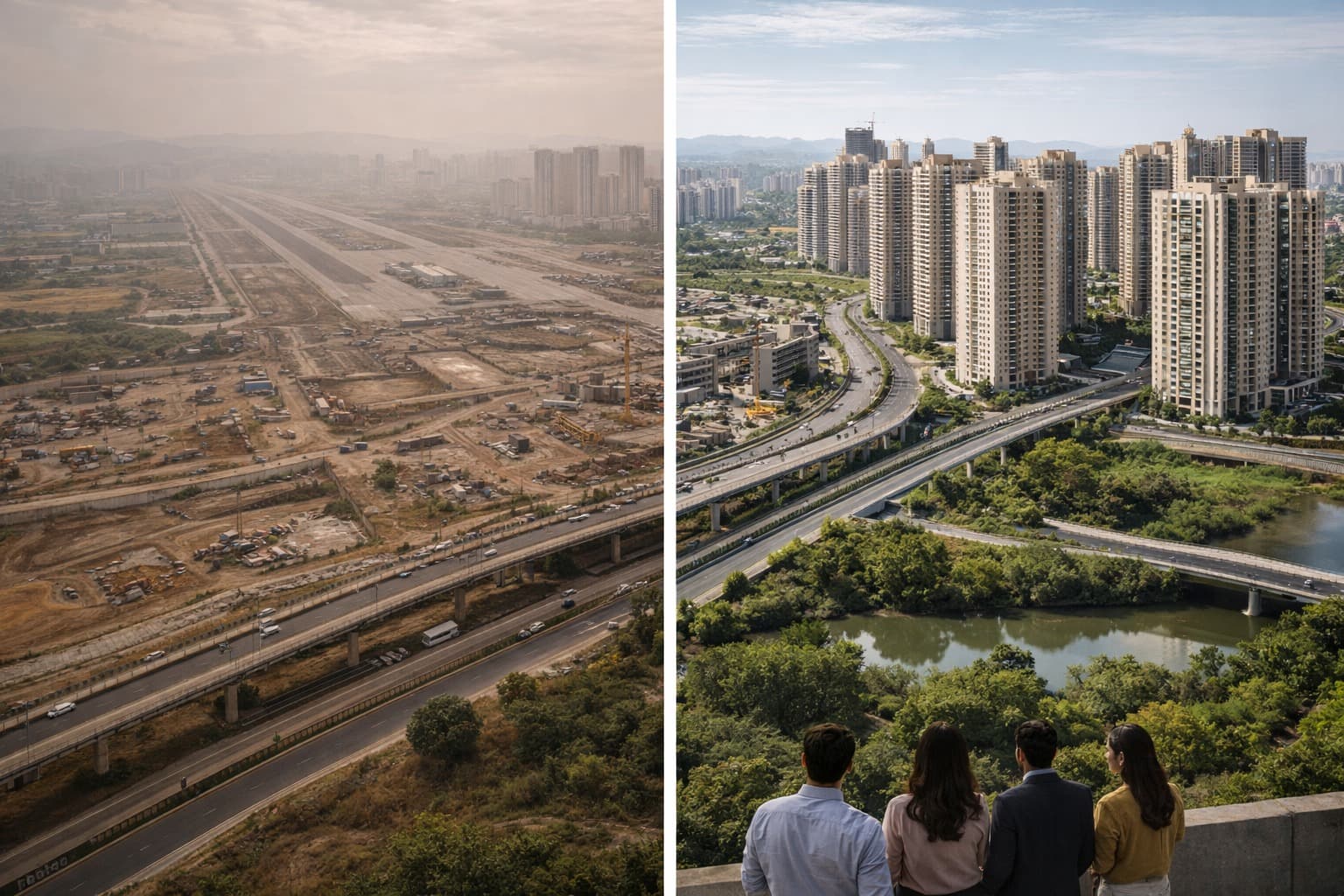
Real estate around operational airports and improving metro networks tends to appreciate in a predictable direction. Navi Mumbai has historically traded at a discount to Mumbai because connectivity to the island city was slow and the social infrastructure was thinner. Both conditions are now being addressed simultaneously. The airport makes Navi Mumbai a destination in its own right rather than just a commuter town. The metro investments reduce the friction of reaching Mumbai and the airport from within Navi Mumbai. The corporate parks and logistics hubs create local employment that generates housing demand from people who live and work within the city itself.
Summary
CIDCO's Rs 16,250 crore FY27 budget is anchored on the Navi Mumbai International Airport and supported by Metro Line 8, a Rs 6,521 crore Thane-NMIA elevated corridor, 19,300 new housing units, and specialised economic zones including Aerocity, EduCity, and MediCity. For real estate investors, this plan signals a sustained, government-backed infrastructure push that is structurally supportive of Navi Mumbai property appreciation over the next five to ten years.
Video will be embedded from: https://www.youtube.com/watch?v=qnlYeSNVWKU