
PoA for NRI Property Across Indian States: What You Need to Know Before You Sign
Summary
For NRIs managing Indian property, a Power of Attorney is key. This guide details PoA types, the notarization and attestation process, crucial state-specific stamping and registration rules, and safeguards against misuse.

The Problem Every NRI Recognises
You have a flat in Bengaluru sitting vacant. Or a plot in Chennai that needs to be transferred. Or a Pune apartment where the tenants need a new agreement signed. But you are in Dubai, Toronto, or Sydney, and flying to India every time something needs a signature is neither practical nor cheap.
This is precisely why the Power of Attorney exists, and why it has become one of the most used legal tools among NRIs managing property in India. Done correctly, it lets a trusted person in India handle almost everything on your behalf. Done carelessly, it can go badly wrong.
Two Types, Two Very Different Uses
Before anything else, you need to understand the difference between a General Power of Attorney and a Special Power of Attorney, because conflating the two is where most problems start.
A General PoA, or GPA, hands over broad authority to the person you appoint. They can manage rent collection, pay utility bills, deal with society matters, appear in legal proceedings, and handle multiple transactions over an extended period. It is the tool of choice when you want an ongoing arrangement covering several aspects of property management.
A Special PoA, or SPA, is narrowly scoped. It authorises the holder to do one specific thing, such as registering a sale deed for a particular flat, or executing a lease agreement for a named property. Once that task is done, the document's purpose is exhausted. For property sales especially, legal advisors consistently recommend the SPA route. It limits exposure and reduces the risk of the authority being misused beyond its intended scope.

The Step-by-Step Process for NRIs
The process of creating a valid NRI Power of Attorney starts abroad, not in India.
First, you draft the document with the help of a lawyer familiar with Indian property law. The draft must clearly name the grantor, the attorney holder, and the exact scope of authority being granted. Vague language in a PoA creates loopholes that are hard to close later.
Next, you sign the document in your country of residence in front of a notary public and two witnesses. The document then needs authentication. If your country of residence is a signatory to the Hague Convention, an apostille stamp from a designated government authority is sufficient. If it is not, the document needs attestation from the nearest Indian Embassy or Consulate. Holders of Indian passports and OCI cards are specifically exempt from the apostille requirement, but notarisation by a notary public is still mandatory.
Once the authenticated document reaches India, typically sent by courier to your attorney holder, the clock starts. The PoA must be stamped and adjudicated at the Sub-Registrar's office within three months of arriving in India. After this window, the document can be treated as legally invalid for property transactions. The adjudication process is where an authorised officer verifies the document, affixes the required stamp, and issues a certificate of adjudication. This can take anywhere from two to fifteen working days depending on the state office's workload.
How State Rules Differ
This is where many NRIs get tripped up. Stamp duty on a PoA is not uniform across India. Every state has its own Stamp Act and its own rates, and a PoA adjudicated in one state cannot simply be used in another state without fresh stamping.
In Maharashtra, stamp duty on a property-related PoA ranges from ₹500 to ₹5,000 depending on the nature of the transaction. The state has made e-stamping mandatory for several document types including PoAs. States like Delhi and Karnataka also support e-stamping, which reduces the need for physical visits for at least part of the process.
Karnataka charges stamp duty of 5 percent of the market value when the PoA authorises the sale of real estate, which makes it one of the costlier states for property-related PoA execution. Delhi charges ₹100 for a general PoA and ₹1,000 for a sale-related one, making it considerably lighter on the pocket. Tamil Nadu and Kerala, which operate under the Indian Stamp Act with state-specific amendments, have their own rate schedules that require separate verification before execution.
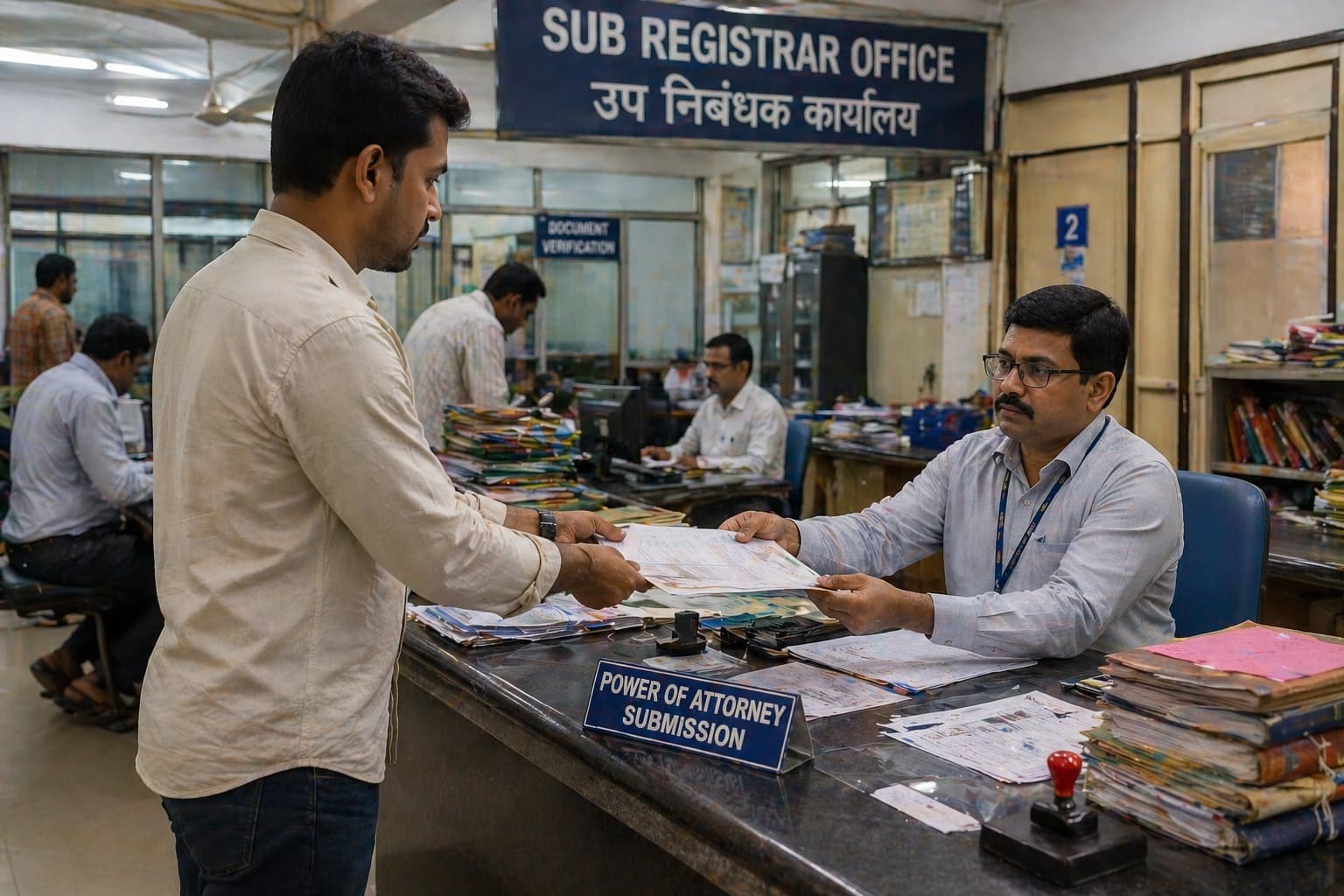
One important rule applies everywhere without exception. A PoA that authorises the sale of immovable property must be compulsorily registered at the Sub-Registrar's office. Stamping alone is not enough. This was reinforced by a Karnataka High Court ruling and reflects the broader position across Indian states that sale-linked PoAs need full registration to hold legal weight.
Protecting Yourself from Misuse
Giving someone your Power of Attorney is an act of significant trust. A few safeguards make that trust harder to abuse.
Always set a validity period in the document itself. A PoA without an expiry date stays live until formally revoked, which creates ongoing risk if the relationship with your attorney holder changes. Build in a reporting requirement, asking the holder to send you periodic written updates on transactions undertaken. Exclude high-risk actions explicitly, such as gifting the property, creating any charge or mortgage, or making transfers to third parties.
If you ever need to revoke the PoA, execute a formal Deed of Revocation, notify the holder in writing, and if the original PoA was registered, get the revocation registered as well. Publishing a notice in a local newspaper adds an additional layer of protection in cases where misuse is suspected.
Summary
A well-executed NRI Power of Attorney removes the need for constant travel to India while keeping your property interests firmly protected. Whether you choose a General or Special PoA, the process involves notarisation abroad, attestation or apostille, and mandatory stamping and adjudication in India within three months. Stamp duty and registration rules vary significantly across states like Maharashtra, Karnataka, Delhi, and Tamil Nadu, making it essential to consult a local lawyer in the state where your property sits before you finalise the document.