
E-Registration of Property in India: A Complete Guide for Homebuyers in 2026
Summary
E-registration of property in India is becoming mandatory from 2026, driven by the Registration Bill 2025. This guide details the digital process, required documents, and benefits for homebuyers, ensuring faster, secure transactions.

Introduction
Property registration in India used to be an ordeal. Multiple trips to the sub-registrar's office, stacks of photocopies, long waiting times, and the ever-present risk of human error in manual records. For decades, buying a home meant navigating a system that had barely changed since the Registration Act of 1908.
That is now changing fast. E-registration of property has arrived across much of India, and the government is pushing to make it the default. Understanding how it works is no longer optional for any homebuyer.
What Is E-Registration
E-registration is the process of completing property registration digitally, replacing the physical stamping, document submission, and manual recording that traditionally required presence at a sub-registrar's office.
It encompasses three core elements working together: electronic stamp paper generation, online document submission, and digital verification of identity using Aadhaar and biometric authentication.
The goal is to record property ownership in a way that is faster, tamper-proof, and accessible from anywhere.
The Registration Bill 2025: India's Big Reform
The Central Government introduced the Registration Bill 2025, designed to replace the Registration Act of 1908 that had governed property transactions for over a century.
The bill introduces enabling provisions for fully online registration, electronic presentation and admission of documents, issuance of electronic registration certificates, and digital maintenance of records. It permits Aadhaar-based authentication while also providing alternative verification for those who do not possess Aadhaar or choose not to use it.

Once operationalised, this bill will create a standardised digital framework across all states, replacing the patchwork of state-specific systems currently in use.
From February 2026, digital property registration has become mandatory in several states, with buyers and sellers completing the process through state land registry portals.
How E-Registration Works: Step by Step
The process begins with drafting a legally correct sale deed or agreement, usually prepared by a lawyer or property advocate. This document outlines the transaction terms, property description, and both parties' details.
The next step is obtaining e-stamp paper through the state's designated online portal. Physical stamp papers are being phased out. E-stamps are generated through secure government systems, cannot be duplicated or forged, and carry a unique identification code.
Once the deed is prepared and stamped, both the buyer and seller must upload supporting documents to the state's registration portal. These typically include identity proof, address proof, the property title deed, the encumbrance certificate, PAN cards, and any required no-objection certificates.
An online appointment is then scheduled at the sub-registrar's office for biometric verification. In most states this is still required for the formal execution, but the queue is shorter because all documents are pre-uploaded.
On the appointment day, both parties attend for biometric fingerprint and facial authentication via Aadhaar. Compulsory video recording of the registration process now serves as legal evidence. Once verified, the registration certificate is issued digitally and can be downloaded immediately.
The entire process, from uploading documents to receiving the registered deed, is expected to complete within seven working days under the new framework, compared to the 15 to 30 days that physical registration often took.
Documents You Will Need
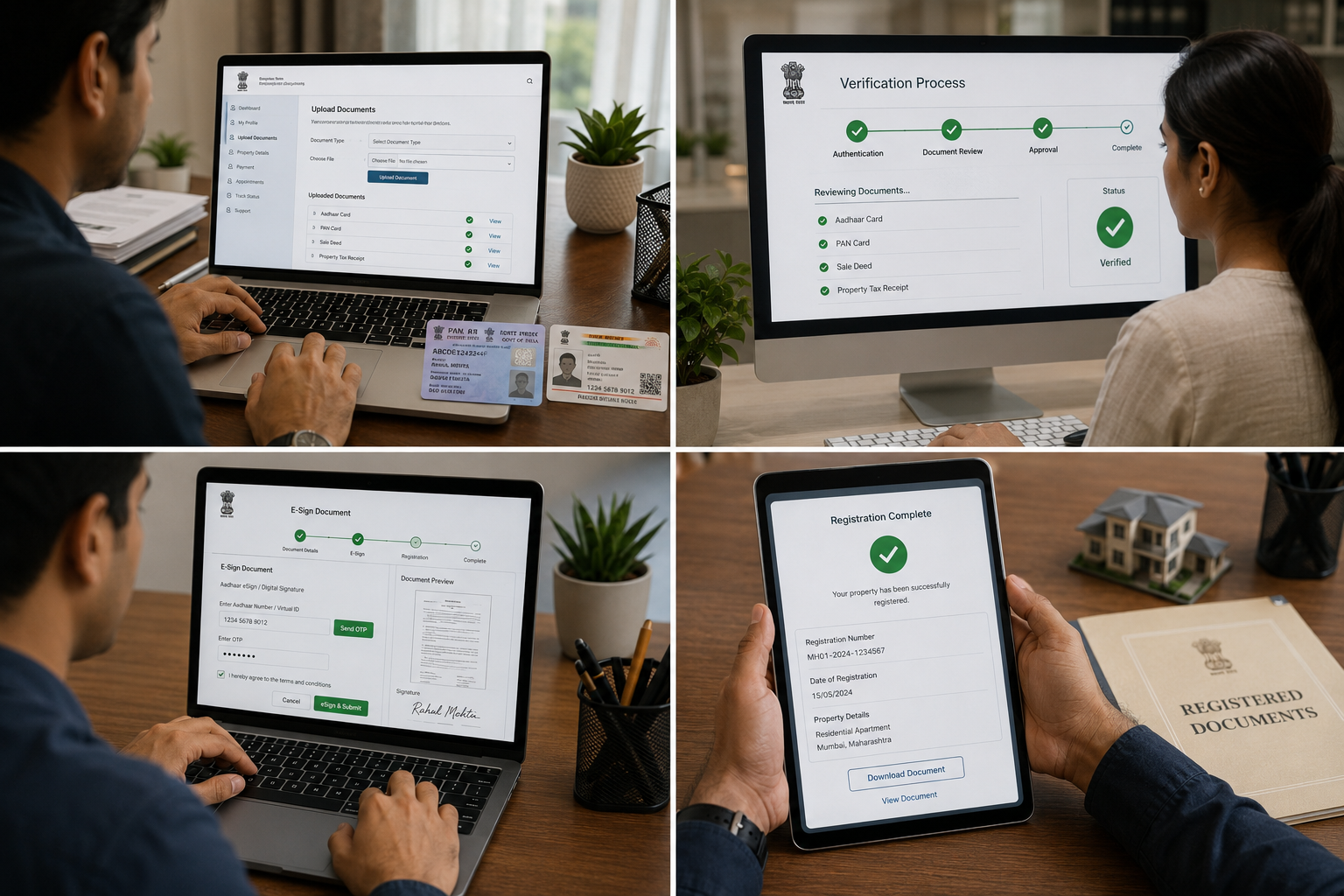
Regardless of state, the core document checklist remains consistent. Aadhaar card and PAN card for both buyer and seller. A recent address proof such as a utility bill or bank statement. The sale deed or agreement draft prepared by a qualified lawyer. Previous title documents establishing the seller's ownership chain. An encumbrance certificate confirming the property carries no outstanding loans or legal claims. Any applicable NOC from a housing society, bank, or development authority.
For NRIs completing registration remotely, a properly executed and notarised power of attorney is essential, along with passport and visa documentation.
Why This Matters for Homebuyers
E-registration removes several of the biggest risks in traditional property transactions.
The e-stamp system eliminates forged stamp papers, which have historically been a tool for property fraud in India. Digital records make it far harder to sell the same property to multiple buyers, a scam that has trapped buyers across cities. Automated validation checks in online portals catch errors in documents before submission, reducing rejections.
For buyers purchasing from NRIs or developers based in different cities, remote registration capability means the transaction no longer depends on all parties being physically present in the same city.
The integration of property records with Aadhaar, PAN, and eventually other government databases also means that unverified ownership claims become harder to sustain over time.
Summary
E-registration of property in India is becoming mandatory, backed by the Registration Bill 2025 and state-level digital portals already operational in Maharashtra, Karnataka, Delhi, and several other states. The process involves e-stamp generation, online document submission, Aadhaar-based biometric verification, and digital issuance of registration certificates. For homebuyers in 2026, understanding e-registration is not just useful. It is essential protection for one of the most significant financial decisions of their lives.
Video will be embedded from: https://www.youtube.com/watch?v=-xCSvYwoLO4