
India's ₹17 Lakh Crore Infrastructure Bet: What It Means for Your Next Property Decision
Summary
India's massive ₹17 lakh crore infrastructure plan signals big shifts for real estate. It will reshape land values and housing demand, but success hinges on execution, not just announcements. Track project progress to find prime investment opportunities.

Introduction
There is a moment when a country decides it is done apologising for its roads, its ports, its power supply. India appears to have reached that moment. In January 2026, the Department of Economic Affairs under the Ministry of Finance announced what may well be the most ambitious India infrastructure plan in recent memory: a three-year PPP project pipeline comprising 852 projects with a combined price tag exceeding ₹17 lakh crore. That is roughly equivalent to the entire annual output of several mid-sized economies, committed in a single structured document.
For the average homebuyer or property investor, the natural instinct is to file this under "government news" and move on. That would be a mistake. Announcements of this scale reshape land values, alter rental demand, and redraw the geography of desirable addresses. This one deserves a closer look.
What Exactly Is This Plan?
The PPP project pipeline works on a model where the government and private sector join hands: the government provides the framework, policy support, and sometimes partial funding, while private players bring in capital, expertise, and operational efficiency. Think of it as a contract between ambition and accountability.
This particular pipeline covers fiscal years 2026, 2027, and 2028. The goal, as the Finance Ministry stated when announcing it, is to give investors and developers visibility well in advance so they can plan, commit capital, and mobilise resources without the usual fog of uncertainty. That kind of advance notice is rarer than it sounds in Indian infrastructure circles.
Who Is Building What?
The 852 projects split into two broad groups. Central government ministries are sponsoring 232 projects worth over ₹13 lakh crore, with the Road Transport and Highways Ministry alone accounting for 108 projects valued at roughly ₹8.76 lakh crore. The power sector contributes 46 projects worth about ₹3.40 lakh crore, while ports, shipping, railways, and civil aviation share the remainder.
State governments and Union Territories bring in 620 projects of their own, collectively worth around ₹3.84 lakh crore. Andhra Pradesh leads at the state level with 270 projects exceeding ₹1.15 lakh crore, and Tamil Nadu follows with 70 projects crossing ₹87,000 crore. The spread across more than 20 states ensures this is genuinely a national push rather than a concentration in already-developed corridors.

The Roads Story Is the Real Estate Story
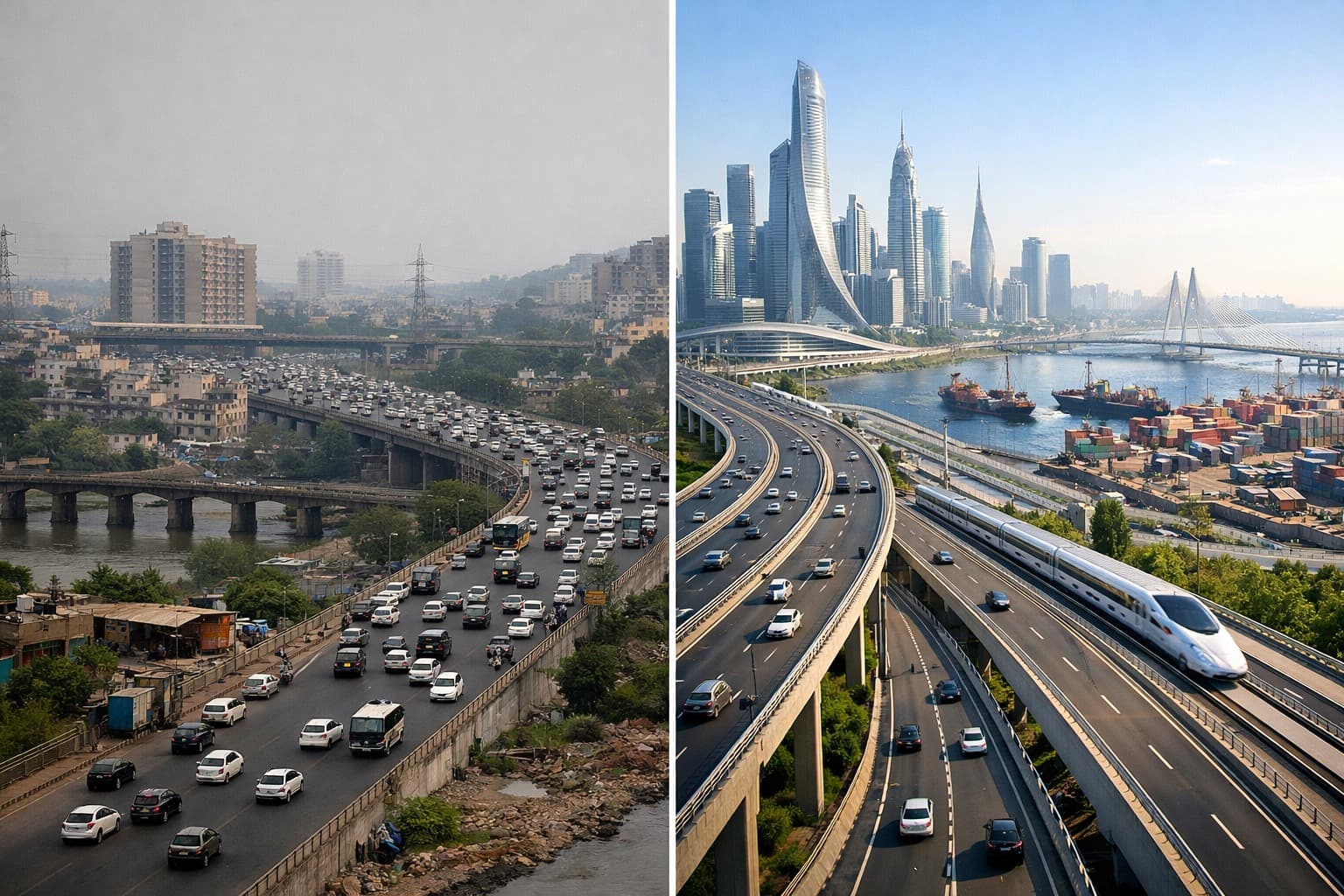
Here is something seasoned property watchers understand instinctively: wherever a good road goes, prices follow. The dominance of highway and road projects in this 17 lakh crore infrastructure plan is therefore directly relevant to property buyers.
New highways and expressways open up land that was previously too far from city cores to command serious valuations. Towns that were 90 minutes away suddenly feel like 45-minute commutes. Peripheral townships, plotted developments, and affordable housing projects in these corridors tend to appreciate sharply once construction begins. We have seen this repeatedly with the Delhi-Mumbai Industrial Corridor, the Purvanchal Expressway in UP, and several stretches under Bharatmala. The India infrastructure investment now proposed under this pipeline will very likely repeat that pattern.
Power and Ports: The Invisible Multipliers
The 46 power sector projects may not grab headlines the way highways do, but their real estate impact is underestimated. Reliable electricity is still the single biggest deciding factor for industrial and warehousing investment in Tier 2 and Tier 3 cities. When power supply improves in a region, factories come. Factories bring jobs. Jobs bring workers who need homes. And suddenly a sleepy district headquarters becomes a housing market.
The port and logistics projects follow a similar logic. India's coastal and waterway infrastructure has long been a bottleneck, and the 22 port projects in this pipeline signal serious intent to fix that. Areas around emerging logistics hubs such as inland container depots, multimodal freight terminals, and coastal economic zones consistently attract commercial and residential development once the physical infrastructure is confirmed.
State-Level Projects and Tier 2 Opportunity
The 620 state-level PPP projects deserve particular attention from investors who have been watching Tier 2 and Tier 3 cities with interest but hesitating for want of conviction. Projects in urban infrastructure, water management, and local transport across states like Tamil Nadu, Andhra Pradesh, and others signal that growth is deliberately being pushed beyond the eight or ten cities that dominate most investment conversations.
Smaller cities with upcoming metro rail proposals, ring roads, or industrial parks within this pipeline are genuinely worth tracking. Property in these markets tends to be priced low enough to absorb correction risk while offering meaningful upside if the infrastructure actually arrives on schedule.
The InvIT Angle: New Ways to Play This Theme
The Economic Survey for 2025-26 flagged that the government plans to launch a public Infrastructure Investment Trust, or InvIT, in 2026. An InvIT is essentially a listed instrument that lets ordinary investors earn returns from operating infrastructure assets, much like a mutual fund but backed by roads, power lines, or gas pipelines instead of stocks.
For property investors who want exposure to the India infrastructure development 2026 theme without buying physical real estate, InvITs offer a lower-entry alternative. Those who already own property in infrastructure-adjacent corridors may find their asset values supported by the same underlying activity that InvIT investors are earning dividends from.
The Honest Caveats
Any experienced watcher of India real estate 2026 will tell you that the gap between announcement and delivery is where Indian infrastructure policy most often stumbles. Land acquisition remains slow and legally contested. Environmental clearances take years in environmentally sensitive corridors. State-level project execution varies enormously from Andhra Pradesh to Jharkhand. And viability gap funding, the government subsidy that makes otherwise unviable PPP projects bankable, needs to be calibrated correctly or private players simply walk away.
The 852-project number is an inventory of intent, not a guarantee of completion. Buyers and investors would do well to track which specific projects receive actual financial closure and which merely remain on the portal waiting for takers.
What Should a Property Buyer Actually Do?
Watch for project corridor overlaps. If a new highway aligns with a proposed industrial cluster and a state-level urban transit project, the land in that triangle is worth investigating. Study the PM Gati Shakti National Master Plan portal, which maps these projects geographically and shows how different infrastructure layers converge. When multiple infrastructure categories converge on the same geography, that is typically where the strongest property investment opportunities India emerge.
Do not buy just because infrastructure is announced. Buy when construction begins or financial closure is confirmed. That is when the risk-to-reward ratio shifts meaningfully in the buyer's favour.
Summary
India's ₹17 lakh crore infrastructure plan spanning 852 PPP projects across central ministries and states is one of the most consequential policy signals for India real estate 2026. From highway corridors and power projects to ports and urban transit, the PPP project pipeline will alter land values, drive housing demand in emerging corridors, and create genuine property investment opportunities in India. But careful tracking of execution milestones rather than announcement dates will separate informed investors from those caught holding land that waits indefinitely for the road that never came.
Video will be embedded from: https://www.youtube.com/watch?v=IvXLIFuXRYs