
India's 7 New High-Speed Rail Corridors: Routes, Timelines and What They Mean for Cities
Summary
India's Budget 2026-27 unveiled 7 new high-speed rail corridors, a ~4,000 km, Rs 16 lakh crore investment set to dramatically cut travel times. These routes will transform real estate, urban development, and employment geography across key cities by 2031, enabling same-day business travel.

Introduction
India has been talking about high-speed rail for decades. The Mumbai-Ahmedabad corridor absorbed most of that conversation. Then came the Union Budget 2026-27, and suddenly the ambition shifted from one line to seven. Finance Minister Nirmala Sitharaman announced a network of high-speed rail corridors positioned explicitly as growth connectors. The total planned network spans close to 4,000 kilometres. The projected investment sits at Rs 16 lakh crore. And for anyone watching Indian real estate, employment geography, or urban development, the implications are genuinely transformative.
The Seven Routes Announced
The corridors declared in Budget 2026-27 cover both the southern technology belt and the northern cultural heartland. The seven confirmed routes are Mumbai-Pune, Pune-Hyderabad, Hyderabad-Bengaluru, Hyderabad-Chennai, Chennai-Bengaluru, Delhi-Varanasi, and Varanasi-Siliguri via Patna.
Each corridor addresses a different travel problem. The southern quadrilateral stitches together India's four largest technology employment cities into a high-speed loop. The northern corridors connect the capital to Uttar Pradesh and extend further into eastern India toward West Bengal.

Travel Time Reductions That Matter
Delhi to Varanasi currently takes around 8 to 10 hours by train. The high-speed corridor brings that down to roughly 3 hours and 50 minutes. Varanasi to Siliguri via Patna, which currently stretches across a full day of travel, is projected at approximately 2 hours and 55 minutes on the new line.
Mumbai to Pune takes anywhere from 3 to 4 hours depending on the service. The high-speed corridor targets that journey in under 40 minutes. For the southern technology belt connecting Hyderabad, Bengaluru, and Chennai, the reductions make same-day business travel between these cities genuinely feasible for the first time.
Implementation and Timelines
The National High Speed Rail Corporation Limited has been directed by the Railway Board to update Detailed Project Reports and begin pre-construction activities across all seven corridors. The government has targeted operational readiness across the network by 2031, which is aggressive but not implausible given the simultaneous standardisation of construction methods, signalling systems, and rolling stock production being pursued to accelerate the pipeline.
Budget 2026-27 allocated a record capital outlay of Rs 2,78,000 crore for Indian Railways overall, the highest single-year railway allocation in the country's history. The high-speed corridors represent the most visible use of a portion of that figure.
The Real Estate Angle Nobody Is Discussing Enough
Every international precedent for high-speed rail tells the same story. Property values within a 5 to 10 kilometre radius of new HSR stations appreciate significantly ahead of line completion and continue rising for years after operations begin.
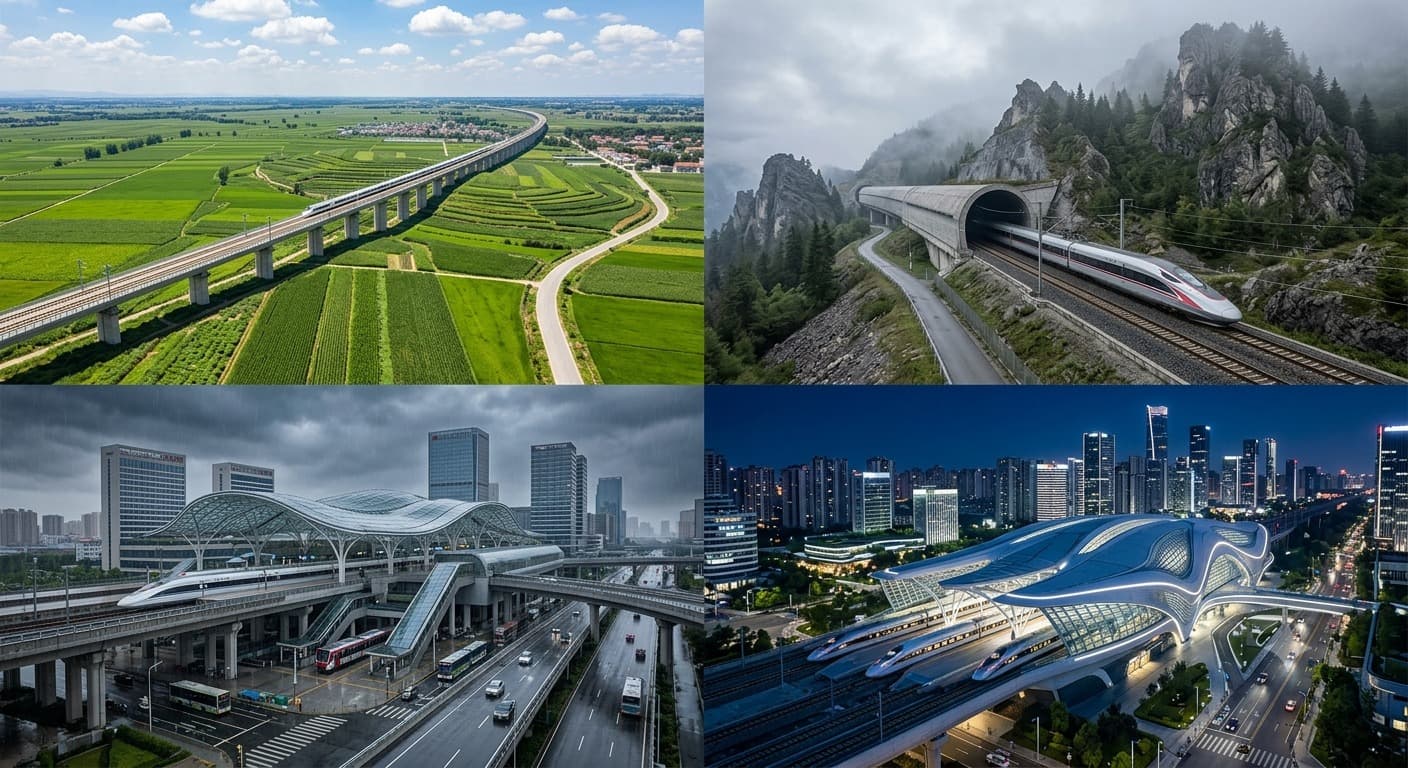
In India, the property markets most immediately positioned to benefit include Pune's emerging corridors, which will suddenly offer Delhi-Mumbai proximity via connection through Mumbai; Patna, which lands on the Varanasi-Siliguri line and gains the kind of national connectivity it has lacked for decades; and secondary nodes along the Hyderabad-Chennai corridor, where cities like Nellore and Vijayawada stand to gain serious commuter and investment appeal.
Challenges Worth Acknowledging
Land acquisition remains India's most stubborn infrastructure hurdle. Elevated corridors require surgical precision through densely built urban areas. Environmental clearances for the Varanasi-Siliguri route through ecologically sensitive eastern terrain will take time. Workforce training at scale for high-speed rail operations and maintenance is a competency India is building rather than possessing.
None of these are reasons for pessimism. They are reasons for patience.
Summary
7 new high speed rail corridors announced in Union Budget 2026 India across nearly 4,000 kilometres represent the most significant single infrastructure commitment in Indian rail history outside the Mumbai-Ahmedabad project. Mumbai Pune Delhi Varanasi Hyderabad Bengaluru Chennai bullet train routes will reshape employment geography, commuting patterns, and property values across every city they connect. Union Budget 2026 railway investment 16 lakh crore HSR corridors signals national intent at a scale that will take years to fully price in. How high speed rail corridors will transform Indian cities by 2031 is a question whose answer is already being written in the land acquisition offices and project planning desks of NHSRCL today.