
Solar Homes in Tier-1 Cities: Trends & Adoption
Summary
Solar homes are rapidly becoming mainstream in India's Tier-1 cities, driven by rising electricity costs and the transformative PM Surya Ghar scheme. This shift offers substantial financial savings, enhances property values, and sees accelerating adoption despite urban-specific challenges.

Introduction
There is a quiet revolution happening on the rooftops of Indian cities. Not the dramatic kind that announces itself in headlines, but the slow, practical kind where a homeowner in a Bengaluru apartment society sits down one evening, looks at a Rs 8,000 electricity bill, and decides that enough is enough. Solar homes in India are no longer an idealistic concept reserved for eco-conscious pioneers. In 2026, they are a financial decision. And increasingly, they are a real estate decision too.
The shift is showing up in data. India has already crossed the 4 million household mark under the PM Surya Ghar scheme as of May 2026, with the government projecting coverage of 75 lakh homes by December of this year. May 2026 alone recorded 3.16 lakh fresh installations in a single month, averaging roughly 15,000 new solar property India additions every day. That is not pilot programme territory anymore.
The Urban Electricity Problem Driving This
Ask any homeowner in Mumbai, Delhi, or Chennai why they are suddenly interested in rooftop solar city solutions, and the answer is almost always the same. Power bills. Electricity tariffs in India's tier-1 cities have been climbing steadily, and the trajectory shows no sign of reversing. A mid-size apartment running two air conditioners through summer can generate bills that make groceries look affordable by comparison.
Rooftop solar adoption in urban India is, at its core, a response to this pressure. The technology provides a hedge. Your solar panels generate through the day, reduce grid dependence during peak consumption hours, and through net metering, can even push surplus units back into the grid in exchange for credit. Over a 25-year panel lifespan, the arithmetic usually works out very favourably.
What PM Surya Ghar Actually Offers Urban Homeowners
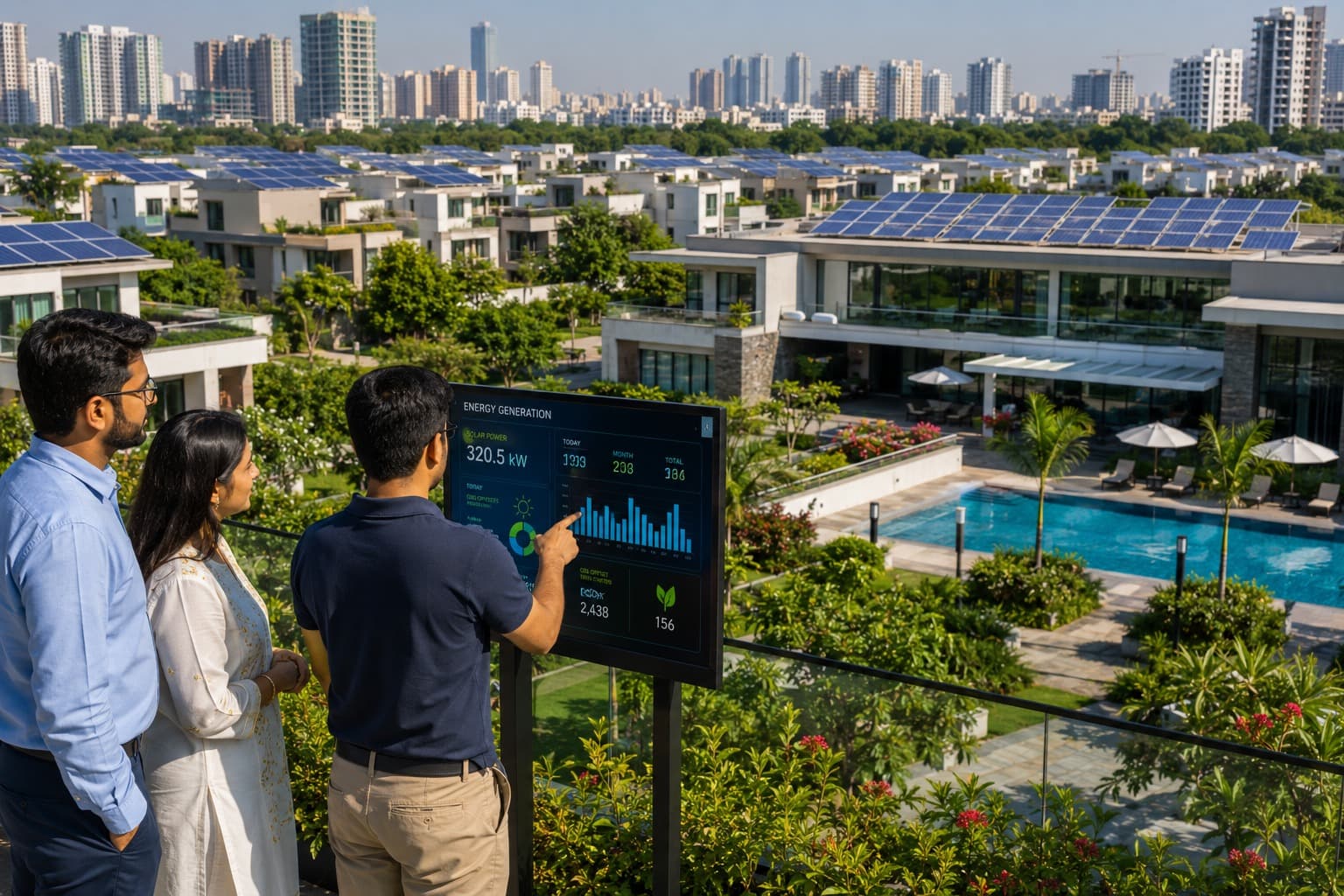
The central government launched the PM Surya Ghar: Muft Bijli Yojana in February 2024 with a financial commitment of Rs 75,021 crore. The scheme offers subsidies of up to Rs 78,000 for eligible residential installations, which can reduce the upfront cost of a 4 kW system from roughly Rs 2.5 lakh to somewhere around Rs 1.5 to 2 lakh after the benefit is applied. PM Surya Ghar scheme residential reach has grown remarkably fast, with over 63 lakh applications registered on the portal as of early 2026 and more than 25 lakh systems actually installed.
The PM Surya Ghar Yojana benefits for urban homeowners extend beyond the subsidy itself. More than 17 lakh families reportedly now pay zero electricity bills. That is a genuinely transformative outcome for household budgets, particularly in cities where electricity costs tend to be higher than the national average.
Tier-1 City Adoption: Who Is Actually Doing This
States like Gujarat, Maharashtra, Rajasthan, Uttar Pradesh, and Kerala collectively account for over 71 percent of India's installed residential solar capacity. The metro city pockets within these states, particularly in Pune, Ahmedabad, and Bengaluru, are seeing the sharpest momentum.
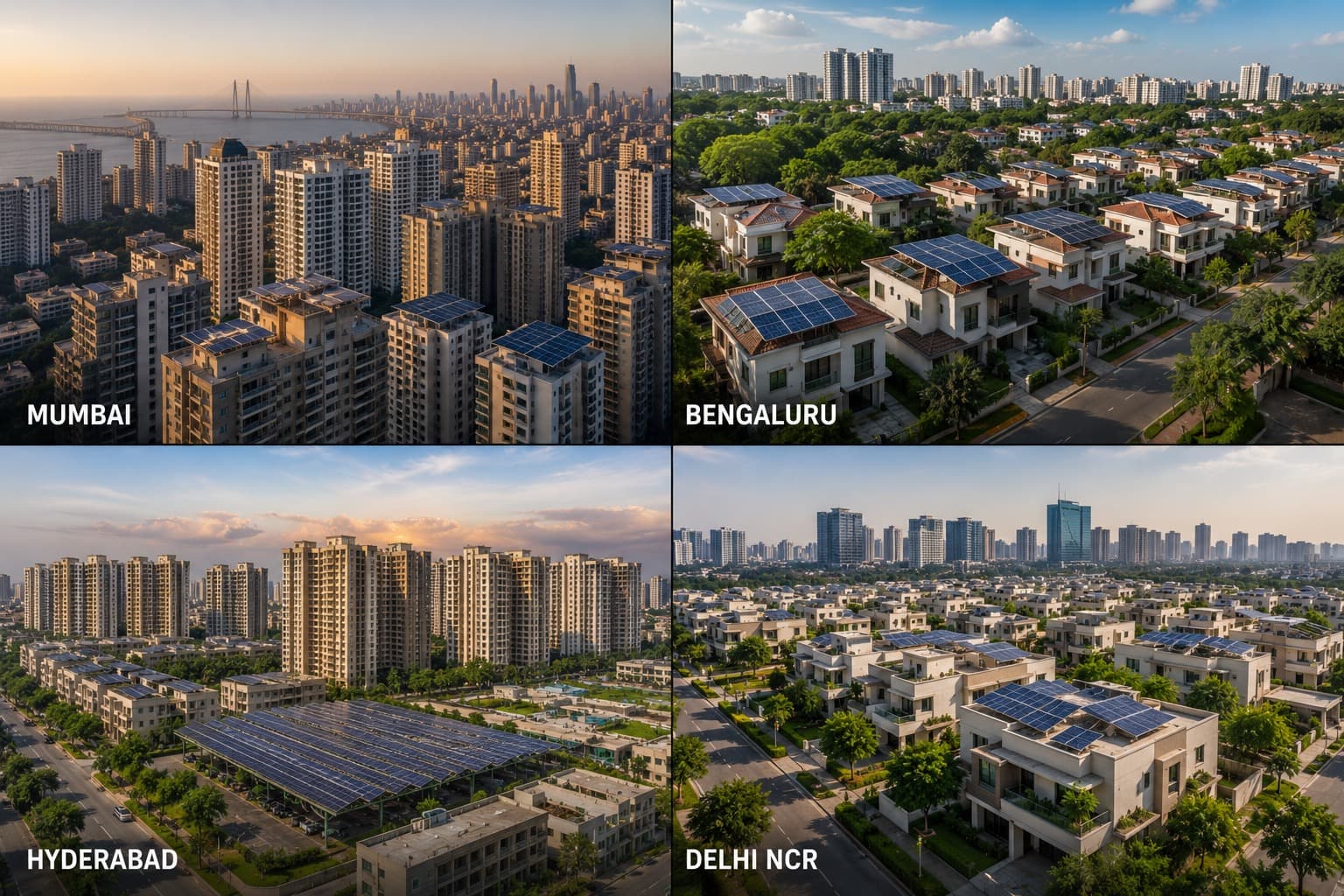
Rooftop solar adoption trends in Mumbai Delhi Bengaluru differ slightly from one another. In Mumbai, coastal humidity and cloud patterns create some technical limitations, but the city's high electricity tariffs make the investment case compelling enough to work through those constraints. Delhi benefits from stronger sunshine and state-level capital subsidies that sit on top of the central scheme. Bengaluru, with its large IT professional demographic that is both environmentally aware and financially sophisticated, has seen strong uptake particularly in gated communities and independent villas.
Solar manufacturing capacity in India also nearly doubled between 2024 and 2025, which has helped ease supply constraints that previously slowed installations.
The Property Value Conversation
Here is where solar homes in tier 1 cities India start getting interesting for buyers and sellers alike. Realtors in cities like Pune, Bengaluru, and Coimbatore have begun reporting that homes with fully owned solar installations command 3 to 5 percent higher prices compared to otherwise identical properties without panels. Why solar homes sell faster in tier 1 cities India comes down to a simple buyer logic: a ready system means immediate savings, no installation hassle, and no waiting period.
How solar panels increase property value in Indian cities is still an emerging conversation in the Indian market, but the direction is clear. Properties with installed systems are reportedly selling 15 to 20 percent faster than comparable non-solar homes. As electricity costs continue rising and solar awareness climbs from 50 percent among households in 2020 to 90 percent today, this premium is likely to widen, not narrow.
The Flat and Society Challenge
Independent houses and villas have a straightforward path to residential solar installation metro cities. But what about the crores of Indians living in apartment complexes? This is the more complicated and more important question for tier-1 urban markets.
Apartments can participate through Resident Welfare Association applications and group net metering models, which allow an entire society to collectively benefit from rooftop installations on common areas. Some states have begun regulatory acceptance for these community models. The adoption rate within housing societies remains lower than for independent homes, partly because collective decision-making is slow and partly because rooftop space is often limited and contested. But the policy direction is moving toward making this easier.
Barriers That Still Exist
The honest picture is not all smooth momentum. As of mid-2025, only about 22.7 percent of applications under the government scheme had actually converted into completed installations. That gap between interest and completion reflects real bottlenecks: vendor capacity constraints, financing complications, and approvals processes that vary by state and by local distribution company.
Cost and subsidy for residential rooftop solar in Indian metro cities can also still feel high for households in the middle of the affordability spectrum, even after government benefits. Access to low-interest financing and streamlined vendor selection are the two areas where industry observers consistently identify the biggest room for improvement.
Summary
Solar homes in tier-1 cities India have moved firmly from novelty to mainstream consideration in 2026. The PM Surya Ghar scheme has surpassed 40 lakh household beneficiaries, rooftop solar adoption in urban India is accelerating with over 3 lakh monthly installations, and solar panels property value India data now shows clear price premiums for equipped homes. With solar homes India awareness reaching 90 percent nationally and electricity tariffs rising steadily, urban homeowners who evaluate residential solar installation metro cities today are making decisions with compelling long-term financial and resale logic behind them.