
How Solar Homes Are Quietly Becoming a Real Estate Developer's Smartest Business Decision
Summary
Solar homes are now a financially savvy move for Indian real estate developers, driven by drastically falling costs and new revenue streams. Growing demand for green buildings, accessible zero-upfront financing, and strong government support make solar projects more profitable and attractive to buyers and tenants, leading to higher NOI.

Introduction
A few years ago, putting solar panels on a residential or commercial building was largely a gesture. Something developers did for an award category or a sustainability brochure. The economics were rarely the primary argument.
That calculation has shifted dramatically. Solar real estate in India today is driven not by green enthusiasm but by hard financial logic. Falling panel costs, rising grid electricity tariffs, government incentives and a growing pool of tenants and buyers who actively prefer energy-efficient buildings have combined to make solar energy developers one of the more interesting business pivots happening quietly across Indian real estate.
The Cost Side Has Completely Changed
The price of solar photovoltaic technology has fallen over 90 percent in the last fifteen years globally. In India, where rooftop solar has been pushed aggressively under national schemes, installation costs for commercial projects have dropped to a level where payback periods often fall between four and seven years for large residential or commercial buildings.
After that payback window closes, the electricity generated is effectively free. For a developer managing common area power consumption across a large gated community or commercial complex, that translates directly into lower maintenance costs and better net operating income on the asset.
Solar panels commercial buildings India also provide something equally valuable: protection against future electricity price increases. Grid tariffs in most Indian states have risen 5 to 8 percent annually over the past decade. Locking in on-site generation insulates a project from that escalation curve for twenty-five or more years.
New Revenue Streams Beyond Cost Savings
Here is where it gets genuinely interesting for developers. Solar energy does not just reduce costs. In many Indian states with functional net metering policies, surplus power generated by rooftop installations can be fed back into the grid and credited against the building's electricity bill.
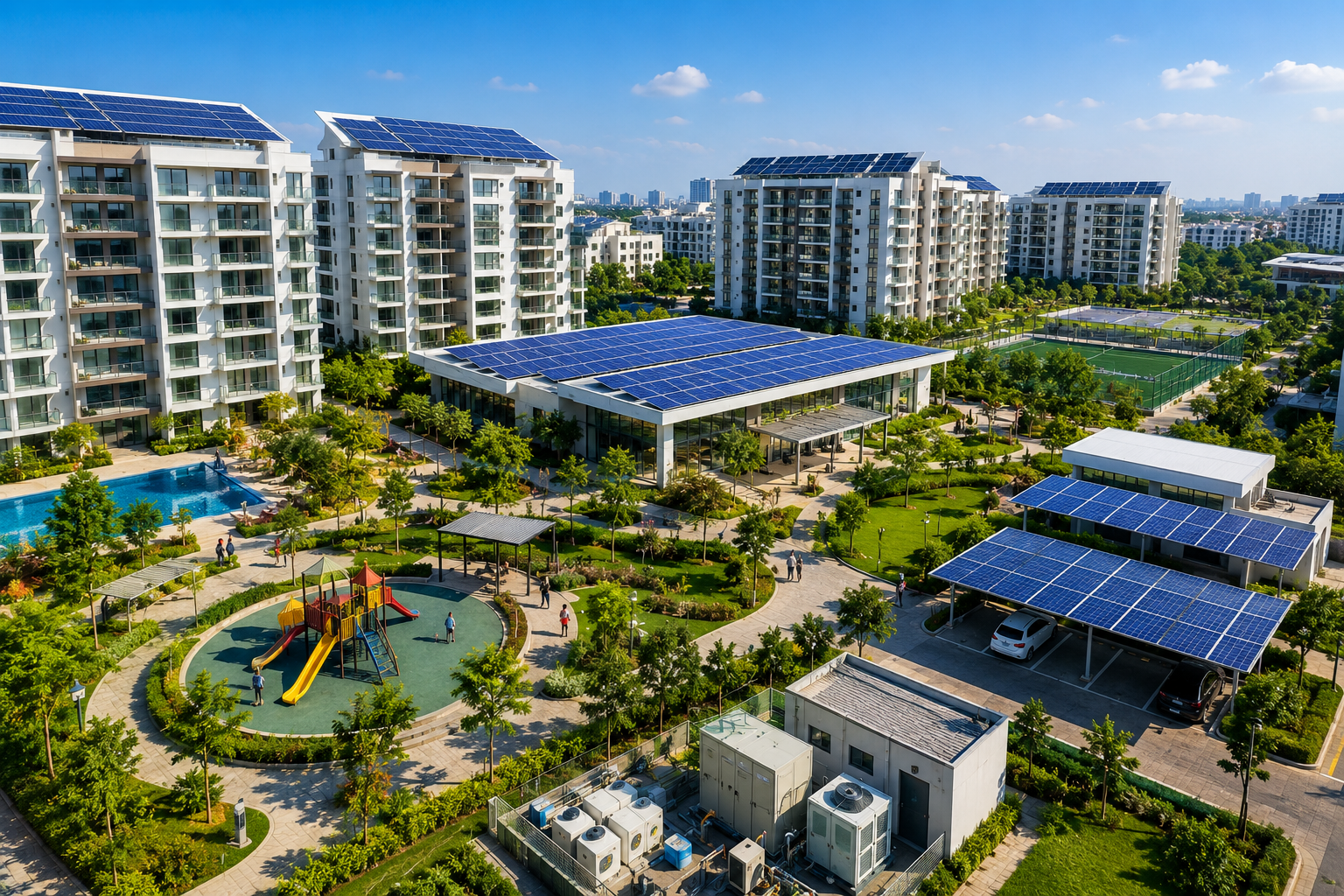
For large housing societies or commercial parks with substantial rooftop or parking canopy installations, this creates a measurable income stream. Common area electricity charges, which are a persistent source of friction between residents and management committees, can be reduced significantly or eliminated entirely. That directly improves resident satisfaction and, in the resale market, makes the project more attractive to buyers evaluating running costs alongside purchase price.
Solar canopies over parking areas deserve particular attention. They serve a dual purpose that pure rooftop installations do not. They generate power while simultaneously providing covered parking, which in a country where summer temperatures regularly cross 40 degrees Celsius is not a minor amenity. Covered parking increases daily convenience for residents and adds a visible quality signal to the project's common areas.
The Tenant and Buyer Demand Is Real
Green buildings India are no longer a niche preference. Large corporations leasing commercial space increasingly carry formal mandates to occupy buildings that meet defined sustainability standards. Global Capability Centres, technology companies and multinational financial services firms routinely require LEED or IGBC-rated buildings as a precondition for shortlisting.
For a commercial developer, offering a solar rooftop India powered building is now a genuine competitive advantage in tenant conversations rather than a nice-to-have feature. It reduces lease-up periods, can support slightly higher rent conversations and improves tenant retention because occupiers do not want to give up the sustainability credentials that a certified green building provides to their own ESG reporting.
On the residential side, homebuyers are increasingly aware of electricity costs as a component of total ownership expense. A project that demonstrably reduces common electricity bills through solar homes real estate investment wins a practical argument that cuts through marketing noise.
Financing Has Become Accessible
One barrier that previously slowed solar adoption among developers was upfront capital. A large installation across a multi-tower project could require several crore in investment before any savings began flowing.
Power Purchase Agreements have largely dissolved that barrier. Under a PPA structure, a third-party solar provider installs and maintains the system at no upfront cost to the developer. The developer commits to purchasing the generated power at a pre-agreed rate, which is set below prevailing grid tariffs. Savings begin from day one and the capital expenditure burden disappears entirely from the developer's balance sheet.
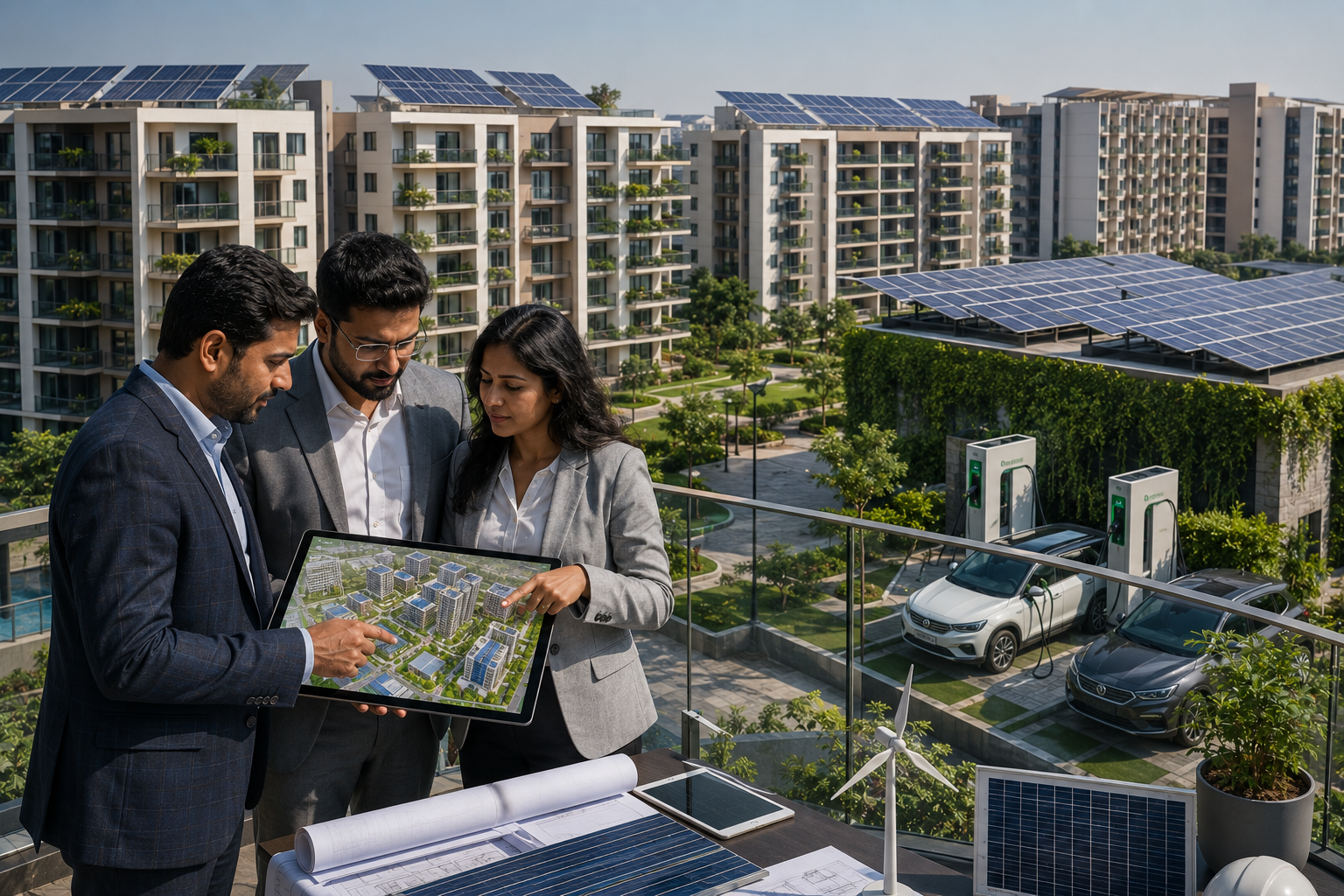
Leasing arrangements follow similar logic. Both models have made solar PPA real estate India adoption accessible to mid-size developers who previously found the upfront commitment difficult to justify against competing construction cost pressures.
The Regulatory Wind Is Behind Developers
India's national targets include 500 gigawatts of renewable energy capacity by 2030. Rooftop solar sits centrally within that roadmap, supported by accelerated depreciation benefits, subsidy schemes under PM Surya Ghar and renewable purchase obligations for commercial consumers above certain consumption thresholds.
As carbon disclosure requirements tighten and green building certification becomes a stronger purchase signal, the developer who has already embedded solar energy infrastructure into their project will hold a structural advantage over those still relying entirely on grid power.
Summary
Solar homes real estate has moved from an environmental gesture to a sound financial strategy for Indian developers. Falling installation costs, net metering income, PPA-based zero-upfront financing, rising tenant demand for green buildings India and government policy support all point in the same direction. Developers who integrate solar rooftop India systems into residential and commercial projects today are not just reducing operating costs. They are building assets that command stronger tenant interest, better resale positioning and higher solar energy NOI real estate performance over a twenty-five year generation horizon.